@AdamJoseph Why do you keep expecting journalism from a guy who is not and has never been a journalist? Take for what he is - an influencer and stop looking for any type of moral or etics there.
Summer “Plan”
Feb/March - Spoke to Julian, who was relaxed and open to all options.Also had serious interest in Kenan Yildiz leading up to the summer. Approached Juve, who said absolutely no chance.
Early summer: Worked for months on Morgan Rogers. Mikel’s main target, after Kenan was not for sale. Got Morgan on board and knew we could do it for £85 - 100m but decided to play the field to spin plates. Waited too long, and now the Elliott A. deal dictates the new market price. Villa now want more than £115m. We check in with Barcola, who is also in a similar price range.
The club decide, after weeks of delaying, to finally engage in some talks with Villa, who tell us they want an amount close to the Elliott A. deal. While we delay, Alonso has spoken to Morgan, Behdad has spoken to Nassef, and they wrap up months of our work and delays in 36 hours. We were even offered the chance to match and refused.
We then internally agree that Morgan was not worth that, so we pivot to the market opportunity that was “Vini Jr.” The hierarchy accept this is a generational signing and say, “Let’s do whatever it takes to get him.” They agree personal terms and leave the final decision up to him. He chose Madrid. The club are then deflated but satisfied with their efforts in this particular case.
They then pivot back to Kenan in a desperate attempt to convince Juve with creative deals, such as using Martinelli, but the answer is clear: not for sale.
We have been checking in with Alvarez this whole time, who is fixated on Barça despite being told it will never happen. They realise he is the only “level raiser” left, so push hard for Julian, who doesn’t believe his Barça dream is over.
They check on Gakpo (I’m sure many other names too). N’Diaye’s agent is saying, “Come get me.” They bite on the Fofana offer and consider it to some degree.
In the end, they feel disappointed with the outcome of the whole window. Its been below par for sure.
Personally, I tried to voice my concerns early when I saw patterns during the Morgan saga. I was alarmed because you don’t just become competent overnight after being this “dithery” and hesitant, trying to spin plates. Read the post I quoted.
Side note, but a big side note, because the truth matters : They explored the sale of Myles via Kia to understand his market value. Myles always said he wanted to stay. He is settled now, and the matter is closed.
I am a fan just like you. I also, like you, get excited when MY club promises big things. I think if there is disappointment within the club about the conclusion of the summer, then fans should be entitled to voice their opinions too. Again, your frustrations are justified. Many who know more feel the exact same way.
My argument is PSG signed Doué, who at the time was on the come-up. The market is there for shrewd people to take advantage of. Mikel deserves world-class people around him. Premier League champions, UCL finalists, and we end up with a weaker attack?
Man City rebuilt their whole midfield in one summer and we have not signed a true world class attacker in how many windows? 5 or 6?
It was the summer of Premier League champions, but we didn’t plan nor execute a Champions summer.
I am gutted and very worried we are very short on numbers, but I will always back Mikel and the lads. They give it their all.Mikel, being the person he is, will want to now focus on what’s next, and that is Chelsea.
If anyone at Arsenal is reading this, fans are not crying about a shiny new toy, they back the squad and understand we are in good place but wanted to be in a great place.
🚨 William Saliba has decided NOT to have surgery on his back injury after consultation with Arsenal. The player will now have a long period of rest & although the duration of absence is not known, it is expected to be months. ❌🇫🇷 [@lequipe]
i've gone through quite a few journals the past few years
[ what didn't work ]:
- taking over 2 to 3 trades per day
- back to back entries (re-entering after a loser)
- trading too many pairs (spreading themselves thin)
- random sizing
- only using market orders (they’d always be offside anyways)
- executing using timeframes below 5m
- not having daily structure (some morning routine)
- adding to a losing position (quite obvious)
- entering before knowing where they would exit
[ what was working ]:
- limiting trading to certain session hours (new york/close)
- planning specific levels (not zones) before each session
- sizing in accordance to regime (example: 5d vs 60d atr)
- increasing initial trade size once already in profit
- focusing on price action from their avg trade time
- trading majors (btc,eth) nothing smaller than solana
- aiming for a 45% + win rate (low-mid win % in general)
[ why they were messing up ]:
- trading pnl graph (thinking of past results)
- not accounting for probabilities resetting
- social media impact on their execution
- spreading thin across pairs to avoid boredom
- inability to not mess with an open position
- not stepping away from the desk frequent enough
- outcome focused mindset over input focused
[ actions they used to fix ]:
- collected data (having data = conviction)
- reviewing after every trade (creates time delay)
- turn off the pnl completely
- adopting a 3 question checklist before entering
- removing all trading apps from phone
- strictly limiting time on socials (lookup "brick - social")
none of this is to say there’s a right or wrong way to trade.
i'm 100% certain there are people trading 20 trades per day making money, and people trading 15 different pairs too.
i just wanted to share my personal observations from people I have worked with.
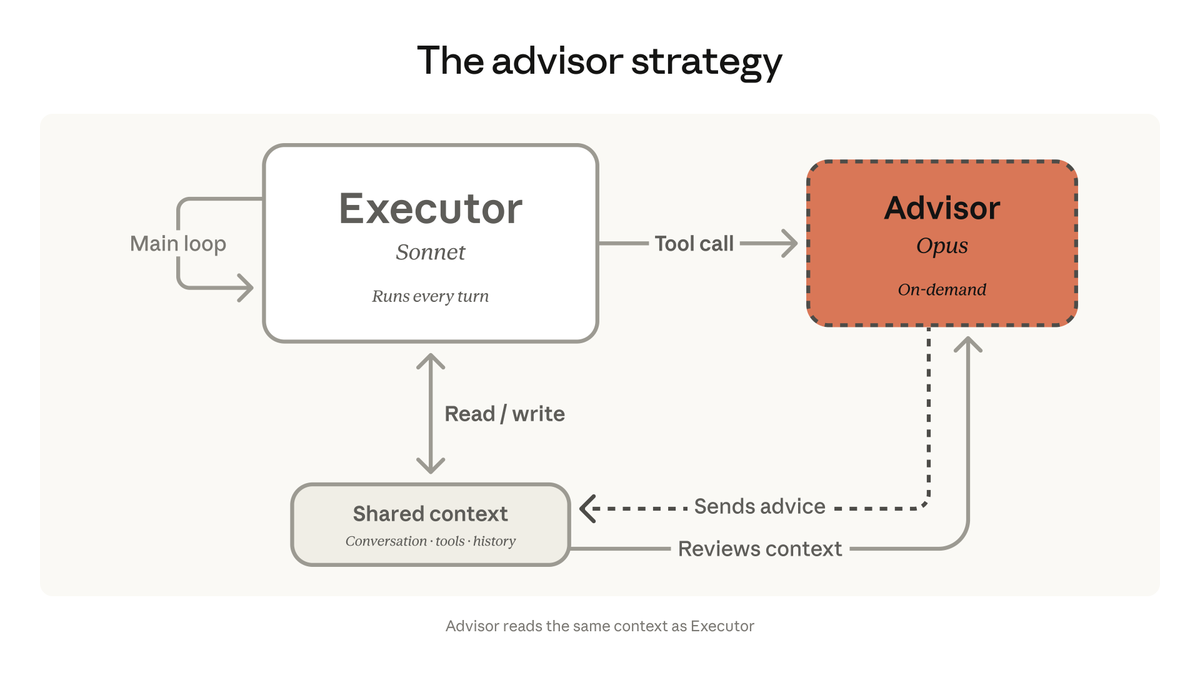
We're bringing the advisor strategy to the Claude Platform.
Pair Opus as an advisor with Sonnet or Haiku as an executor, and get near Opus-level intelligence in your agents at a fraction of the cost.
Here is a 7-min video on how I trade Mouse Traps:
0:06 - Intro
0:47 - Why Speed is important
1:44 - Limitations of Candle Stick charts
2:51 - Footprint Breakdown w/ MMT
3:46 - "P" Shape Profile
4:03 - My Footprint Settings
5:26 - What you don't want to see


![afcstuff's tweet photo. 🚨 William Saliba has decided NOT to have surgery on his back injury after consultation with Arsenal. The player will now have a long period of rest & although the duration of absence is not known, it is expected to be months. ❌🇫🇷 [@lequipe] https://t.co/YayoB9dPhS](https://pbs.twimg.com/media/HN1Upg3WkAAs4wP.jpg)
![Luckshuryy's tweet photo. i've gone through quite a few journals the past few years
[ what didn't work ]:
- taking over 2 to 3 trades per day
- back to back entries (re-entering after a loser)
- trading too many pairs (spreading themselves thin)
- random sizing
- only using market orders (they’d always be offside anyways)
- executing using timeframes below 5m
- not having daily structure (some morning routine)
- adding to a losing position (quite obvious)
- entering before knowing where they would exit
[ what was working ]:
- limiting trading to certain session hours (new york/close)
- planning specific levels (not zones) before each session
- sizing in accordance to regime (example: 5d vs 60d atr)
- increasing initial trade size once already in profit
- focusing on price action from their avg trade time
- trading majors (btc,eth) nothing smaller than solana
- aiming for a 45% + win rate (low-mid win % in general)
[ why they were messing up ]:
- trading pnl graph (thinking of past results)
- not accounting for probabilities resetting
- social media impact on their execution
- spreading thin across pairs to avoid boredom
- inability to not mess with an open position
- not stepping away from the desk frequent enough
- outcome focused mindset over input focused
[ actions they used to fix ]:
- collected data (having data = conviction)
- reviewing after every trade (creates time delay)
- turn off the pnl completely
- adopting a 3 question checklist before entering
- removing all trading apps from phone
- strictly limiting time on socials (lookup "brick - social")
none of this is to say there’s a right or wrong way to trade.
i'm 100% certain there are people trading 20 trades per day making money, and people trading 15 different pairs too.
i just wanted to share my personal observations from people I have worked with.](https://pbs.twimg.com/media/HIr8DHubYAAn8s5.jpg)