With over $4B AUM, Securitize just became the first public company to bring their own stock on chain, on day 1.
This is another major step forward in bringing the power of blockchain technology to the world.
And it’s happening here, on Avalanche.
To the Avalanche community:
Yes. I've been quiet. Quiet isn't idle. I understand why the two look the same from the outside, and closing that gap is on me.
So here's what the quiet actually held.
We put forward three ACPs aimed at validator economics and how the network rewards the work of securing itself. We built more precise ways to measure the chain's economic activity, and shared early results. Behind that, we tightened how the team runs day to day. Less visible, but it's why the rest moved, and why it moves faster now. I recognize the frustration, because this work isn't always visible from the outside. But the work happened, and it's happening. I did a poor job telling you what we could. That's my communication failure, not a work failure. I've written a piece that lays out the exact economic reasoning behind the recent proposals and the direction they point, and it goes out with this letter.
Now the part I want to be straight about: tokenomics is not a solved problem. Not here, not anywhere. I'm not interested in patches that look good for a cycle and unwind in the next one. I'm interested in fixes that compound. And compounding is slow before it's fast.
We're being deliberate about the order. You can't design how a network captures value until you've defined what value it actually produces, and that "what" has been loosely defined across this industry for years. So we started there.
Think of it the way an economy tracks more than one number. There's the value produced on the chain, the revenue protocols earn because they build here, which is what our gross chain product metric captures. And there's the value that accrues to the people using it, the activity that exists only because the chain does. We're building measures for both, to see value from enough angles to form a cohesive picture. Measure the "what," then design the "how." Get it backwards and you optimize for the wrong thing. That design could eventually include new transaction types or new primitives at the platform level, conveniences worth paying for. That can only come once measurement tells us what's worth building.
How we find the "right" design is by experimenting.
Short term, that means taking parameters that have sat as static constants since launch and letting the network set them dynamically, measured and adjusted on purpose, so we can watch how the system responds to small changes. ACP-283 is one example: it's about learning empirically where fees begin to dampen on-chain activity, so the network can stay well below that line instead of guessing at it with a number set years ago.
Everyone contributes here. Validators decide whether these changes activate, and where the fee floor sits over time. My job is to make the case in the open and show the work, not hand down an answer.
I'll also be honest about the limits. There's only so much we can test without risking the robustness of the chain, which is exactly why these initial changes are small. Every data point we can gather safely matters. Each one is a hint about whether the long-term design holds, or whether it's time to go back to the drawing board.
The answer won't be identical for every chain. It can't be. But the process I trust is the same everywhere: measure honestly, design deliberately, ship, observe, adjust.
I know patience is thin and the doubt is real. I'm not going to narrate it back to you; you and I both live in it. What I'll say is that my confidence comes from the work I see every day, from people who could be somewhere easier and aren't. They stay because the hard problems are the ones worth staying for.
One thing I want understood because it's the whole point. In proof of stake, security isn't a feature you ship. It's a bill an attacker has to pay, denominated in the network's own token. The economic weight behind that token isn't incidental to security. It *is* the security. And it sets a ceiling: no serious institution settles more value on a chain than it would cost to compromise it, because past that line the attack stops being a tail risk and becomes a trade.
Getting the economics right is what keeps that ceiling above the value the chain carries, even as that value grows. That's not a vanity exercise. That's the work, and it's why I prioritize it.
So yes, AVAX matters.
On communication: you'll see the detail behind the ACPs and the metrics, not just letters like this one. Hold me to that.
I came here to be a compounding force in this ecosystem. That's a slow way to start and a hard one to stop 🔺
A few years ago, something like this would have been dismissed as impossible. Today, it’s just Thursday.
Institutions are choosing Avalanche as the fundamental rail for value transfers of all kinds.
Congratulations @Securitize!
@Gafu55237506@freiformation Responsibility isn't limited to those who pull the trigger. History has repeatedly shown that looking away while innocent people suffer often leads to even greater tragedies.
@isaacrrr7 As long as the root cause is ignored or remains unrecognized, people will continue to complain about the consequences. Lasting solutions are achieved by addressing the cause, not merely the symptoms.
so bullish on what the @avax creative team put together. this is what blockchain adoption actually looks like.
imagine saving for years to take your son or daughter to the world cup, flying across the world, getting to the gate… and finding out your ticket isn’t real.
this is a real problem that blockchain solves. verified tickets. less fraud. more trust.
this is what we mean when we say we’re building technology for business. the business is fifa. the outcome is millions of fans getting into the stadium with confidence, knowing their ticket is real. 🔺⚽️
@Cointelegraph Micron, SanDisk, AMD, Intel, Nvidia, IBM, etc. are all apparently AI royalty and trading through the roof. Meanwhile Oracle delivers massive AI deals and the market responds with a collective shrug. Perfectly rational behavior, as always.
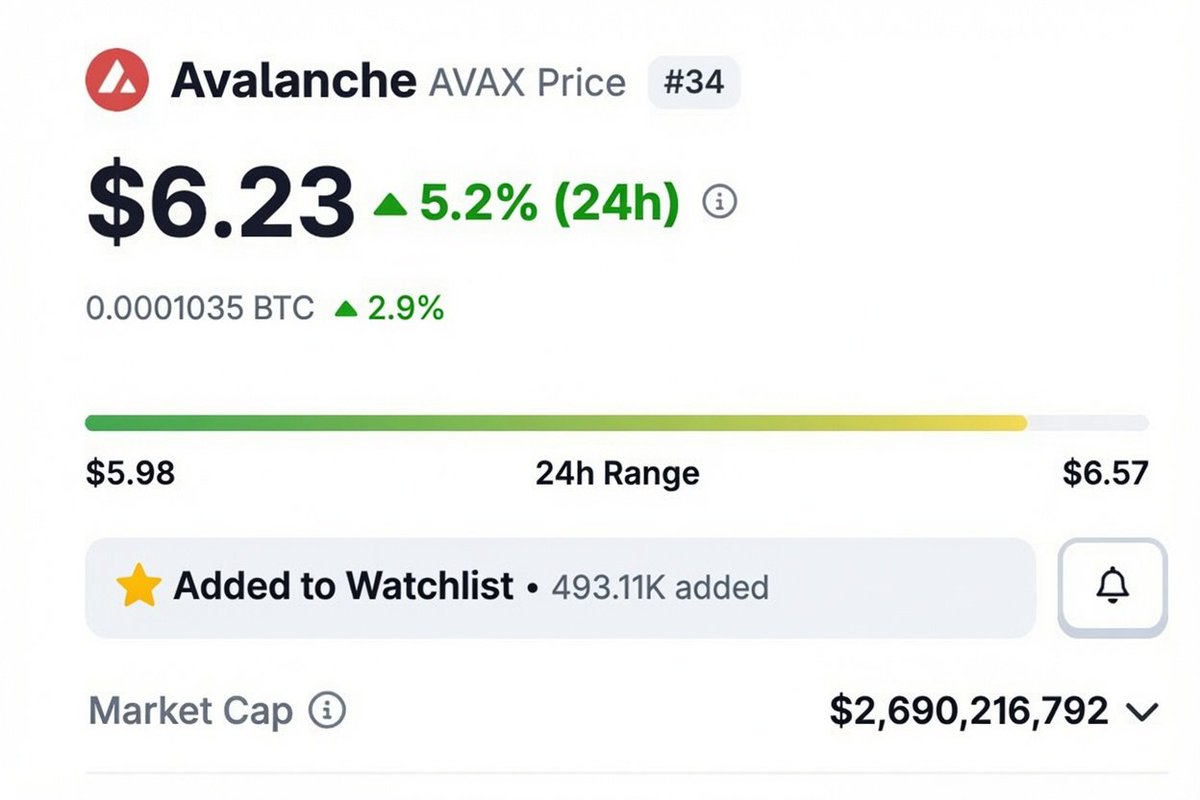
Could $AVAX Ever Recover and Reclaim Its Previous ATH?
this is probably one of the biggest questions people are asking right now.
Could AVAX ever go back to $144?
Honestly, I think a lot of people are looking at the chart first, when they should be looking underneath it.
one thing I've learned after being in this space for years is, price eventually follows fundamentals. not the other way around.
the strongest tokens in this industry didn't become valuable because people kept buying them every day. they became valuable because their ecosystems kept growing, more builders showed up, better products were launched, communities kept expanding, and eventually the token started reflecting all of that.
that's why I always pay more attention to what's happening behind the scenes than what's happening on TradingView.
We've seen this movie before.
years ago, almost every major project people respect today went through its own ugly phase. Ethereum was constantly criticized for high fees and scaling issues. Solana went from over $250 to single digits after the FTX collapse and people couldn't stop calling it dead. BNB was dismissed by many as just an exchange coin.
The FUD was everywhere.
the difference is, those teams didn't stop because people on CT lost confidence. they kept building through the noise, kept improving the tech, kept growing the ecosystem, and eventually the market caught up.
that's exactly why I still pay attention to Avalanche today.
not because the price has been exciting.
It hasn't.
but because when I look beyond the chart, I keep seeing reasons to stay optimistic.
Businesses are choosing Avalanche.
Institutions are building on it.
Developers are still shipping.
Builders are still showing up.
the ecosystem keeps expanding with real world use cases, not just hype. from FIFA to payments, RWAs, institutional finance and enterprise adoption, we're already seeing that story unfold.
then there's the part I think many people are overlooking.
The @AvalancheFDN already knows tokenomics need to improve. that's why they're actively working on value accrual, validator incentives, staking economics, token burn, and long term sustainability. they're not pretending everything is perfect. they're working on making it better.
that's what gives me confidence
and soon we'll start seeing more from the developer side of the ecosystem as well. the builders never stopped. now it's about connecting all of that progress back to the token itself.
does this guarantee that AVAX goes straight back to $144?
No.
nobody can honestly say that.
but if fundamentals still matter in this industry, I struggle to find many ecosystems that have what Avalanche already has.
Technology.
Builders.
Institutions.
Real businesses.
Enterprise adoption.
A community that has survived one of the hardest periods in crypto.
to me, that's the foundation of a long term winner.
maybe months. maybe another year. maybe longer.
Markets move on their own timeline.
but I don't think @avax is missing the fundamentals needed for another major run. if anything, it already has most of them.
what it needs now is for all of that progress to translate into stronger demand for the token. and from everything I'm seeing, that's exactly the direction the Foundation is pushing toward.
So could AVAX recover?
I think it absolutely can.
Will it happen tomorrow?
Probably not.
but I've been in this space long enough to know that the market has a funny way of laughing at strong projects before eventually rewarding them.
the chart tells you where $AVAX is today.
The fundamentals tell you where it could be tomorrow. 🔺
From the beginning, Avalanche was about expanding what builders could create. We saw how blockchain could change the way value moves, assets are owned, and markets are designed.
Now businesses are turning those ideas into better payments, customer experiences, and everyday products.
And they’re building on Avalanche. Because it lets them shape their own infrastructure, set their own rules, and scale around what their products need.
That’s what this new brand is all about. It captures why Avalanche was built the way it was, how we grew to this moment, and points to the conclusion that feels inevitable.
Business outcomes define the future of blockchain: faster payments, more efficient markets and stronger customer experiences.
Avalanche is built for entrepreneurs turning those needs into products & services.
I've spent the last six years at Ava Labs, focused on one thesis: the future of blockchain belongs to purpose-built networks that solve real world problems.
Today's brand refresh makes that thesis the centerpiece. "Technology Built for Business."
This isn't just marketing. It's a reflection of what's already happening and what's coming — dozens of live L1s, enterprise partners like Toyota, FIFA, SMBC, and Securitize building on Avalanche because the architecture was designed for exactly this.
The mindshare shift matters. Crypto has spent years competing on narratives. The brands that endure will be the ones competing on utility. On infrastructure. On outcomes.
Avalanche is entering its next chapter, and the brand now tells that story clearly. The real world is coming Onchain, and we've built the rails.
Real tickets. Real scans. Real fans.
29k+ tickets have been issued on Avalanche and scanned at @SI_Stadium for FIFA World Cup watch parties so far, powered by @si_tickets_.
Each ticket represents a real use case, powered by blockchain, invisible to the user.
RWA alanında ilk 4te avax ama gerisi ne yazık ki iyi değil dediğiniz gibi. En son business peşindeyiz deyip topluluğu da boşvermiş olmaları bu ayı sezonunda hiç güzel sonuç vermiyor görüyoruz. Hep söylüyoruz içerde starteji bilmeyen, bildiğini sanan birileri var, onları acilen ekipten çıkarmak lazım.
Avaxın sorunu bir süredir teknik açıdan sunduğu faydanın avax tokenomicsine hiçbir faydasının olmaması. Bu yüzden şuan hem L1 teknolojisini kullananları hem onun güvenliğini sağlayan validatörlerin stake gelirlerini hem de takım ve diğer harcamaları hep unlock olan avax ile satıp karşılamaları. Bu da sürekli enflasyonist bir baskı yaratıyor ve bir türlü avax fiyatı yukarı dönemiyor.
Ekosistemdeki benim gibi OG kullanıcılar bunu uzun süredir dile getirdiler ve geçen ay foundation bir yarışma açtı: avax tokenomicsini daha iyi hale getirecek makaleyi yazana 50k dolar ödüllü.
L1ler üzerinde gerçekten büyük paralar var ama bir L1 işletmenin maliyeti aylık sadece 1,33 avax. Şuan 70+ L1 var ve Emin hoca bunların binlere çıkacağı stratejisi ile ve rekabet nedeniyle bu fiyatı belirlemiş. Ama unuttuğu şey zaman. O zamana kadar validatör sayısı 100lerin altına düşecek ve ağın güvenliği de riske girecek. Çünkü validatör geliri de bir hayli düştü.
Bu durum çözülürse yeniden ATH görebilir Avax ama kısa vadede avalabsteki yanlış strateji üreten kafalar gitmeden birşey olmayacak gibi.
BTC daha aşağı giderse 5 ve 4 dolar gelmesi de mümkün Avax için ne yazık ki.
As a newly @Nasdaq-listed company, one of the questions we hear most often is: Why @avax?
Avalanche is the only actual blockchain that meets institutional demand for privacy, security and flexibility without sacrificing verifiability or interoperability.
We believe institutional adoption will be driven by infrastructure capable of supporting real-world deployment at scale.
AVAT was created to provide public market investors with exposure to that ecosystem and the long-term growth we believe it can support.
Learn more: https://t.co/JDOneQ16hP