Do you know this person?
The #WellingtonOPP is seeking the public’s assistance in identifying this suspect, who attended Shopper’s Drug Mart on Main St. in #MountForest at approximately 7:30 pm on October 18, 2026, and stole roughly $2,700 worth of various merchandise.
If you recognise this individual or have any information regarding this incident, contact the Wellington County OPP at 1-888-310-1122.
OPP reference # E261515110
~~~~~
Connaissez-vous cette personne?
La #WellingtonOPP sollicite l’aide du public pour identifier ce suspect, qui s’est rendu au Shopper’s Drug Mart situé sur Main Street à Mount Forest vers 19 h 30 le 18 octobre 2026 et qui a volé pour environ 2 700 $ de marchandises diverses.
Si vous reconnaissez cette personne ou si vous disposez de renseignements concernant cet incident, veuillez communiquer avec la Police provinciale de l’Ontario du comté de Wellington au 1-888-310-1122.
Numéro de référence de la Police provinciale de l’Ontario : E261515110
^cm
#UPDATE: The Coast Guard has suspended the search for the people aboard the medical transport aircraft that went missing around 2 a.m. Saturday, as of sunset, after 66 hours of continuous searching by the Coast Guard and partner agencies. We express our deepest condolences to the families and loved ones.
On the car ride home after a game… hold your tongue.
My biggest regret as a parent is that I talked way too much about my kids’ performance after games they played.
And specifically, I focused way too hard on explaining exactly what they should have done differently and better.
If I could go back in time, I would tell myself: Just shut up, Jon!
Let them enjoy the game. Let them enjoy the moment.
Unfortunately I caused them to tie their identity to their performance. This was poison for their pure love of the game.
So don’t make the mistake I did. Don’t talk at your kids after a game. Don’t analyze. Just tell them you love watching them play and make them feel loved. When they are adults they’ll be glad you did.
Canada’s Trade-War Denial
Canada does not need “time to adjust.” It needs a political class willing to stop confusing indignation with economic policy. And it needs access to the US market.
President Trump is focused on economic sovereignty, this is not personal this is business.
I assumed Mark Carney understood that. He has spent enough time around markets and capital to know that a country cannot posture its way out of a competitiveness crisis. Yet Ottawa’s turn toward symbolism and performative retaliation suggests that faith was misplaced.
Canada does not need another era of Pierre Elliott Trudeau-style progressive theatre: moral signalling, state direction, and lofty ambition detached from the hard work of building productive capacity. It needs an adult willing to confront vested interests, make trade-offs, and put economic strength ahead of political performance. The last adult, it seems, has just left the room.
The elbows-up strategy is embarrassing and hurts Canada long term, like a teenager emotional response to the reality of the world. Carney’s use of it helps neither negotiation nor leverage, and it wounds Canada more than the U.S.
The central strategic objective is obvious: preserve access to the United States, the world’s largest and most dynamic market, Canada’s neighbour, and the foundation of its export economy. That access is not a talking point. It supports Canadian jobs, investment, supply chains, and growth.
Canada focus on China is an own goal. China cannot replace it. China is distant, strategically uncertain, and separated from Canada by geography, institutions, and infrastructure. It cannot reproduce continental integration: shared energy systems, cross-border capital, integrated factories, common standards, and decades of commercial interdependence.
Canada does not get to trade on sentiment while depending on geography.
Nor can it “win” a trade war with its largest customer. Ottawa can impose targeted costs where it has genuine leverage. It can negotiate firmly. But broad retaliation is not a strategy. It is emotional performance masquerading as economic policy.
Too many in the political and economic elite appear to believe retaliation can force the structural adjustment Canada has avoided for years. It cannot. Tariffs do not raise productivity. They do not attract investment, reduce regulatory costs, or make Canadian businesses more competitive. They raise prices for households, increase costs for manufacturers, and encourage mobile capital to locate elsewhere.
Retaliation for its own sake is an expensive expression of national frustration. Canadians pay the bill.
The deeper problem is not merely American pressure. It is Canadian failure: weak business investment, poor productivity growth, regulatory paralysis, provincial trade barriers, slow approvals, inadequate infrastructure, and a subsidy culture that protects incumbents rather than rewards builders.
Canada is rich in assets and poor in execution. It has energy, minerals, capital, skilled people, and privileged proximity to America. Yet it has made investment too slow, too risky, and too expensive.
The answer is not submission. It is reform: deregulate, accelerate approvals, remove barriers to capital and internal trade, and lower the cost of building.
Canada may need time to adjust. But first it needs to end its denial.
Tonight, Canada declined to finalize the trade deal under the terms agreed earlier this week.
Despite the U.S. offer to Canada to receive the best treatment of any major exporter to our market, new demands and walk backs of other commitments by Canada have upended the careful balance reached in the past days. In addition, Canada is continuing to maintain its prolonged retaliation against the United States, including, among other things, flat-out prohibitions on certain American goods and services.
For decades, Canada has enjoyed the most favorable access to the U.S. market of any country. And from the beginning of President Trump’s trade program, Canada has continued to enjoy the best treatment in the world, even after – like China – retaliating against the United States. This week, the United States agreed to provide even better treatment to Canada, offering significant tariff reductions on steel, aluminum, autos, and lumber.
The U.S. offer was also forward looking, and included a historic economic and national security partnership to cooperate on export controls, combat transshipment, enhance digital trade, and align certain external tariffs. The offer would have led to supply chain coordination on aerospace, complementary actions to address unfair trade practices, critical minerals cooperation, increased enforcement against imports produced with forced labor, and the announcement of formal U.S.-Mexico-Canada Agreement (USMCA) negotiations.
This is a missed opportunity for Canada to partner with the United States, which is the fastest growing economy in the G7.
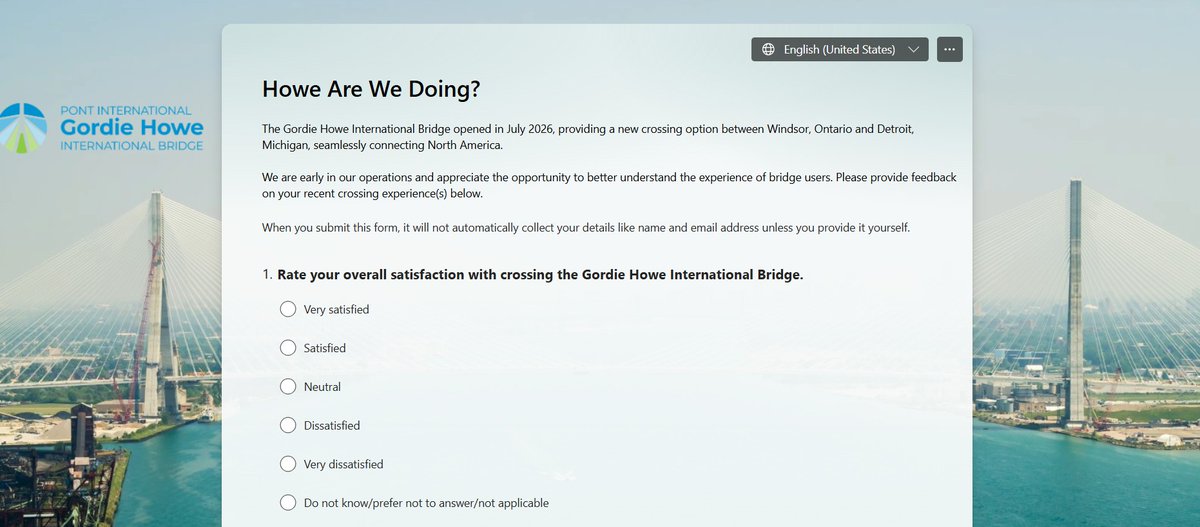
✏ It’s been a busy first two weeks at the #GordieHoweBridge. Tell us about your crossing experience!
We’ve launched a survey on our website. Your feedback will help us improve customer experience: https://t.co/r3PDVpMFKp