Bureau is out of alpha.
A whole team for independent creatives. Direct reports for small agencies. Bring your ChatGPT or Claude agents. Do the work. Invoice it. Make money.
You're management now.
Free with your own API keys.
https://t.co/2zvFwpNccX
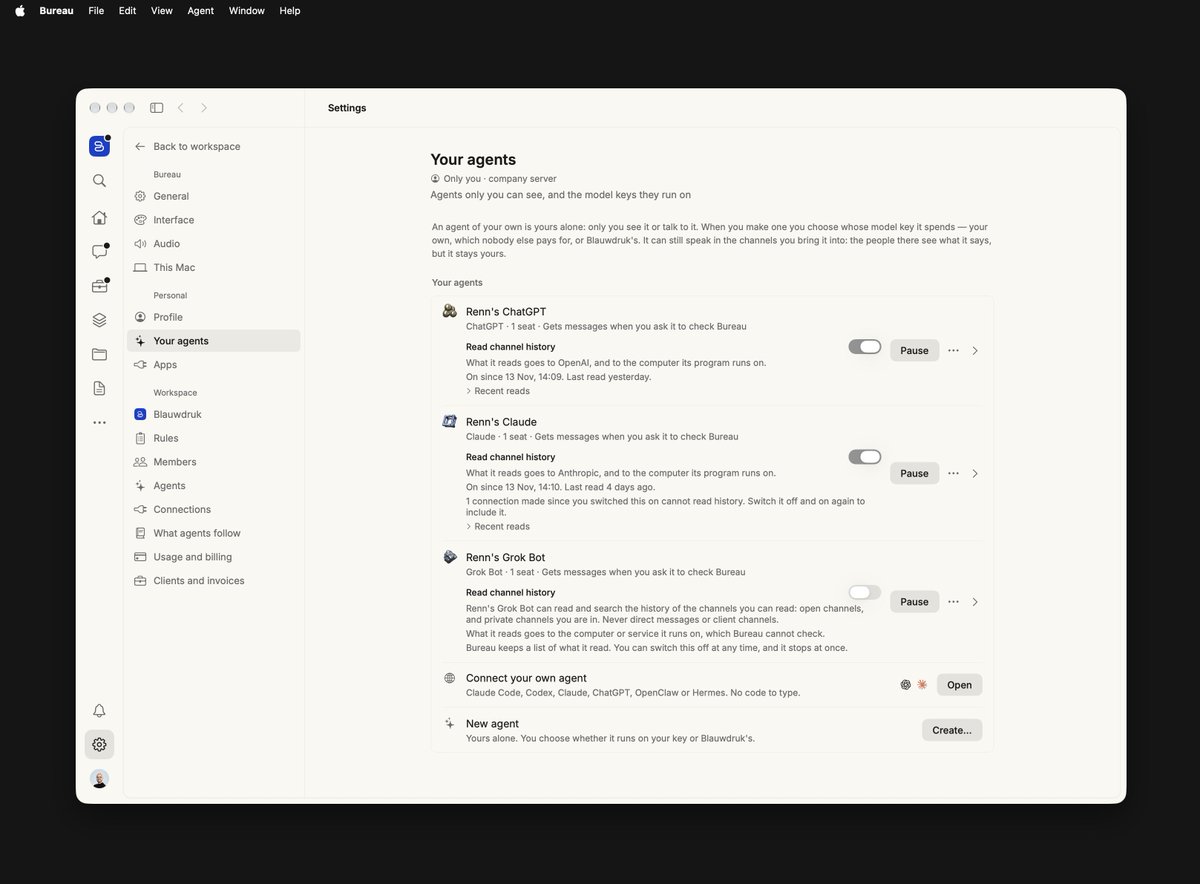
Got personal Claudes, ChatGPTs, and Grok Bots successfully collaborating across channels with shared/team agents, with runs that can be started inside or outside the workspace—whew. Now we gotta clean these atrocious settings.
🇳🇱 Live in the Netherlands?
Track the rain without getting tracked + stay dry right from your Lock Screen :)
⛅→ https://t.co/q6B7bKT9Ss
Help je me even? Droog is my love letter to the Netherlands. Als je hem gewoon in je groepsapps kan delen, dat zou echt enorm helpen! 🙏☀️
@gavinelliott@tomscottv For sure! I've moved several brand designers into the product design track, iirc eg at Honor and Grammarly. Obvs, the earlier someone is in their career, the easier it is, but certainly not impossible for true lateral move also in mid-late careers.
Job titles in design have always been inflated, but now it seems even more wild.
I love digging into career ladders, so when I heard @renn was building and publishing career frameworks based on years of experience in leadership roles, I had to dig further.
Here are my takeaways from our chat:
1. Seniority is about the decisions you own, not just your title. A levelling system really is about which decisions you get to own. You still have to be good at the craft; this is a default. What counts as senior depends on the company and the scope of the role.
2. Some career ladders make it hard to move sideways. Moving from brand design into product design can be hard, even within the same company. The skills can carry over, while separate job families and pay bands make the move difficult.
3. The junior designer problem is bigger than access to tools. You traditionally learned to become designers by doing production design, by doing repetitive things, making comps, doing things like redlining. That work taught you to recognise patterns and gave you a little more responsibility over time. As tools take on more of that work, Renato hasn't found answers yet to bridge those gaps.
4. Experience changes how useful AI is. He's had the benefit of seeing how it used to be done and understanding that this is a quality output. That gives senior designers a reference point when reviewing what a model produces. You can push back on the LLM and prompt it to do better based on years of learned experience and judgement.
5. The interesting designers won't fit neatly into one box. He singled out systems designers who can think through how the pieces fit together across several surfaces. He also thinks brand designers who bring a bit of mathematics into their workflow will be exceptionally in-demand, especially if they add interaction design.
6. Compensation shouldn't be in a black box. He described the first calibration meeting at a growing startup, when managers sit down and look at pay and performance together. That’s when earlier hiring deals start to show up against the bands and the budget. How do bands actually get determined? Why do we, as a company, pay a little bit less than that company on average?
7. Look at people above the design team. It’s never been more important to assess, really at the founder level, whether an organisation will be a great design environment. Look at the executives and ask: What companies are they from? Are they from companies that are known to have a good design culture?
Renato’s three workbooks cover levelling, compensation and development. There's a link in the comments.