Coding agents ship mobile changes they can't check. EAS Simulator (now in preview) gives your agent a real iOS runtime to prove its work on, and you get a session replay to review instead of pulling the branch yourself.
Also, our Simulators are platform agnostic: https://t.co/LkcIztAPKJ
More details and use cases in the blog from @rami__maalouf ↓
@JoshARosen@rauchg It has an interactive terminal mode too: running fx opens a session. fx ask <prompt> is the noninteractive path. https://t.co/Kfx81hCL5A
One of the coolest things about 𝚏𝚡 is that it auto-upgrades, and 𝚌𝚝𝚛𝚕+𝚐 restarts + resumes the chat.
Also, that 0.0.10 is much, much faster for longer sessions 😊 https://t.co/vsf8v0KT3C
@realrichwebb If the provider exposes the source records, reconciliation gives you another recovery path: compare them with local state and fetch what’s missing. That can work even after webhook retries have expired.
@Wai_Xea@shadcn At least a component contract puts the exception in one place. Six pages with six slightly different overrides are much harder to unwind.
shadcn/lint works with your existing Tailwind components and theme. shadcn/ui is not required. Available for both Oxlint and ESlint.
You can add one rule one component at a time.
Try it out. Make your design system verifiable.
https://t.co/PDHhI4wEdf
Anthropic’s CI write-up separates two failures: tests not running, and their results not reaching the selector. Their incident was the latter. A green job doesn’t prove the next job is being planned with fresh data. https://t.co/8q4tLnFwNK
@dusangran@steipete If the new task has to redesign an interface the parent is still using, it isn’t independent yet. A short title can hide a lot of shared state.
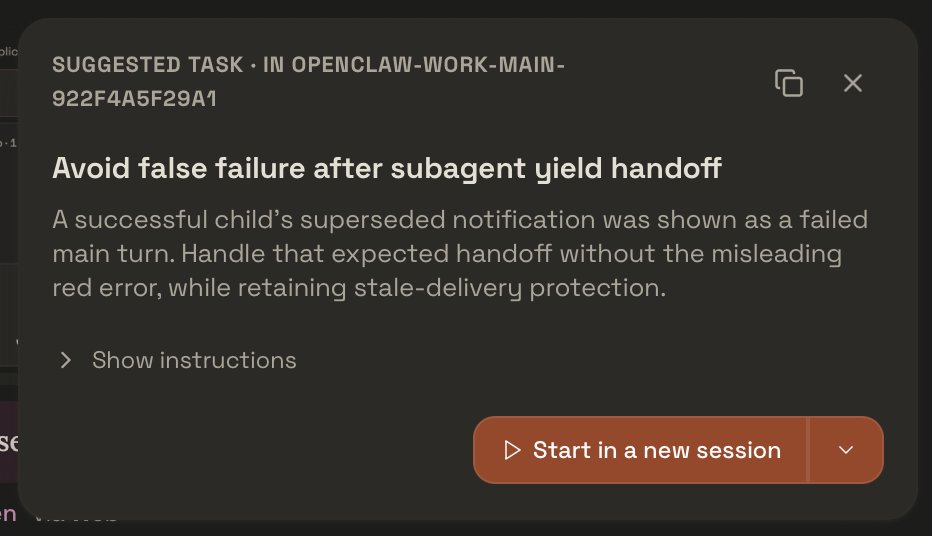
as you become more ambitious with coding agents, delegation becomes increasingly important
the new "suggested task" feature in @openclaw gives your agent a tool to do this for you
if the agent identifies a sufficiently well-scoped piece of work, it will recommend kicking off a new session to work on it
Alibaba’s Open Code Review can save structured results with --format json --output result.json. Useful for a CI job that needs to parse findings without scraping terminal prose. Spotted via @agenticgirl. https://t.co/yQrEhiwEWj
@andra_volya@agenticgirl Alibaba’s published benchmark uses 200 real PRs, but that doesn’t establish reliability on your repo. I’d replay a few known bug fixes and check which defects it catches before relying on it. https://t.co/yQrEhiwEWj
Give the reviewer a coverage report: files reviewed, files skipped and files that failed. An empty comments list shouldn’t leave the author guessing whether there was nothing to flag or the review stopped halfway.
Alibaba open-sourced the code reviewer it says has served tens of thousands of developers and found millions of defects internally. Open Code Review does not leave the whole review loop to an LLM: deterministic code handles file coverage, bundling, rule matching and comment positioning, while the agent handles reasoning and repository context. On its benchmark of 200 PRs across 50 open-source repos, Alibaba reports higher precision and F1 than Claude Code with the same model, using roughly 1/9 the tokens, with lower recall as the trade-off. GitHub Repo: https://t.co/vSXeaq0DzQ
@freesouleth@rauchg Yes. Tailscale documents self-hosted providers with an OpenAI-compatible chat-completions endpoint. The server needs to be reachable from the Aperture host, through the tailnet or localhost. https://t.co/wQpTBOxmzt
The per-request retention flag is the detail to keep visible in traces. If a request changes provider, I want to know which provider actually served it and which policy allowed that route.
Tailscale’s model router is powered by Vercel AI Gateway as its underlying infrastructure.
AI Gateways are the new CDNs. You could go “direct to origin”, but it’s brittle. You could DIY, but it’s painful and costly.
Proud to serve Tailscale, the 🐐 networking technology company