My trading day takes about 3 hours.
9:00 NY: Build my bias top-down and mark POIs on NQ.
9:30–11:30: Execute. One winner and I'm done. One loser gets me a second shot. Two losers and I'm out.
After: Journal, close the charts, move on.
Same process. Every single day.
My trading day takes about 3 hours.
9:00 NY: Build my bias top-down and mark POIs on NQ.
9:30–11:30: Execute. One winner and I'm done. One loser gets me a second shot. Two losers and I'm out.
After: Journal, close the charts, move on.
Same process. Every single day.
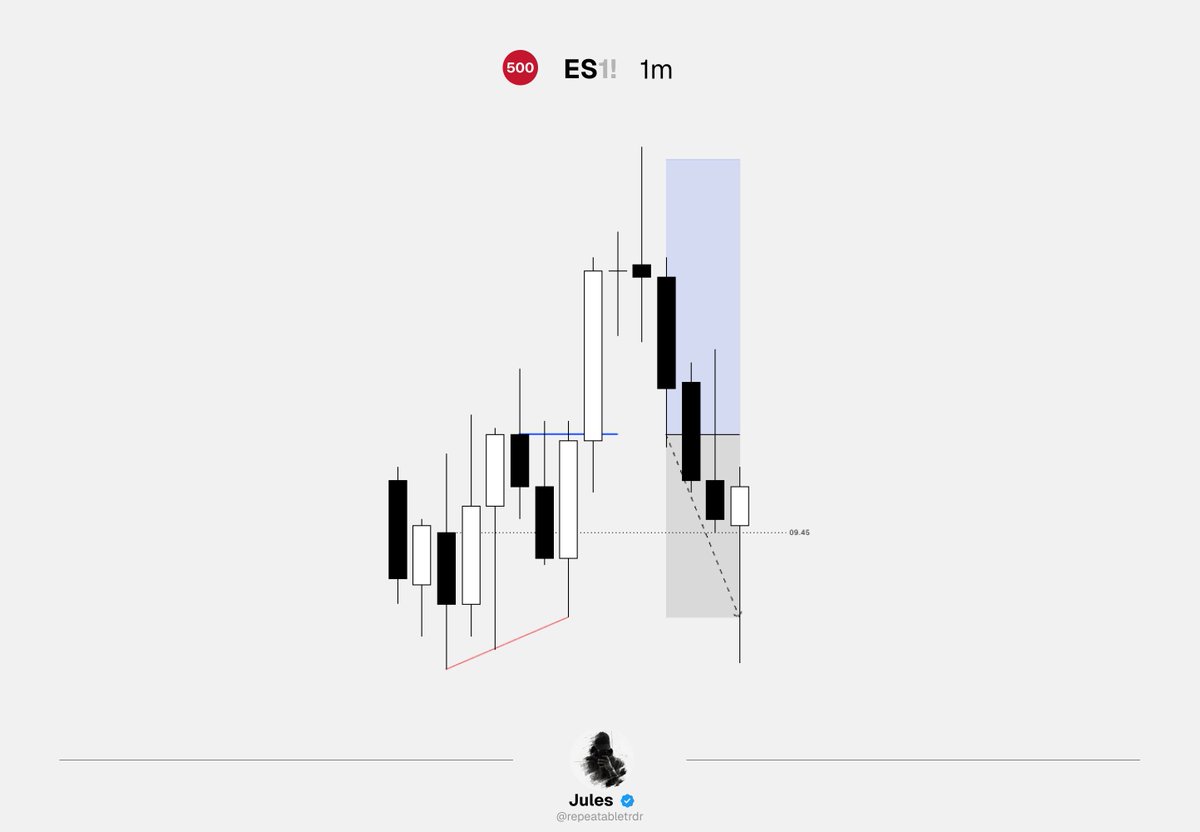
NQ Short | -1R (-$2,957)
Starting the week with an L.
Was looking for a move into the 8:30 low before considering longs, but the market had other plans.
Day 1 of sharing every single trade. Wins and losses. 🤝
Loser: Long | -1R (-$2,000)
Wanted to trade the continuation of the 9:30 move towards PDH.
Should've waited for the 15m FVG to get mitigated before entering.
Rushed the entry. Completely avoidable.
Lesson learned. On to tomorrow. 🫡
NQ | 2 Trades | +0.5R (+$2,080)
Winner: Long | +1.5R (+$4,080)
Picture-perfect setup after a lot of patience in today's market.
Still not happy with my execution though. Got way too emotional during the move.
Took a loss before this one. Breakdown below 👇
I spent years looking for the perfect trading strategy.
Started with indicators like RSI and EMAs. Then supply and demand. Then ICT, which honestly was way too complex for me back then.
Every time something didn't work right away, I convinced myself there had to be something better out there.
So I kept switching.
Until I came across the Fractal Model by TTrades.
For the first time, something just clicked.
It reminded me of what my father-in-law, who's been in the markets for over 40 years, always told me:
"Swing points are the only thing you need for trading. The market never turns without forming a swing high or low."
And that's when I decided to stop searching.
I picked one model and committed to it.
Even when it didn't work right away. Even when I had losing streaks. Even when I started doubting it.
Because I realized I had spent years looking for a better strategy instead of actually getting better at one.
I skip good setups.
Not because I'm afraid of losing money. Because losing makes me feel stupid. Like I was wrong. Like I don't know what I'm doing.
So instead, I sit there and watch the setup play out without me.
I'm still working on this, but it's gotten a lot better.
Three things helped:
1. Backtesting. I went through hundreds of setups until I had enough evidence to trust my edge.
2. Execution. I forced myself to take valid setups instead of finding excuses to skip them. Win, loss, win, loss. Sometimes 3 or 4 losers in a row. During those stretches, I felt like the dumbest trader alive. But by the end of the month, I was still profitable.
3. Time. After years of taking losses, I eventually realized they're just part of the game.
Being wrong on one trade doesn't mean I'm wrong about my strategy.
@muri0n I wouldn't call it a nightmare tbh. I'd definitely go back to trading full-time once I start my own family.
But if you don't have enough social connections, hobbies, or a life outside of trading, it'll eventually eat you up.
In 2023 I quit my IT job to trade full-time.
Not because I was profitable. IT had burned me out, and I had enough saved to give it a shot.
Those three years taught me more than anything else, and I'd 100% do it again.
But three months ago, I decided to take on a side job.
Not just for the paycheck. I wanted something outside of trading. A reason to step away from the charts, interact with people, and stop thinking about the markets 24/7.
Now I trade the New York open for two hours, close my laptop, and move on with my day. No pressure to make money every single day.
Turns out, trading gets a lot easier when your whole life doesn't revolve around it.
@SaintDanO 100%. At first, trading full-time was literally a dream come true. But after a while, the loneliness and stress really started catching up with me.