Ohad: “Verification is old news. The real deal is synthesis.”
Elon points at the same destination.
Tau’s breakthroughs means stating formal requirements to synthesize software satisfying them, and guarantee it meets the specification across every input.
Blockchain upgrades usually require new software and a coordinated restart across all nodes.
Tau Net introduces technology that allows a blockchain to amend itself without a hard fork, client updates, or downtime.
This demo shows how Tau Net users can upgrade the network's consensus mechanism simply by stating their requirements and agreeing to them.
You can change the law of the Tau Net blockchain right inside a block, ushering in a new era of blockchain and software governance capabilities.
Showcasing Pointwise Revision:
Pointwise Revision is a built-in mechanism that jointly takes new software requirements and the current specification as input. Then outputs a program that consistently satisfies both the new requirement and the maximum of the previous specification.
This allows software to update correctly according to given rules, and it is all handled by providing only the required changes to the software.
Explore testnet alpha here: https://t.co/HHRC2GV0pb
Andrei built a swarm of AI agents that live on Tau Net's testnet.
They have their own identities and guardrails. They propose rules, vote on them, stress test the chain.
June dev update 👇
🛠 June Dev Update – Agent Swarm Stress Testing & Solver Breakthroughs
Major advances in testnet reliability, solver performance, and language infrastructure. Andrei built a full agent swarm for stress testing, David's predicate blasting outperforms standard bit blasting, and Ohad completed his long-running paper.
Highlights:
• Agent swarm stress-testing testnet alpha — own identities, guardrails, goals
• Predicate blasting outperforming bit blasting in most benchmarks
• Quantifier normalization algorithm at prototypical implementation
• Ohad's paper done — leveraging existing optimized LTL tools
• Plugin system for Boolean type extension
• Full Unicode + wide string parser support
Timestamps:
0:14 – Karim Kaddeche: Development overview
4:50 – Andrei Korotkoff: Agent swarm, governance tracing, node reliability
8:48 – David Castro Esteban: Predicate blasting, LTL branch, benchmarks
11:34 – Lucca Tiemens: Quantifier normalization, OC-LTL paper
13:58 – Tomáš Klapka: Parser fixes, Unicode, plugin system
15:58 – Ohad Asor: Paper completion, Boolean algebra discoveries
"The new way proved successful... good news for the engineering side because we can use existing tools." �� Ohad Asor
📣 Tau Net's June Q & A Is Live
Treasury transparency, alpha testnet timeline, consensus security, Tau as an AI agent coordination layer, quantum resistance, and formal verification in crypto.
Questions & Timestamps:
0:12 - Community fund usage?
1:45 - Why did Kilian leave?
2:16 - Alpha testnet completion timeline?
2:55 - VC fundraising status?
3:52 - Node count vs consensus manipulation?
4:36 - Is Izar Fliss still involved?
5:03 - Growing Tau Net adoption?
9:03 - Tau vs Palantir ontologies?
9:57 - Tau for AI agent software?
10:44 - Licenses & patents update?
11:17 - Quantum resistance roadmap?
11:43 - Tau as AI agent coordination layer?
16:40 - The full vision — what does it look like?
20:00 - Formal verification interest in crypto?
20:59 - Is the team selling tokens?
21:40 - Tau as LLM verification layer?
Agents without a formal methods constraint layer carry too much risk and won't scale.
We invented GSSOTC (Guarded Successor Second Order Time Compatible logic) to build for complexity and scale.
• Enforced constraints are guaranteed across all updates, preventing tampering and enabling true software safety. Define what must or must not happen, e.g. never transmit private data
• Up to 90% reduction in dev and maintenance time and cost, with simpler systems reducing reliance on deep codebase knowledge
Read more: https://t.co/burxujtlLV
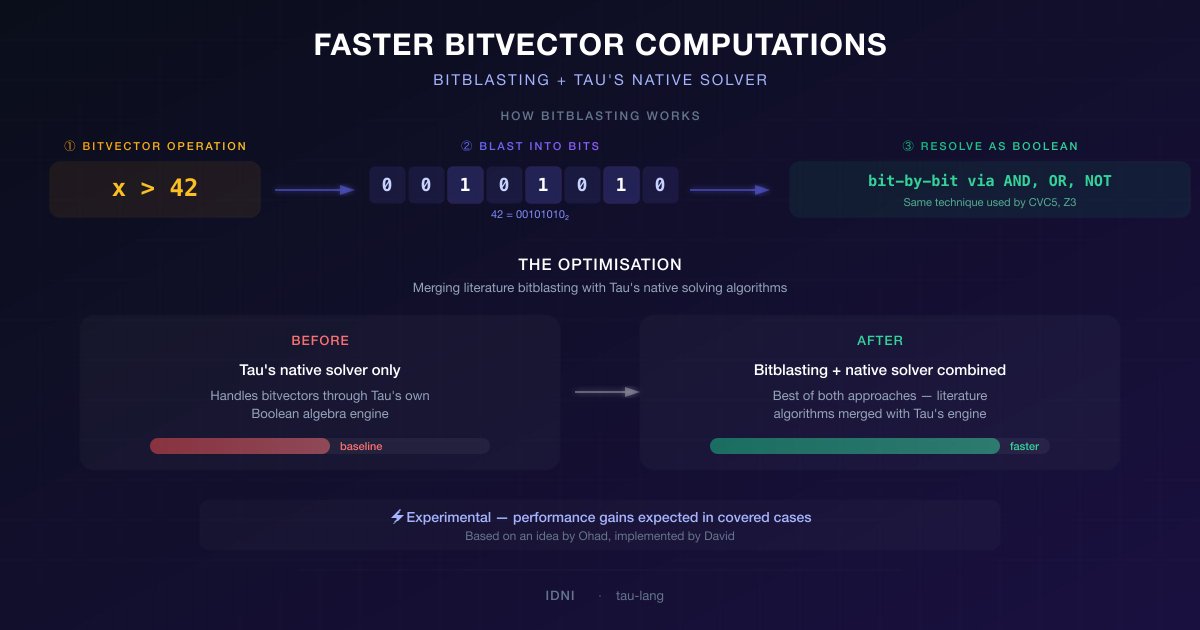
🔢 Faster bitvector computations for Tau Language.
David is merging established bitblasting algorithms from the literature with Tau's own solving algorithms.
The best of both to speed up bitvector operations.
Experimental, with performance gains expected as it matures. 🧵👇
It's coming. The missing technology is a specification language where collective requirements compile directly into system behavior.
Current architecture: users vote, devs interpret, code gets written, hope it matches intent.
The required architecture: users express requirements, system discovers logical consensus, requirements ARE the program.
This requires a language that can reason about its own sentences in a decidable, consistent way.
This is what the Tau Language was built for.
🛠 Tau Testnet Alpha Update - Major Infrastructure Progress Significant strides toward Testnet Alpha this month!
The blockchain infrastructure has reached a critical milestone with DHT-based state storage now fully implemented.
Highlights:
- Enhanced block format now includes Tau state used alongside transactions
- Proof of Authority consensus implemented with BLS signatures
- DHT-based state storage complete
- followers can sync state without recompiling from transactions
- Improved DHT with stricter validations and enhanced gossip
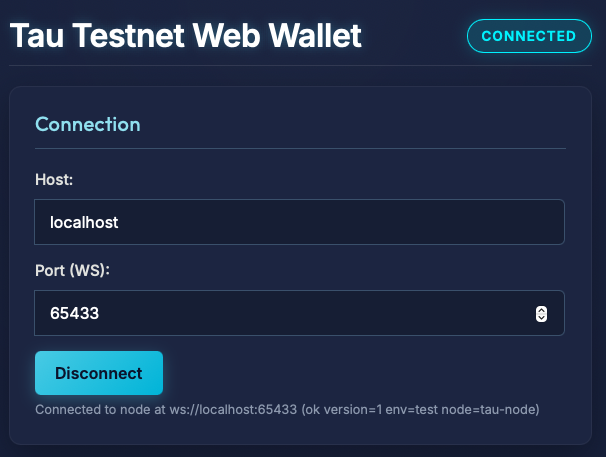
COMING NEXT: PoA node, Android wallet, and web wallet rollout
🛠 January Latest Dev Update – Type Inference Merged, Chain Sync Advances
Tau Net development kicks off 2026 with major progress: type inference merged to main branch, faster chain synchronization with DHT snapshots, and continued bit vector implementation. The team is moving fast with TestNet components coming together.
Highlights:
- Type inference branch merged to main with overloading in recurrence relations
- Chain synchronization now binds blocks to exact rule snapshots
- DHT publishing enables state validation without replaying transactions
- Bit vector simplification rules implemented and expanding
- Function and predicate definitions restored after type inference updates
Timestamps & Summaries: 👇
0:16 – Karim Kaddeche (Development Overview):
- Andrei made big step toward faster, safer chain synchronization
- Each block now bound to exact rule snapshot for execution
- Proof of authority path with BLS signatures for block authentication
- DHT publishing of Tau rule and account snapshots per block
- Secondary nodes can verify blocks and apply state without replaying transactions
- David merged type inference branch to main this week
- Lucca implemented basic bit vector simplification rules
- Tomáš working on simplified Tau API for Tau Net integration
3:43 – Tomáš Klapka (Tau Language Developer):
- Syntax changes for overloaded operators (distinguishing logic vs math)
- Helped debug type inference issues with functions and predicates
- Working with Lucca on Tau API redesign for input/output streams
- Simplified API enables easier interaction with Tau Net
4:28 – Lucca Tiemens (Tau Language Developer):
- Implemented all basic bit vector simplification rules
- Working on advanced simplifications (non-commutative operators)
- Fixed function and predicate definitions (broken after type inference updates)
- Proofreading Ohad's research on boolean function quantification
- Advanced bit vector work almost ready to push upstream
7:30 – David Castro Esteban (Lead Developer):
- Type inference now allows overloading in recurrence relations
- Solved bugs from last month, merged branch to main
- Fixed union find algorithm issues
- Split code between type scoped resolver and scoped union find resolver
- Updated syntax of all test cases
- Added README sections on type inference (scopes, variable resolution)
- Tau tree implementation changes, removed unneeded term info
- Refactored type inference to simplify test cases
10:04 – Ohad Asor (Founder & CTO):
- Continued research on quantification of boolean functions
- Making progress on this "very hard problem"
- Hopes to support common cases efficiently soon
📣 Tau Net's January Q & A Is Live
Kicking off 2026 with questions on Tau's architecture, AGI potential, privacy, and why no competitor can replicate Tau Language.
Questions & Timestamps:
0:16 - Does Tau require global account state or is UTXO compatible?
0:49 - Is governance private on-chain? Are trusted third parties required?
1:40 - Can non-Tau software interact with Tau software and network?
2:31 - What is AGI and why is Tau key to such technology?
3:35 - Can Tau work with anonymity & zero-knowledge proofs? Is Agoras ideal?
4:22 - Non-anonymity in user opinions could target bad actors - am I misunderstanding?
4:55 - Should Ohad write comprehensively about his AGI definition?
5:30 - Is Tau Net more censorship resistant than Bitcoin or Ethereum?
5:52 - What are the trade-offs of Tau Net scalability & hardware requirements?
6:30 - How does Tau solve the necessity of a core team? How does consensus work?
7:15 - Are there competitors who could make Tau obsolete by combining ML with symbolic reasoning?
8:15 - Development seems slow - could big tech catch up? Are my concerns valid?
8:45 - Do we have to learn Boolean algebra to build on Tau?
Yes! And even if token holders could vote on every decision, someone still has to translate votes into code.
Which is where additional centralization and botlenecks hide.
This is impossible to solve by adding more voting.
You need governance decisions that are directly executable specifications.
We have MVP in the works, will DM you with an invite.
🧵 Big news: The Tau Testnet repository is now public!
After months of development, you can now track our progress toward the first blockchain with automatic software development and logical consensus detection. Here's where we are:
This tweet is +1y old, but I've said it for much longer. ChatGPT came years ago, and "AI" is still more or less the same. Against all "expert" predictions, it didn't cure cancer, it didn't colonize Mars, it didn't discover new physics, it didn't really improve much. Because I was right all along: machine learning is around its peak, and it is a huge bubble. Nowadays it's obvious, but back then I was a single voice against the whole world. Not only that machine learning is fundamentally incapable of logical reasoning, but the architecture of those giant data centers, is also incapable of logical reasoning. And I keep telling you: the real deal is Logical AI, and we are the leaders of this segment. Machine learning is only for translation.
📣 Tau Net's October's Q & A Is Live:
Thank you all for all the questions this month. Keep 'em coming!
Questions & Timestamps:
00:10 - DAO on TauNet: can users amend smart contracts via group discussion (no central authority)?
00:36 - Status of bit-vectors & tables; will syntax be similar to SBF/TauSpec?
01:32 - If Tau outperforms humans, what meaningful roles remain for people?
02:06 - At genesis only transfers/rule proposals exist—later, can users define what appears in other columns?
02:59 - Plans to improve engagement while awaiting product release?
03:42 - Energy: will Tau require AI-like power usage, and how is it different?
05:04 - Is KRR essential for a debate arena (refine opinions, resolve conflicts, execute specs, reach critical mass)?
05:24 - How does Tau address human resistance to radical change (loss aversion, conservatism, uncertainty)?
05:39 - What if Tau loses and centralized ML-AI dominates?
06:28 - When will “laws of changing the laws” be available—Testnet Alpha or later Testnet?
07:08 - Relevance of languages supporting the “three laws of laws” beyond blockchain?
07:58 - Poll: trust an AI to run a country (yes/no/only with oversight)—how would Tau answer?
08:53 - Is TauNet now “just implementation”? What’s the underlying philosophy?
09:29 - Since the last whitepaper, have promised features changed or been dropped?
10:03 - Timeline: if production testnet lands in 2026, when mainnet and Agoras with CNL?
@0xFly_@taunet We handle this and we're the only ones who have a sound solution to it.
@rohanpaul_ai wrote about our paper in a thread here: https://t.co/ZNFe7VQP8B
Tau Net's breakthroughs in formal methods replace confusion and manipulation with trust, safety and user control.
The network is synthesized from your executable specifications shifting control from small, centralized dev teams to you.