Husband of amazing woman, father of 6 boys, imperfect Christ-follower, businessman & state legislator in the best state in the most amazing country on earth.
We do not have a healthcare cost problem.
We have a price-secrecy problem.
Cost is what something takes to make.
Price is what someone decided you will never be allowed to see.
Kill the secrecy and the cost handles itself.
You can be sued personally for your company’s health plan. Not the company. You.
If you sat on the committee that picked the plan’s administrator, ERISA made you a fiduciary, and the liability has your name on it.
The administrator running the plan is usually owned by the same carrier that profits from the spread, and its contract is written so the liability never reaches them.
It reaches you. Most CFOs learn this from a lawyer, not their broker.
You can get an itemized receipt for a $4 coffee but not for the $40,000 your hospital “estimates” your knee will cost. In what other industry do you sign the contract, get the service, and then find out the price by mail 6 weeks later?
Friday question.
"Independent #pharmacies are closing at a rate of at least one per week—not because patients need fewer medications, not because competitors can provide care less expensively, but because vertically integrated PBMs have discovered they can systematically underpay independent pharmacies while overregulation limits our ability to adapt and expand services," said TPA Independent Pharmacy Academy Chair Crystal McEntire. "The path that we are on is unsustainable."
McEntire was invited to testify today before the Texas Senate Health & Human Services Committee and Chair @LoisKolkhorst as it examined the role of PBMs in health care costs and monitored the implementation of SB 1236, passed last year. #PBMReform #txlege
@DrDiGiorgio@MarkRuffalo Shouldn’t the government also own and control all media? Think about the incredible income inequality on the set of a movie. Ruffalo gets paid millions for getting CGI’d green while the many other workers on set work for pittance. #txlege
This has to be one of the most ridiculous laws ever passed (and that’s saying something!).
Doctors can’t own a hospital but private-equity can. Apparently, conflicts of interest only exist if you are a doctor, but MBAs don’t have any. Smh. #txlege
Members of the Texas Legislature recognize the important role that physician-led hospitals can play in the healthcare system.
@LoisKolkhorst, @RepJamesFrank and @TomOliverson have all mentioned physician-led hospitals in recent Texas hearings on affordability.
Rising #txhealth costs are now Texas voters' No. 1 concern, and the #txlege is taking notice.
The @TexasHouse Select Committee on Healthcare Affordability, led by @RepJamesFrank and @RepToniRoseTX, is laying the groundwork for reforms next session to ease the burden on Texas families.
Read more from the @HoustonChron Editorial Board. 👇
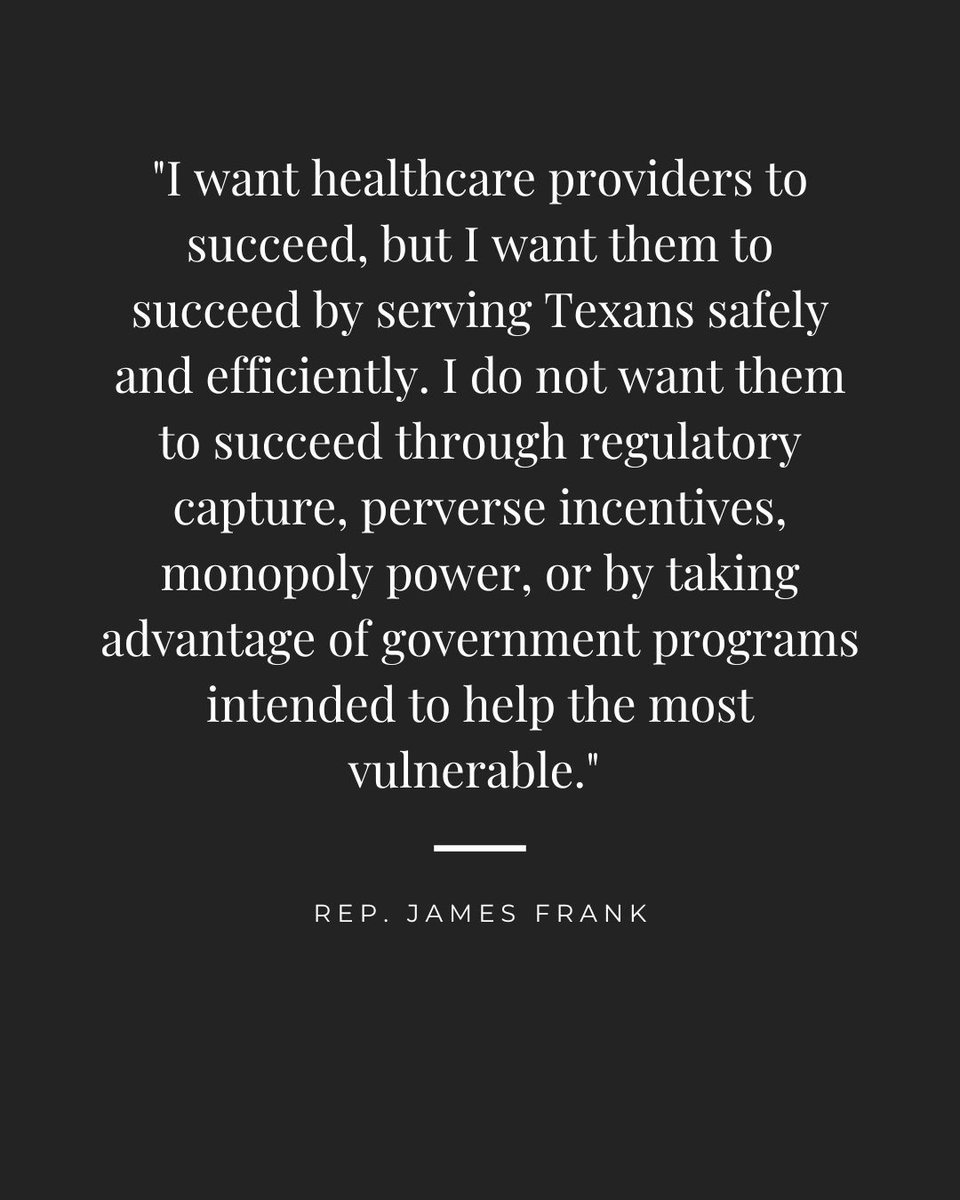
@DutchRojas@DrBradHolland If you can’t win politically at any level, then all is lost for healthcare pricing. Regulatory capture is the problem. Cannot be solved imho without action. If even 1 of 50 states have guts, the market will correct. #txlege
The ACA banned new physician-owned hospitals because doctors owning hospitals was dangerous.
Luckily, health systems owning doctors, labs, imaging, surgery centers, insurers, pharmacies, and Congress is perfectly safe.
@mcuban@PalmerLuckey Truth. We will never have functioning markets in healthcare without serious antitrust enforcement.
Then market forces (and companies like yours) can help bring costs down. #txlege
Why should employers focus on Dr pay so much when doctor pay is only 8% of total medical spend?
Shouldn’t employers first focus on hospital prices? Hospitals comprise > 40% of spend and have HUGE pricing differences based more on market strength than quality. #txlege
If Medicaid expansion is the answer to high private healthcare costs, then explain the chart below:
As far as Senator Kolkorst is concerned, no one has been more bold taking on special interests in healthcare.
You don’t have to agree with her policies, but don’t question her motives. #txlege
Regulatory capture is the mechanism by which incumbents convert regulatory agencies into sustaining innovation engines.
The process is straightforward. The regulated industry provides the technical expertise that regulators need to write rules. Over time, the rules become so complex that only people with industry experience can interpret them. The agency becomes dependent on the industry for staffing.
At that point, the regulations no longer constrain the industry. They constrain new entrants. Every compliance requirement, every reporting mandate, every licensing rule becomes a fixed cost that established players can absorb and new entrants cannot.
This is why healthcare regulation grows in volume every year and competition decreases every year.
@moodyforelpaso I’ll agree that both are problems.
But healthcare is 2x more expensive than it should be directly due directly to government policies (& lack of anti-trust enforcement).
Housing is largely driven by supply/demand forces (w/ the exception of a few local governments). #txlege
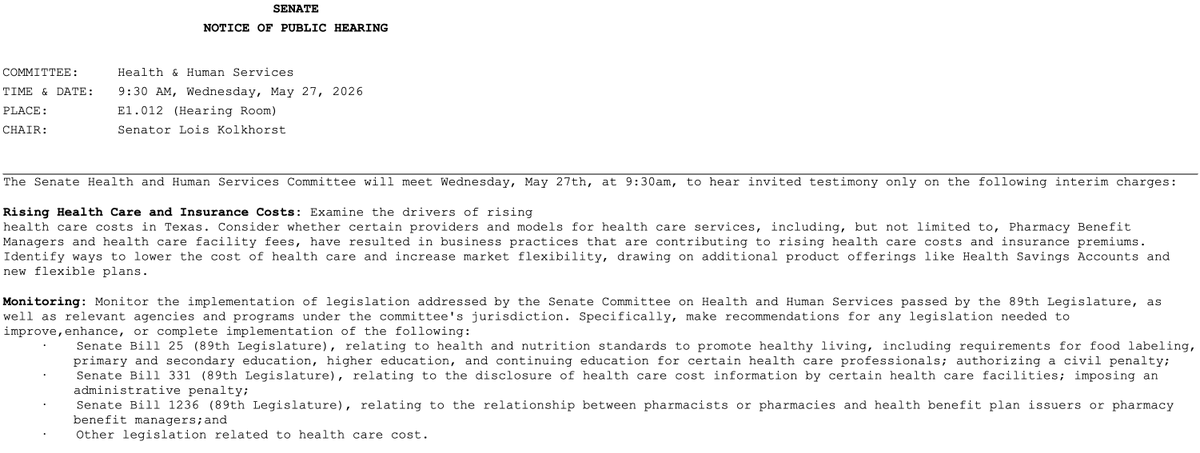
In: #txlege Senate Health & Human Services Committee chaired by @LoisKolkhorst - interim hearing on May 27 to Examine the drivers of rising health care costs in Texas.