Replico researches and builds decentralized protocols that connect blockchain to the real world. We are the builders of @torquemarkets and @proteandaos
Blockchain technology has passed the point where the things we thought we could solve with it can no longer be ignored.
It doesn't matter how radical these innovation; the world must, and the world is moving forward.
Our job is to make sure that Africa moves forward as well.
NEAR HACKATHON is now live with $250K+ in prizes.
No signup. Just ship a public repo + public demo post between November 1st & Nov 14, 23:59 UTC.
Build on NEAR Intents, chain signatures, chain abstraction, NEAR AI Cloud, & more.
Full details: https://t.co/mkP9hKatU4
Why I think optimistic governance and AI agents will be the future of decentralized prop firms
It is already obvious that real-world stocks, indices, and commodity futures are coming onchain, and that perpetual futures are making them a 24/7 activity. Platforms like @HyperliquidX, @PhoenixTrade, @perpltrade, @Lighter_xyz and @Aster_DEX are already redefining what onchain perps should look like.
The question is how everyday DeFi users can tap into this opportunity. There are two groups. Traders need capital. Retail and sophisticated investors want yield.
Traders need the flexibility to execute within the risk parameters they are given. Investors need the assurance that they can stop a trader from wrecking the treasury.
In real-world prop firms, traders get accounts that the firm controls and manages. Giving a trader a wallet with funds is different: it is like handing the money over, which is risky.
Optimistic governance solves this. Think of a treasury with multiple owners and a few managers who execute transactions regularly, without interference. Those transactions are challenged only if they break the rules or are disputed.
That model looks like a workable structure for prop firms. The trader trades continuously, opening and closing positions from the treasury. If an investor thinks a trade is bad, they can dispute it. If a trade breaks the risk rules, such as the daily trade amount, the daily position size, or the allowed leverage, an AI agent automatically disputes it and notifies all investors, who can then take action, such as voting it down.
The contract itself is an account interacting with the perp DEX, so every position opened or closed is visible to everyone.
There is one caveat. This cannot be built on public platforms, because it would expose confidential information about both the traders and the investors.
At @replicolabs, we are building this infrastructure on top of @proteandaos, our messenger governance layer. It lets traders raise capital for perpetual trading and lets investors earn from trading talent by backing a strategy with capital.
With Protean:
✅Private messenger groups provide confidentiality.
✅Our governance system gives traders freedom and protects the treasury.
✅Our agents provide automatic safeguards such as stop-losses, take-profits, and the risk checks above.
We are not just building a tool. We are building the whole package.
Faster...
We have submitted to the @monad Metropolis hackathon.
Protean is multi-chain, and it is the governance tool that lives in your messenger.
Contribute, decide, and execute in your favourite group chat.
Check out our demo on YouTube: https://t.co/noGmzjJfPy
Founders Corner · Ep. 3 🎙️
@MarvinSunday4 is building @proteandaos, a way for a group chat to pool money together and vote on where it goes. Think a contribution for a friend's wedding or burial, with no one person holding the cash.
Testing now on @solana devnet: fast, near-zero fees. Try it on Telegram, with an experimental WhatsApp bot too. 👉 https://t.co/gzVvAVdVAt
@SuperteamNG
Protean is now live on @solana via the Vortexes library and can also be accessed through WhatsApp.
Try out Protean today on Solana or on WhatsApp: https://t.co/nkfdUe8tqX
So we just finished designing and developing DAO Vortexes: the SVM implementation of DAO Spaces.
We're taking this library slowly because of the complexity that comes with Solana development.
Anyways... It's been fun, and we learned a lot, especially that SVM program development is a bit stricter than its EVM counterpart.
We couldn't make governance switchable without some kind of shared state, so Vortexes is built a bit differently from the Spaces contracts. It's a combination of two parts:
Governance programs, which handle the decision logic (proposals, votes, signers) and token vaulting (staking). They hold no DAO funds.
The Vortex Hub, a shared program that keeps every DAO's record, including which governance program it currently listens to, and holds and controls each DAO's treasury.
When a proposal is ready to run, the execute call goes to the hub, not to the governance program. The hub asks the DAO's current governance program for a receipt on that proposal.
Only if the governance program confirms that it passed and can run now does the hub have the treasury execute the proposal's actions.
If a proposal is made to change the DAO's governance, its instructions ask the hub, not the old governance program, to move its pointer from the current governance program to the new one.
That only takes effect after a two-day waiting period, and only once the DAO has been set up in the new program. From then on, the hub listens only to the new governance program when it comes to the treasury and the assets the DAO owns, so the only way to vote is through the governance program the hub points to.
Proposals left over from the old governance can never run again.
Access the repo below 👇
The @proteandaos pages are now live.
What are they?
Messenger WebView pages that let proposers add long descriptions to their proposal, and since they are native to the platforms, users can easily view them and return to the chat.
They also let users watch live governance metrics for that proposal...
Thank you for your attention.
BTW, I'm at @SuperteamNG Startup Village 3.0.
It has been fun so far, especially having a conversation with @NzubeEzudo about product distribution and product framing.
I was also excited to see people like @energy_0x, @psoliteSol, @alexfavour, and others.
Hoping to chill out more with all of you guys.
faster...
Protean Now Supports @base, @monad, and @HyperliquidX Testnets on our beta across Telegram, Slack, and Discord interfaces.
Try out Protean on any of these chains today: https://t.co/nkfdUe8tqX
Our flagship project has been unveiled: @proteandaos, the governance layer for messengers.
The future of on-chain governance is not on dashboards; it is where the communities are.
Let the DAO magic begin. 🪄
A decade of DAO governance.
A decade of nine-figure hacks.
Oligarchs instead of owners, forums instead of votes.
You can't fix a system from inside it. You have to exit and build your own.
Here's what we're building at @replicolabs that is different. https://t.co/HKMRHXxe7G
Blockchain technology has passed the point where the things we thought we could solve with it can no longer be ignored.
It doesn't matter how radical these innovation; the world must, and the world is moving forward.
Our job is to make sure that Africa moves forward as well.
We have said this since 2024... In the future, the whole process of proposing, voting, and execution will be handled by agents onchain and offchain...
Our next phase of @proteandaos will prove that algorithmic governance is the way to go.
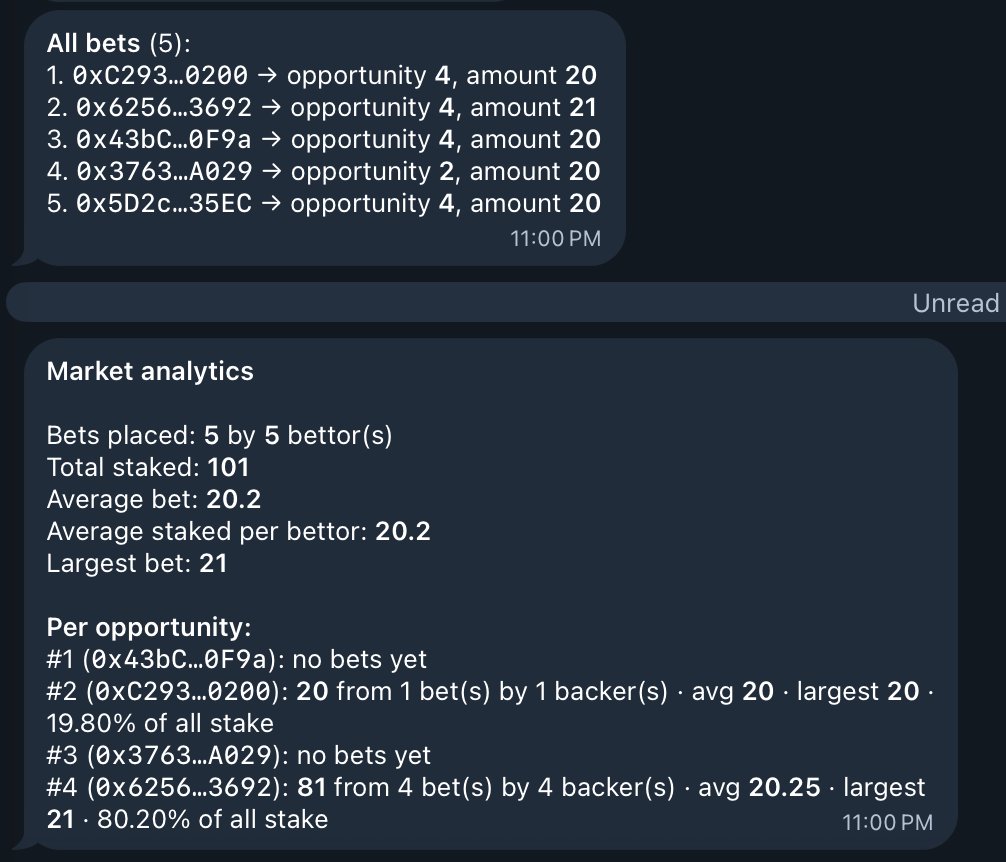
We just finished testing our private opportunity markets on Telegram using @proteandaos.
Key takeaway:
@zama is an awesome privacy tool for EVMs, I personally was relieved to know that all our privacy parameters flowed perfectly into it encrypted system.
I am super excited to test other decision markets with Protean.
Below is our current analytics layout, a bit sketchy, but we would improve it with graphs and charts in the coming weeks.
There was a lot of research and testing put into this library.
Our team always considers the best practices of engineering and first-principles thinking.
While building the Spaces Governance Library, I got stuck on the idea that our contract factories would hold the bytecode of their child contracts inside them (apologies if you're not a Solidity dev).
But I kept hitting "stack too deep" on deployment. I tried --via-ir, and while some contracts then deployed successfully, others exceeded the 24 KB contract size limit—deployment was inconsistent.
I also discovered that deploying a new DAO from the factory meant redeploying the governance contract, the staked governance token, and the governance token every single time. That's very expensive from an engineering perspective, so I had to look for a better approach.
In a way, the answer was something I'd already internalized from Solana: its stateless programs, where multiple accounts interact with a single deployed program instead of each one carrying its own copy of the logic.
After some consultation and a few articles, I realized there was already an implementation of this pattern for EVM: OpenZeppelin's upgradeable clones and proxies.
So in the end, I went with deploying single implementations of the needed tokens (main and staked), the governance contract, and any other components, once.
The factory stores references to these implementations, and when someone hits "create," a minimal proxy clone is created that delegates to those implementations, at a much lower gas cost.
The implementations themselves are never used directly; their initializers are disabled on deployment, so they only ever serve as the logic that clones delegate to.
Now, deploying a new DAO doesn't require a full redeployment at all, just a clone plus a reference to the existing implementation, while each clone still keeps its own independent storage.
It's very similar to what I know from Solana.
Thanks for your attention.