Why Reputation Matters in Web3?
Reputation = Trust.
But current models are too rigid, failing to capture what makes contributors valuable. One-size-fits-all doesn’t work for DAOs, DeFi, or NFTs!
Discover why custom models are the future https://t.co/I8GcYLGO3f
@Brent_Fulfer We’re building a decentralized reputation protocol solving trust in Web3 by enabling protocols, DAOs, and foundations to create custom on-chain reputation models.
We just won prizes at ETHGlobal for our work with Uniswap Foundation!
Would love to chat about our vision.
ETHGlobal Hackathon Recap 🎉
@ETHGlobal BKK was intense: 2000+ builders, 800+ projects deployed.
We’re thrilled to announce that @Reputable_Tech won prizes from both @blockscoutcom and @UniswapFND! 🏆
Check out our project:
🔗 https://t.co/T0tw71RQ65
Our demo showcased a custom reputation model that scores top DeFi developers, extracting value from Ethereum Mainnet to Unichain Sepolia by analyzing their contributions both on-chain and off-chain.
Here’s why this matters 👇
With the launch of Unichain, @UniswapFND seeks to attract and reward high-impact DeFi developers.
But how do you target top contributors in a brand-new ecosystem with no transaction history or metrics?
That’s where Reputable steps in.
Reputable enables protocols to create customizable reputation models that leverage Web3 & Web2 data, ensuring resources flow to the most impactful contributors while building trust-driven ecosystems.
For this demo, we scored developers contributing to the top 100 DeFi protocols.
@UniswapFND’s goals for Unichain:
- Airdrops & Incentives – Reward top developers to foster loyalty & contributions.
- Grants & Funding – Allocate resources to high-impact developers.
- Governance – Empower high-reputation devs for a meritocratic ecosystem.
Key Features:
- Customizable Models – Tailored to unique needs & metrics.
- Sybil-Resistant Attestations – Hybrid on-chain & off-chain scoring.
- Monetizable Models – Tradable reputation assets.
- Decentralized Validation – Consensus-driven data integrity.
- Trustless Computation – Transparent, on-chain scoring.
While the model we deployed at the Hackathon was relatively basic, we’ve got a far more advanced version running in our centralized beta:
🔗 https://t.co/UjBRyqTCz6
More to come. Stay tuned.
@Reputable_Tech Token Economy and Incentive Model
Reputable aligns incentives across protocols, model creators, nodes, and users, creating a sustainable economy for custom on-chain reputation models.
Here’s how it works 👇
1/ Protocol Fees for Model Deployment
Protocols creating custom reputation models pay a deployment fee. This fee funds the setup and supports Reputable’s infrastructure, helping us maintain a robust, scalable network.
2/ Model Labeling Fees for Verification
For additional credibility, protocols can add a Model Labeling feature (like an audit), verifying and labeling high-quality models with a "Verified Checkmark." This extra fee ensures trusted, reliable data.
3/ Revenue Sharing for Model Usage
Every reputation score generated triggers a computation fee, distributed as revenue across the ecosystem between:
- Model Creators: Earning from score computation fees, encouraging impactful model creation.
- Decentralized Nodes: Supporting computation and verification, with incentives to maintain network resilience.
4/ Tradable ERC-721 Models: A Marketplace for Reputation
Each model on Reputable is tokenized as an ERC-721 NFT, making them tradable assets. Protocols can sell, license, or rent models.
Key Use Cases for @Reputable_Tech
DeFi Users Categorization
Enable DeFi platforms to reward high-reputation users with benefits such as better lending rates, reduced fees, or exclusive services, fostering loyalty and deeper engagement.
Grant Access and Funding Allocation
Screen grant applicants based on past contributions and involvement in the community, ensuring funds are allocated to developers with meaningful, impactful records.
DAO Governance
Assign voting power based on engagement and genuine contributions rather than simple token ownership, supporting a governance structure rooted in participation and merit.
GameFi
Reward fair play and social contributions, allowing high-reputation players to access rare assets or exclusive features, thus encouraging positive community interactions within gaming ecosystems.
Decentralized Advertising
Tailor ads to user interests and behaviours, offering high-reputation users relevant ads, improving both ad effectiveness and user experience.
We think it's all about Reputation.
Influence is a market. It’s not just about quantity, but quality measured over time.
The tricky part is creating real, trust-based connections. With @Reputable_Tech, protocols can go deeper by building custom on-chain reputation models for creators.
Rather than quick, one-off sponsorships, creators build reputation scores based on meaningful metrics like engagement quality, loyalty, and long-term impact—drawing data from both on-chain interactions and off-chain behavior.
This approach incentivizes long-term partnerships where creators and audiences align naturally, leading to genuine loyalty and higher engagement.
Off to Bangkok soon for Devcon! 🇹🇭 Let me know if you’ll be around – would love to connect!
We’ll be cooking something exciting with @Reputable_Tech for @ETHGlobal Hackathon, integrating @unichain, @blockscoutcom, @eas_eth, and @web3auth.
4/ Soon Protocols will be able to create custom reputation models, defining their own parameters and weights. Reputation scores can be minted on-chain, enabling personalized reputation models that suit each protocol’s unique needs.
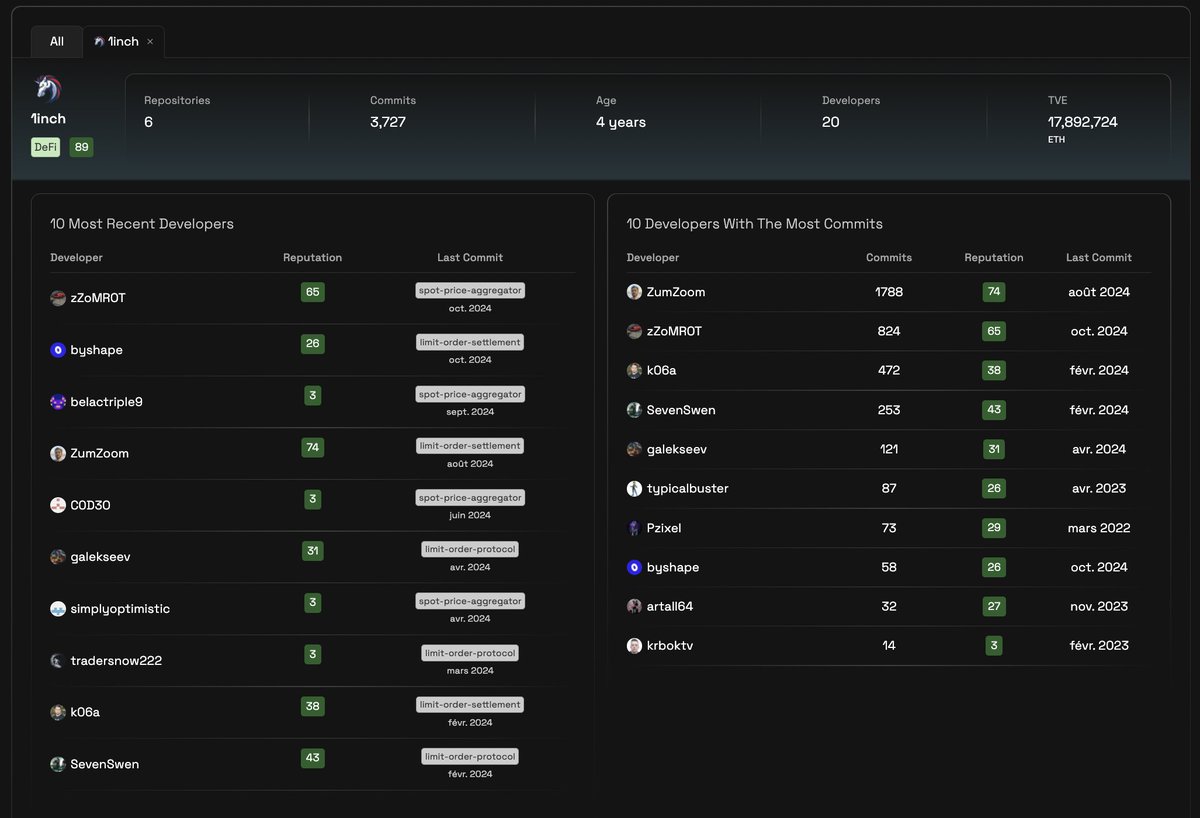
🧵 1/ 📢 @1inch ranks #13 in our Top 100 DeFi protocols on Ethereum Mainnet!
20 Developers actively working across 6 repositories
Oldest repo: 4 years
Total Value Engaged (TVE): 18M ETH (~$48B at today’s ETH price) 💰
The future of DeFi is dynamic—and Reputable can make it happen. Want a customized experience based on real value?
Reputable is building the bridge to make DeFi as personalized as Web2!
Dynamic Reputation Models in DeFi? Why Not?
1/ When you use platforms like YouTube, TikTok, or Instagram, the recommendations are tailored just for you. Imagine if DeFi protocols could do the same—adjust their offerings based on your unique on-chain and off-chain activity!
2/ After chatting with dozens of DeFi founders, one major challenge kept coming up: user categorization. DeFi protocols generally don’t label or score users based on activity patterns across multiple platforms.
3/ Think about it—right now, DeFi protocols often lack insights into users’ behaviors, like their favorite blockchain, average staking duration, liquidity provisioning habits, and even social activity on platforms like Farcaster, Lens, or Discord.
4/ @Reputable_Tech can change that by empowering DeFi protocols to create custom reputation models that categorize and score users based on on-chain metrics (staking, TVL, POAPs) and off-chain activity (social following, engagement).
5/ Here’s how it works:
Step 1: Define custom parameters. A DeFi protocol like Aave could prioritize metrics such as staking duration, liquidity provision, or governance participation.
Step 2: Assign weights to these metrics to reflect what’s most valuable for the protocol’s goals.
6/ Reputable then aggregates data, creating trusted, sybil-resistant scores that allow DeFi protocols to dynamically adjust incentives, reward high-value users, and even tailor lending rates based on individual reputations.
7/ For Protocols:
- Gain a clear view of end-user profiles.
- Dynamically adjust strategies based on real-time user engagement.
- Customize rewards to incentivize valuable contributions effectively.
8/ For Users:
- Earn exclusive rewards based on your reputation.
- Access variable interest rates depending on your activity and reputation across chains.
- Get targeted incentives and recognition in DeFi ecosystems based on real value.
Reputation Scores
After the computation, the reputation scores are generated and made available for use by the protocol. These scores can be applied across various use cases, such as governance, reward allocations, contributor recognition, or filtering out low-value users.
6/6
How Reputable Custom On-Chain Reputation Models Work
At the heart of Reputable’s customizable reputation system is the ability for any protocol to define and deploy its own model, tailored to its specific requirements.
1/6
Trusted Compute
Once attestations are generated, the Reputable Protocol verifies their validity through the Reputable Hub Contract, then retrieves the model to compute attestation using selected parameters.
5/6
I've interviewed +80 Web3 Protocols interested in DID and Web3 Reputation; here are some takeaways 🧵
Strong Demand for Customization: Protocols expressed a strong desire for customizable reputation models tailored to their specific needs.
Developer Identification: Difficulty in identifying and reaching developers who have successfully built valuable projects.
Web3 User Insights: There's a critical gap in understanding end-user interactions with DeFi protocols.
Value of Trust: Building trust with their communities is recognized as a key component.