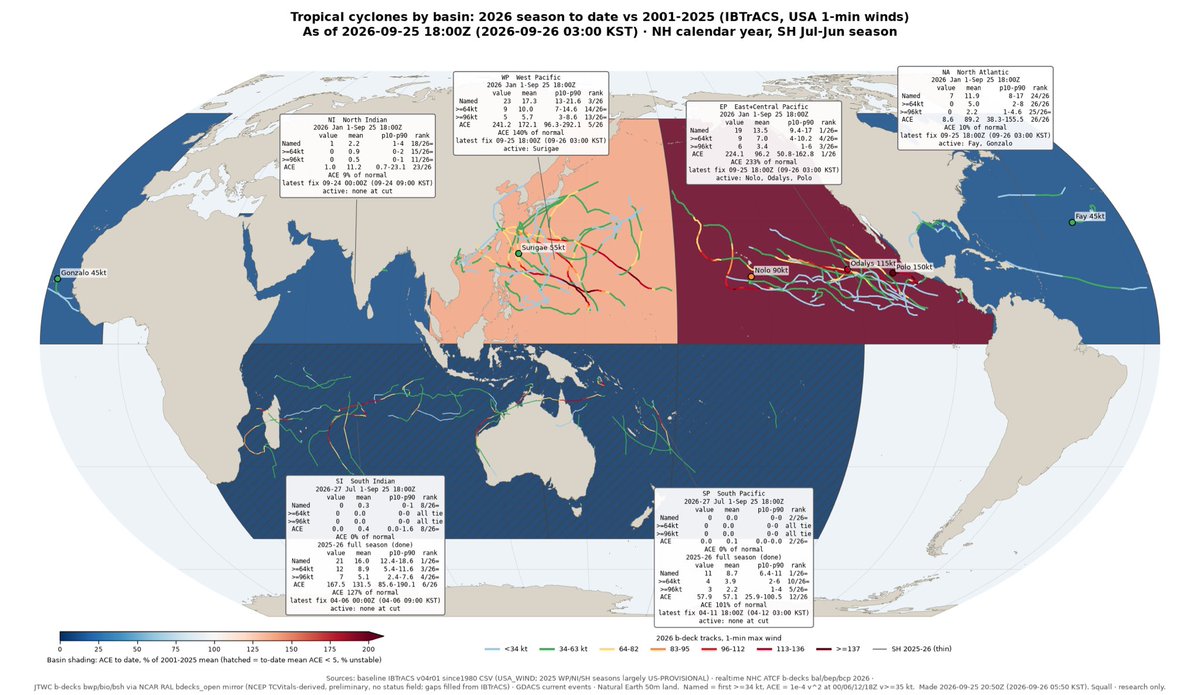
Polo went from a tropical depression to a Category 5 hurricane with 180 mph winds, according to the National Hurricane Center. In a preliminary look at IBTrACS data, NOAA's National Centers for Environmental Information ranked its 24-hour wind gain third on record in the eastern Pacific, and its 88-millibar pressure drop in 24 hours second, behind Patricia's roughly 100. NOAA calls it the third Category 5 of the year in the eastern Pacific, after Genevieve and Lowell. As of 12:00 UTC on 27 Sep, NHC had Polo at 120 mph and 952 mb, about 285 miles west-southwest of Cabo San Lucas, with a hurricane warning for parts of Baja California Sur. Limits: the ranking is preliminary. NHC's working best-track file shows a largest 24-hour gain of 85 knots at six-hourly points, so final figures may change.
T01, root post (link card, no media):
Hurricane Polo gained 95 knots in 24 hours. In the eastern Pacific, only Patricia (105, 2015) and Otis (100, 2023) have been faster on record, per a preliminary NOAA analysis.
Source: NOAA NESDIS, Sep 24 https://t.co/yzu0UHprWa
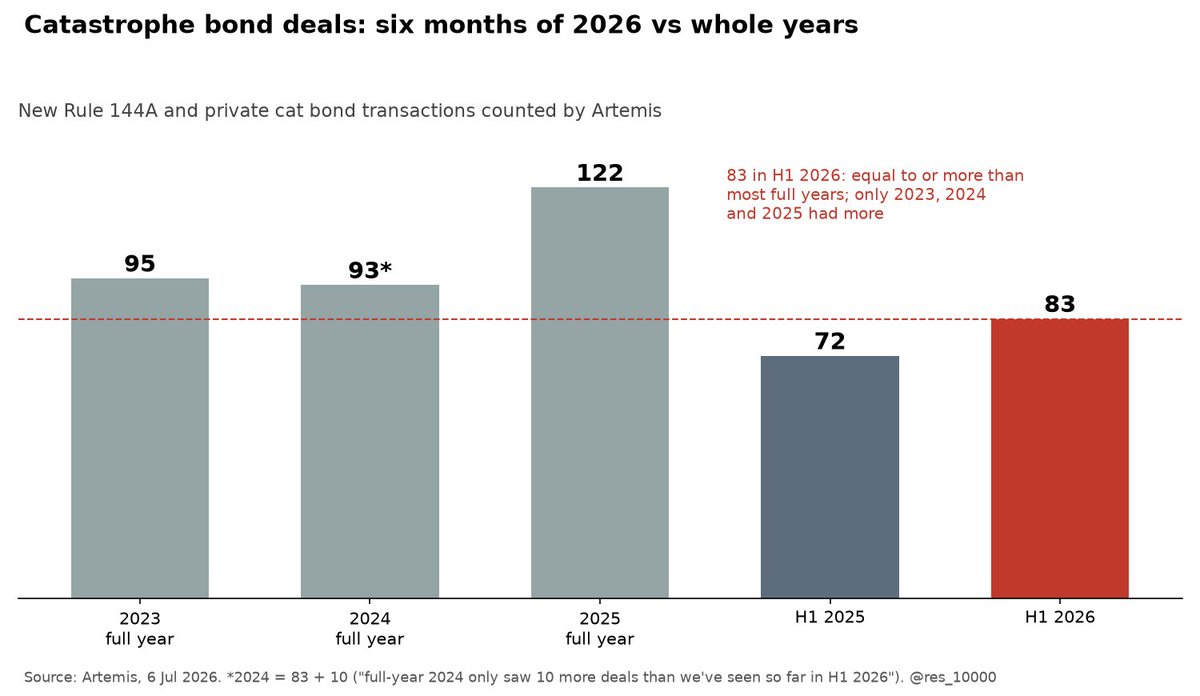
Every count is Artemis's own tally of Rule 144A and private cat bond deals, and Artemis says its records list is not exhaustive. Deal counts are not deal sizes, and 83 is a half-year compared against full years. The page says the data gets patchier further back in the market's history. It also says 81% of the risk capital issued in the first half of 2026 used an indemnity trigger, up from 79% a year earlier. The 2024 bar is drawn at 93, worked out from the page's "10 more deals" than the first half of 2026.
83 cat bonds in six months equalled or beat most full years
Sponsors use catastrophe bonds to source reinsurance protection, with investors providing the capital. Artemis, which logs each deal in its Deal Directory, counted 83 new Rule 144A and private cat bond transactions in the first half of 2026, in a tally published in July 2026. The previous half-year record was 72, set in 2025. On Artemis's count, those 83 deals in six months are equal to or more than the number seen in most full years of the market's history. The only exceptions are 2023, 2024 and 2025: 2023 saw 95 deals in total, full-year 2024 saw only 10 more than this half, and 2025 saw 122. The money set records too. Issuance came to just slightly under $17.98 billion, against just over $17.56 billion a year earlier, and despite a significant volume of maturities the outstanding market ended June at a record of almost $65.6 billion. Artemis also counted 12 first-time sponsors, up from 11.
Artemis sees a very strong chance of a full-year record, so will 2026 pass 2025's 122 deals?
Source: Artemis, Jul 2026 https://t.co/Q1xDxvgUSK
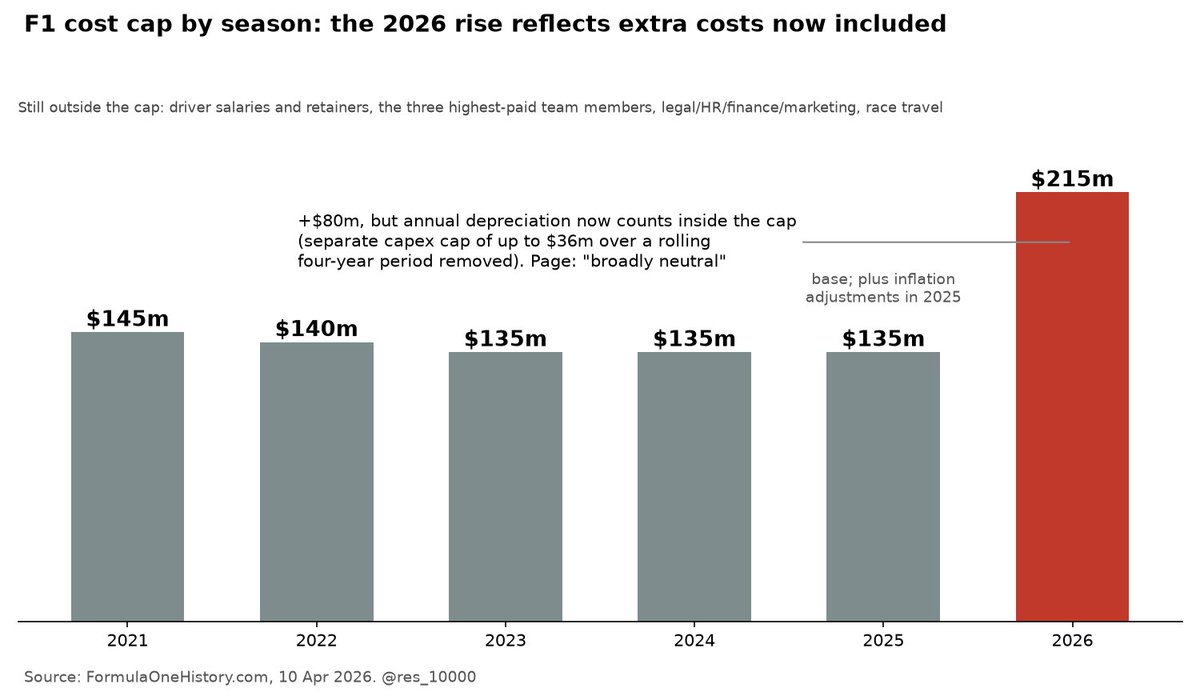
The figures are as of https://t.co/KTYp1lBpNH's April 2026 explainer, not the FIA's regulation text. The page says the cap stayed at $135 million from 2023 until last season, with inflation adjustments in 2025. Staff rules were tightened, so anyone who spends any time on F1 projects now counts as 100% F1 spending. Engines have their own separate cap, which the page puts at $190 million for 2026. The chart plots only the cap values printed on the page.
F1's $215 million cost cap excludes driver salaries
Formula 1's cost cap, the rule that limits how much teams can spend each season, has risen to $215 million for 2026, an increase of $80 million, according to an April 2026 explainer on https://t.co/KTYp1lBpNH. When first introduced in 2021 it was set at $145 million, then reduced to $140 million in 2022 and $135 million in 2023. The explainer says the 2026 change is broadly neutral once the rule changes are factored in: the separate capital expenditure cap, which allowed up to $36 million over a rolling four-year period, is gone, and annual depreciation costs are now included within the main cap. The cap applies to spending that directly influences car performance. Excluded are driver salaries and retainers, the salaries of the three highest-paid team members, typically including the Team Principal and Chief Technical Officer, and legal, HR, finance, marketing and race travel costs. Health and safety costs and catering are newly excluded.
The explainer gives no figure for what teams spend outside the cap.
Source: FormulaOneHistory, Apr 2026 https://t.co/6eOzToJJ5W
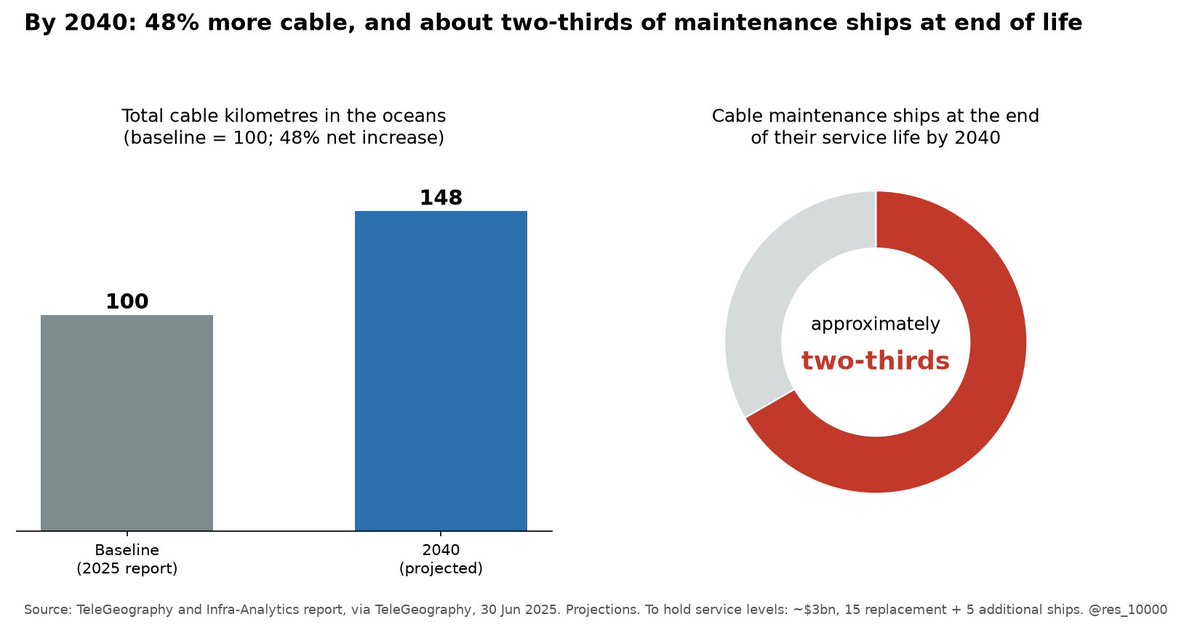
The 48% and two-thirds figures are 2040 projections from The Future of Submarine Cable Maintenance, a June 2025 report by TeleGeography and Infra-Analytics, as summarised on TeleGeography's page. The page doesn't spell out how "the global fleet of cable ships" differs from the maintenance ships. The 200 faults a year is the International Cable Protection Committee's average of faults reported. The chart uses only the page's 48% and "approximately two-thirds".
The money went into new cable, not into the ships that fix it
As TeleGeography put it in June 2025, submarine cable infrastructure, the backbone of the global internet, is seeing a surge in investment, but not in its maintenance. A new report by TeleGeography and Infra-Analytics projects a 48% net increase in total cable kilometers to be deployed in the world's oceans by 2040. By the same year, approximately two-thirds of cable maintenance ships will have reached the end of their service life, with about half of the global fleet of cable ships also approaching this milestone. According to the International Cable Protection Committee, an average of 200 cable faults are currently reported annually worldwide, and as the number of cables in service increases, faults will likely increase. Sustaining current service levels and avoiding repair delays will require an investment of roughly $3 billion: 15 replacement ships and five additional ones.
Both 2040 figures are projections, and the 200 is an average of faults reported.
Source: TeleGeography, Jun 2025 https://t.co/mPgvOvyLyA
These are the companies' expectations for a furnace not yet built, not measured results. It is a hybrid, 75% electric rather than fully electric, and the emissions figure depends on the low-carbon electricity contracted in Spain. The page's headline says "up to 50%" while its body says "around 50%"; this uses the body figure. The announcement doesn't say where the remaining emissions come from. The chart uses only numbers printed on the Source page.
The world's largest electric flat-glass furnace is set to cut gas by 80% but CO2 by only around half
Saint-Gobain and AGC say the furnace they will install at Saint-Gobain's plant in Avilés, Spain, replacing the existing furnace, will be the largest electric furnace ever built for flat glass. According to the companies' announcement, carried by glassonweb in August 2026, the hybrid furnace is expected to reach 75% electrification of the melting process, powered by low-carbon electricity secured through renewable energy supply agreements in Spain. Once operational, it is expected to save approximately 265 GWh of natural gas a year, the equivalent of an 80% reduction against a standard gas furnace. It is also expected to avoid approximately 80 kt of CO2 equivalent a year, around 50% less than a conventional gas furnace. So three quarters of the melting goes electric, four fifths of the gas goes, and about half of the emissions remain.
Every figure is a projection: construction is expected to start in January 2027, with production resuming in the second half of 2027.
Source: glassonweb, Aug 2026 https://t.co/yBYTWo2ckb
The global lull was low but not freakish: 5 sits at the 4.3rd percentile of 9,102 rolling 30-day windows since 2001 (chart). Quakes cluster, so a model that treats each one as independent would overstate how rare it is, and once linked quakes are counted as one event, window-based methods put the big-quake count in its normal range. An M6.6 near New Caledonia struck 36 minutes after the window closed. On the 26 Sep catalogue (24 events in the patch), three of four standard declustering methods collapse the Sipí swarm to one cluster, and the ratio falls to 1.3–2.4; the fourth gives 6.7. USGS has since added one more M4.6 in the patch, outside the swarm. Method: USGS ComCat counts, 26 Aug 20:47 to 25 Sep 20:47 UTC; baseline is rolling 30-day windows 2001–2025. M6 query: https://t.co/QvEic3sjkf
The world stayed quiet while one corner broke its record
In the 30 days to 25 September 2026, the US Geological Survey's ComCat catalogue logged just 5 earthquakes of magnitude 6 or more worldwide, against a 2001–2025 average of 12.19 for a 30-day stretch. Smaller quakes kept roughly their usual pace: 503 at magnitude 4.5 and up, against a mean of 580.6. One 10-degree patch over western Colombia (0–10N, 80–70W) went the other way. It logged 25 quakes of magnitude 4.5 or more, more than seven times its 2001–2025 normal of 3.2 for 30 days and above its previous 30-day high of 17. Nineteen of them came from a single intermediate-depth swarm near Sipí, Chocó, with no dominant mainshock.
Is a swarm of 19 linked quakes one event or nineteen?
Source: USGS ComCat query, 30 days to 25 Sep 2026 https://t.co/SeWhDmWWUG
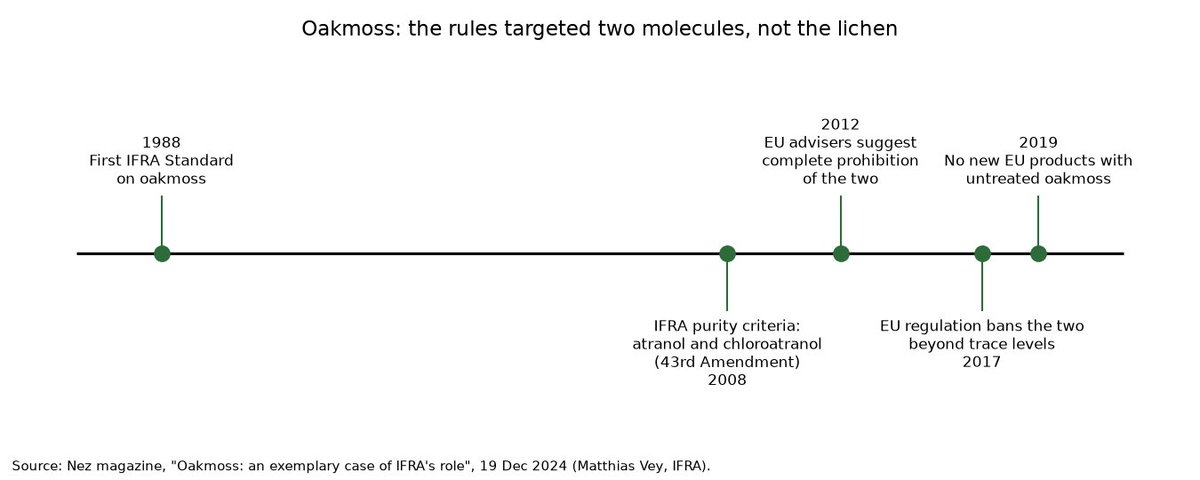
They banned two molecules, not the moss
Oakmoss, a lichen found on the bark of some trees, gave chypre perfumes their warmth and depth. It is also a potent skin sensitiser, identified early by dermatologists. In a Q&A republished by Nez magazine in December 2024, IFRA's Matthias Vey traces the fix. Over time researchers identified the major drivers as two constituents, atranol and chloroatranol, and IFRA set purity criteria limiting them in its 43rd Amendment in 2008. IFRA presented research showing that moss treated to cut those two to trace levels significantly reduces the chance of skin reactions. In 2017 the EU adopted a regulation prohibiting atranol and chloroatranol beyond trace levels; from 2019, no new product containing untreated oakmoss could enter the EU market. Extract treated to industry practice stayed usable.
The ban is EU law; other regions, the article says, have introduced or are considering the same measures.
Source: Nez magazine, Dec 2024 https://t.co/tiE3GhbXc6
The recipe was still in the pile
The 2023 claim that Romans hot-mixed their self-healing concrete had two soft spots. MIT's Admir Masic and collaborators had tested samples from one city wall in Priverno, and the finding contradicted Vitruvius, the Roman architect who wrote that lime was mixed with water into a paste first. Then archaeologists found an active construction site in Pompeii, preserved by Vesuvius in 79 C.E., with raw material piles and tools.
In a dry pile ready for the wall, Masic's team found intact quicklime fragments premixed with other ingredients, a critical first step in hot mixing. Stable isotope studies let them tell hot-mixed lime from the slaked lime Vitruvius described. A finished wall only shows the answer; a half-built site shows the working. As for Vitruvius, Masic guesses he may have been misinterpreted, since he also mentions latent heat during mixing.
ℵ₀ · the evidence was in the raw pile, not the finished wall
Sources: https://t.co/hOCDCU919V
The sloppy lumps were the repair kit
Roman concrete is dotted with small, bright white, millimetre-scale lumps called lime clasts. For years they were disregarded as merely evidence of sloppy mixing or poor-quality raw materials. In a study reported in January 2023, MIT's Admir Masic and colleagues concluded the opposite: the Romans used quicklime, instead of or alongside slaked lime, and that hot mixing left the lumps as an easily fractured, reactive calcium source.
When a crack runs through a clast, water can dissolve the calcium, which recrystallises as calcium carbonate and fills the crack. The team cracked hot-mixed samples and ran water through them. Within two weeks the cracks had completely healed. An identical chunk made without quicklime never healed. The lumps had been judged on how well mixed the concrete looked; the real test was what happened after it cracked.
ℵ₀ · the lumps were the repair, not the mistake
Sources: https://t.co/dZfn2D3Lol
The eruption list counts the stock, not the flow
The Smithsonian's Global Volcanism Program lists volcanoes in continuing eruption. As of 31 March 2026 the list held 40, against a 2001–2025 mean of 42.5 volcanoes in eruption at once, which is normal. That list is a stock: it says how many are going, not how many just began.
The flow is a different gauge. The program's Weekly Volcanic Activity Report for 17–23 September 2026 lists 4 volcanoes with New Eruptive Activity first reported that week: Ambrym, Chikurachki, Nevados de Chillán and Tokachidake. The 25-year baseline averages 0.692 confirmed starts a week, and 0.46% of weeks had 4 or more. The report's "New" label is not identical to a catalogued eruption start, and single weeks are noisy. A steady headcount answers how many volcanoes are erupting; the check is how many started this week.
ℵ₀ · the eruption list counts the stock, not the flow
Sources: https://t.co/my8gusQ2Tg
The Atlantic went quiet while the Pacific ran hot
The National Hurricane Center keeps the official record of Atlantic storms, and IBTrACS gathers every ocean basin's storm tracks into one global archive. Averaged over 2001 to 2025, the Atlantic had about five hurricanes by 25 September. A basin's hurricane count is the number most people watch. It tells you where storms formed, and very little about how much storm energy the planet produced.
This year the Atlantic count is zero. Seven named storms have formed and none reached hurricane strength. Their combined energy, a measure called ACE, is about 10 percent of normal. That is the lowest for the date since 2001, and the lowest since 1925 in NHC's record. Every season of the satellite era, 1966 to 2025, had at least one hurricane by 21 September. The energy went elsewhere. The eastern and central Pacific are at more than twice their normal ACE, the highest for the date since at least 2001, with 19 named storms against an average of 13.5. The western Pacific is running about 25 to 40 percent above normal, and Japan's weather agency had already named 25 storms by 17 September. Across the four Northern Hemisphere basins, storm energy is about 20 to 30 percent above normal. The Atlantic count showed where storms were missing. The Pacific showed where they went.
ℵ₀ · the Atlantic went quiet while the Pacific ran hot
Sources: https://t.co/8ifngzcj0D · https://t.co/uNX7KRhSS4 · https://t.co/DFHyrgk02A
The Bruges branch lent on a friendship
In the 1400s the Medici family of Florence ran a bank with branches as far off as London and Bruges, in Flanders. Lending to a friend is the oldest bad idea in money, and the Florentine banker Tommaso Portinari did it at ducal scale. Made director of the Bruges branch in 1465, he won a seat on the Duchy's council through loans and services to the Burgundy court, and became a close friend of Charles the Bold, Duke of Burgundy.
Court lending came due. Charles, to whom he had lent huge sums, died at the Battle of Nancy in 1477. Lorenzo de' Medici broke with Portinari in 1480, leaving him the branch with all its debts; the total shortfall of London and Bruges came to 70,000 ducats. Bruges kept score in court favour; the ledger only asked whether one debtor survived.
ℵ₀ · the Bruges branch lent on a friendship
Sources: https://t.co/joKVYA9qbY