Complex marketing doesn’t need complexity. It needs clarity.
Teams spend weeks planning, days auditing, hours creating and still don’t execute.
The problem isn’t ideas. It’s speed.
The gap between thinking and doing is where growth dies.
Today, that gap is 3 minutes.
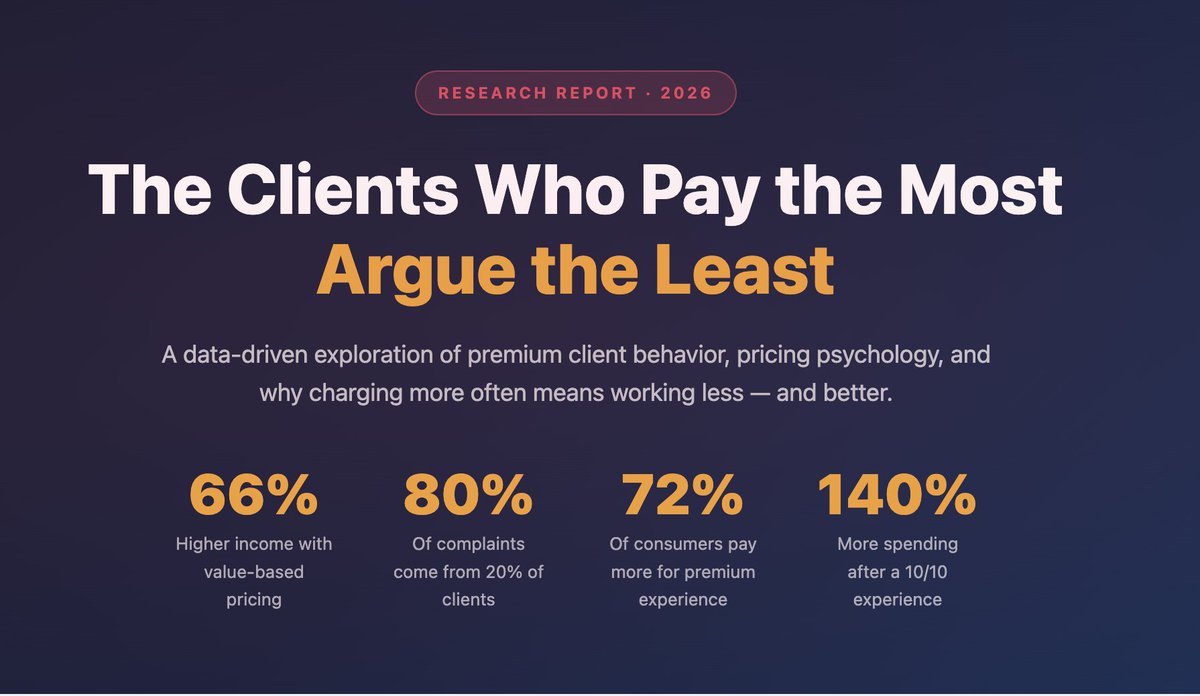
The clients who pay the most often argue the least.
Not because they do not care.
Because they understand value.
Low-budget clients often buy effort.
High-value clients buy outcomes.
That difference changes everything.
A low-budget client may ask:
How many hours will this take?
Can you make it cheaper?
Can you add one more thing?
Why does this cost so much?
A high-value client asks:
Can this solve the problem?
How soon can we start?
What do you need from us?
What result should we expect?
The more painful the problem, the less they debate the price.
The more obvious the value, the easier the sale.
This is why positioning matters.
If your offer sounds like a task, people compare prices.
If your offer solves an expensive problem, people compare outcomes.
The goal is not to charge more for the same thing.
The goal is to solve a problem that is worth more.
Better clients do not come from better persuasion.
They come from better positioning.
#BusinessStrategy #Consulting #Positioning #Sales #Entrepreneurship
Great founders talk to future customers before they have a product.
Not after.
Not when the landing page is finished.
Not when the MVP is already built.
Before.
Because customer conversations are not a marketing task.
They are product research.
The goal is not to convince someone your idea is good.
The goal is to find out whether the pain is real.
Before building, great founders ask:
What problem keeps coming back?
How are people solving it today?
What is frustrating about the current solution?
Who feels the pain most often?
Who has already paid to solve it?
What would make this urgent?
A lot of startup failure comes from building too early.
The founder falls in love with the product before falling in love with the problem.
But the best companies are built differently.
They start with conversations.
Then patterns.
Then pain.
Then product.
Your first customers are often hidden inside your first 100 conversations.
#Founders #Startups #CustomerDiscovery #MVP #ProductMarketFit
The gap that kills creators is not talent.
It is consistency between attention and trust.
A creator can get views and still struggle to make money.
A post can go viral and still bring no real opportunities.
Why?
Because attention is not the same as positioning.
Many creators are good at making people stop scrolling.
But they are not clear enough about:
What they do
Who they help
What problem they solve
Why they are credible
What someone should do next
That gap kills growth.
It creates an audience that watches but does not buy.
They like your content.
They agree with your ideas.
They may even comment often.
But they still do not understand your offer.
Creators do not just need more content.
They need a sharper bridge between content and business.
Every post should help people understand one of three things:
What you believe.
What you know.
How you can help.
Views create reach.
Clarity creates revenue.
#CreatorEconomy #PersonalBranding #ContentStrategy #LinkedInGrowth #Marketing
These 10 Niches Are Bleeding Money
Some niches do not need more content.
They need better visibility.
A lot of businesses are losing money because their website does not explain clearly what they do, their competitors are easier to find, and AI tools cannot confidently recommend them.
Here are 10 niches quietly bleeding money right now:
➡️Local service businesses
➡️B2B SaaS companies
➡️Law firms
➡️Real estate agencies
➡️Clinics and wellness providers
➡️Coaches and consultants
➡️Marketing agencies
➡️Home improvement companies
➡️Accounting and finance firms
➡️Online education businesses
The problem is not always the offer.
The problem is often discoverability.
People are searching on Google.
They are asking ChatGPT.
They are checking Reddit, LinkedIn, TikTok, YouTube, Instagram, and Google Maps.
But many businesses still only optimize for one surface.
That is expensive.
Because invisibility does not look like a broken funnel.
It looks like silence.
No leads.
No calls.
No booked meetings.
No clear reason why competitors are winning.
The next wave of growth will not only come from better ads.
It will come from being easier to find, easier to understand, and easier to trust.
#SEO #AEO #MarketingStrategy #SmallBusiness #LeadGeneration
Users are usually right about their problems.
But they are often wrong about the solution.
That is one of the biggest traps founders fall into.
A user says:
“Can you add this feature?”
But what they really mean is:
“I am struggling to get this outcome.”
The feature request is not always the answer.
The pain behind the request is the real signal.
Great founders do not blindly build what users ask for.
They ask better questions:
Why do you need this?
What are you trying to accomplish?
How are you solving this today?
What happens if this does not get fixed?
How much time or money is this costing you?
The user gives you the problem.
Your job is to understand it deeply enough to build the right solution.
Bad founders collect feature requests.
Good founders diagnose pain.
Great founders turn messy user problems into simple, valuable products.
#Startups #Founders #ProductDevelopment #CustomerDiscovery #SaaS
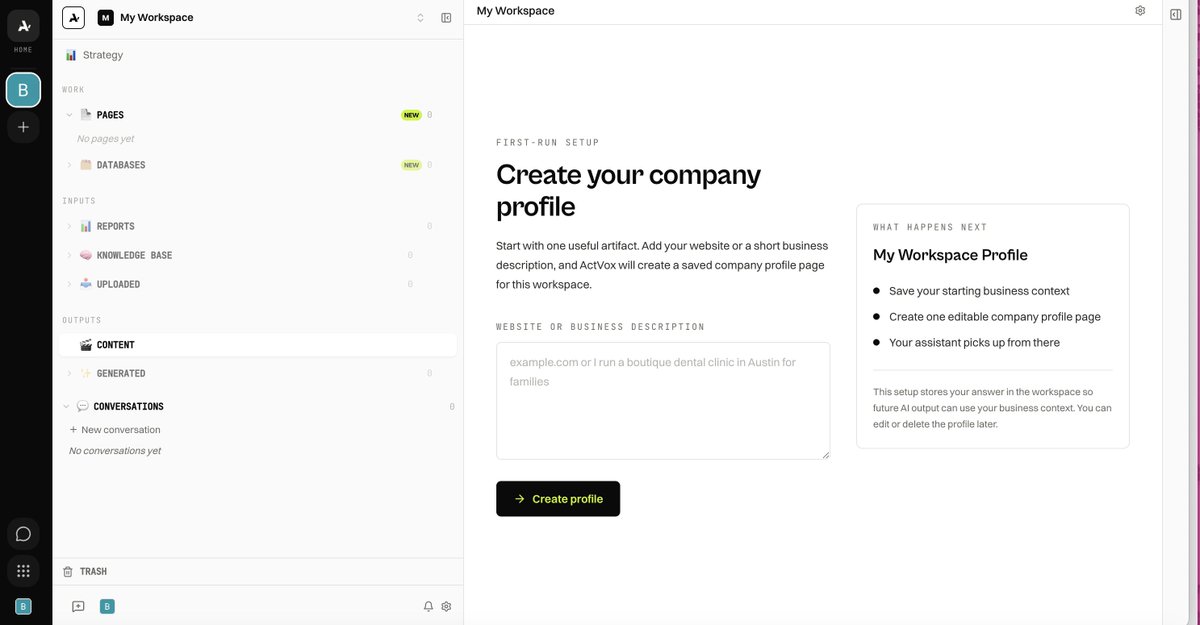
The workspace agent can now update a user’s business profile directly from conversation.
Instead of forcing users to complete long forms, the assistant can ask for missing details, save stated facts, update the profile page, and continue the setup loop until the profile is complete.
For example, if a user says, “We’re a wellness studio in Bali for expats and tourists,” the agent can save the industry, audience, and location, then ask the next useful question instead of losing the context.
Technically, this was supported by a new update_workspace_profile action with safe, additive profile updates, hash-guarded page refreshes, and tests around profile completion.
The result is a more natural onboarding experience where users describe their business in plain language and ActVox turns that into structured workspace context.
We see this problem every day, and that is why ActVox exists. Founders are building real products, but many of them get stuck because they do not know what to fix first, what content to create, which channel to focus on, or how to make people understand why their product matters.
@pcshipp Exactly. That is why ActVox helps founders who do not even know marketing. You do not need to know SEO, AEO, content strategy, competitor research, positioning, or what to post next. Founders should not have to become full-time marketers just to get their product seen.
Most businesses do content backwards.
They start with the question:
“What should we post?”
But that is not the first question.
The better question is:
“What does the market already need us to explain?”
That one question changes everything.
Because now content is not a guessing game.
It is not a performance.
It is not a random calendar filled with motivational posts, product updates, and repackaged advice.
It becomes evidence-based.
You look at the website and ask:
Is the business clear?
Are the services explained?
Are the buyer questions answered?
Are the pages structured well?
Are there trust signals?
Can AI systems understand what this company does?
Can a customer compare this business against alternatives?
You look at competitors and ask:
What are they saying that we are not?
What pages do they have that we are missing?
What proof are they showing?
What topics do they own?
Why would Google or an AI answer engine cite them instead of us?
You look at social and ask:
Is there a consistent point of view?
Does the brand show expertise?
Is the content native to the platform?
Are we building memory, or just publishing updates?
You look at content gaps and ask:
What questions are buyers asking before they buy?
What objections need to be handled?
What comparisons should exist?
What educational content would make the product easier to trust?
What content could help both humans and AI understand the brand better?
Now the content calendar writes itself differently.
You are no longer saying:
“Post 3 times this week.”
You are saying:
“Explain this missing concept.”
“Answer this buyer question.”
“Show this proof.”
“Create this comparison.”
“Clarify this service.”
“Turn this audit finding into a post.”
“Turn this competitor gap into a campaign.”
“Turn this FAQ into a search-ready page.”
That is a completely different level of marketing.
It is calmer.
Sharper.
More useful.
More strategic.
This is also where AI becomes genuinely helpful.
Not as a machine that pumps out generic content.
But as a system that helps connect research to execution.
That is the idea behind ActVox.
You create your organisation.
Add your brand name and logo.
Run a report on your website.
Save it to your workspace.
Build a knowledge base around your business.
Then use the report and knowledge base to create strategy, content ideas, and execution plans based on what is actually true about your brand.
That last part matters.
Based on what is actually true.
Not random prompts.
Not generic templates.
Not “write me 30 posts about marketing.”
Not content detached from your website, competitors, category, or audience.
The future of content is not more volume.
It is better diagnosis.
Better inputs.
Better strategy.
Better timing.
Better understanding of how people and AI systems discover, evaluate, and recommend brands.
The brands that win will not be the ones posting the most.
They will be the ones that are easiest to understand, easiest to trust, and easiest to recommend.
That starts with knowing where you actually stand.
Then building from there.
Most brands don't have a content problem.
They have an insight problem.
Publishing more won't fix unclear positioning, missing trust signals, or unanswered buyer questions.
Research first.
Create second.
Evidence → Strategy → Content → Results.
#Marketing#SEO#AEO#ActVox
The best marketers think like surfers.
They do not create the wave.
They study it.
They watch the timing.
They read the direction.
They understand the current.
They know when to paddle.
They know when to wait.
They know when a wave has already passed.
Most businesses do the opposite.
They create content from inside the building.
They talk about product updates nobody asked for.
They write blogs for keywords they barely understand.
They post generic advice because competitors are posting generic advice.
They chase every platform without knowing where their audience actually pays attention.
That is not surfing.
That is splashing.
The surfer mentality starts with humility.
The market is already moving.
Customers are already asking questions.
Competitors are already shaping the category.
AI answer engines are already deciding which brands are easy to recommend.
Search results are already rewarding certain topics.
Social platforms are already amplifying certain conversations.
Communities are already creating language around the problem.
Your job is not to invent demand from scratch.
Your job is to notice where demand is already forming — and position yourself to catch it.
That means asking better questions:
What are buyers searching before they know our category exists?
What questions do AI tools answer without mentioning us?
What competitors appear when people ask for recommendations?
What content themes are gaining momentum?
What objections keep showing up?
What problems are customers describing in their own words?
What platforms are shaping trust in our space?
What proof do people need before they believe us?
A surfer does not panic because the ocean is bigger than them.
They learn how to move with it.
That is how modern visibility works.
You cannot force Google to rank a weak page.
You cannot force ChatGPT to recommend a brand it cannot understand.
You cannot force customers to care about content that does not meet them where they are.
You cannot force trust with a clever hook.
But you can improve the signals.
You can make your business easier to understand.
You can answer the questions your buyers actually ask.
You can build pages competitors already have and you are missing.
You can add proof.
You can clarify your positioning.
You can publish content that catches existing demand instead of shouting into empty water.
That is strategy.
Not doing more.
Reading better.
The surfer mentality is especially important now because discovery is fragmented.
Your customers might find you through Google.
Or ChatGPT.
Or Perplexity.
Or LinkedIn.
Or TikTok.
Or Reddit.
Or YouTube.
Or a local map result.
Or a comparison post.
Or an AI-generated summary that mentions three competitors and leaves you out.
The wave is not in one place anymore.
So your visibility strategy cannot live in one channel either.
You need to understand the whole surface area.
That is what ActVox is designed to help with.
It reads the signals across your website, search presence, AI readiness, competitors, social footprint, and content gaps.
Then it helps you see where the waves are forming.
Because good marketing is not always about pushing harder.
Sometimes it is about paddling at the right moment, in the right direction, with the right message.