THIS IS A PURE F*CKING GOLDMINE
Anthropic just shared one of the best tricks for Claude Code.
The idea: let Opus 5.5 write the plan as a script, and let a swarm of cheaper agents run it.
Bigger jobs and way fewer Opus tokens, because the script holds the plan and Opus only sees the final answer.
You just launch Claude Code like this:
claude --model opus --effort ultracode
here's the split:
→ Opus 5.5 turns your task into a workflow script
→ Haiku 5.5 agents scan every file in parallel
→ Sonnet 5.5 agents patch each fix in its own isolated copy
→ you stop burning Opus context on a hundred agent transcripts
Opus only shows up at three moments:
→ writing the workflow before the run
→ reading the verified results after it
→ signing off before anything ships
Opus plans. Haiku scans. Sonnet ships.
JEV engineering is the same move one layer down: the forks that need no thinker (which file, which tool, retry or stop) go to JEV in milliseconds, and the big models only see the ones that split
the full tree
> Opus 5.5 runs the main session and writes the workflow
> scan audits every file on Haiku 5.5
> edit patches each fix on Sonnet 5.5 in an isolated copy
> verify cross-checks every finding on Sonnet 5.5
> Opus 5.5 reads only what survived verification
> JEV routes micro-forks in milliseconds
paste the tree and this prompt into Claude Code ↓
"Rebuild my Claude Code setup around this tree:
1. Run the main session on Opus 5.5 with ultracode on.
2. In every workflow, run read-only scan stages on Haiku 5.5 and edit stages on Sonnet 5.5, each edit in its own isolated copy.
3. Add one rule to CLAUDE.md: every finding gets an independent verifier agent before it's reported, and fix loops stop after two rounds with no progress.
4. Route fast deterministic forks (tool choice, path selection, retries) through JEV.
Show me every change as a diff first. No edits until I say go."
↳ https://t.co/qNrVlFCwC0
save it, it'll come in handy.
Holy shit.
Someone just leaked the Claude Code project template teams are quietly using.
This isn't prompting anymore.
This is AI engineering infrastructure. ⚡
The entire setup revolves around one file: CLAUDE.md
Every time Claude makes a mistake → you add a rule
Every time you repeat yourself → you add a workflow
Every time something breaks → you add a guardrail
Claude literally trains itself on your project.
And the structure is wild:
• CLAUDE.md → project memory & instructions
• skills/ → reusable AI workflows
• hooks/ → automated checks & guardrails
• docs/ → architecture decisions
• src/ → actual code modules
• tools/ → scripts + prompts
You're not chatting with AI anymore.
You're building an AI that knows your repo.
The craziest part?
You only configure this once.
After that Claude: – reviews code automatically
– refactors on command
– enforces architecture rules
– writes release notes
– runs workflows from skills
– remembers past mistakes
And it keeps getting smarter.
Most people:
open ChatGPT → write prompt → copy paste → repeat
This setup:
open terminal → run skill → code shipped
You're basically running AI teammates inside your repo.
This template is the difference between: • using Claude occasionally
• running Claude like infrastructure
Drop it in any project.
Your AI stops guessing — and starts operating
Best GitHub repos for Claude Code that will 10x your next project in 2026:
1. Claude Skills
https://t.co/uXnuMxF5nP…
2. Claude Code Plugins + Skills
https://t.co/1E2U1pdKqS…
3. Awesome Claude Skills
https://t.co/fI2eo68asG…
4. Awesome Claude Skills
https://t.co/DcFJ0JSAuq…
5. Repomix
https://t.co/0P2BDozt78…
6. Claude Session Restore
https://t.co/RHmnoRZBRb…
7. Awesome Claude Code Toolkit
https://t.co/Jr1EaIjjvD…
8. Awesome Claude Code
https://t.co/nvmUjCpkKU…
9. Claude Code Best Practice
https://t.co/UjMn5hlptd… ✅
10. Superpowers
https://t.co/v7kndLYZK0…
How to setup your Claude code project?
TL;DR
Most developers skip the setup and just start prompting. That's the mistake.
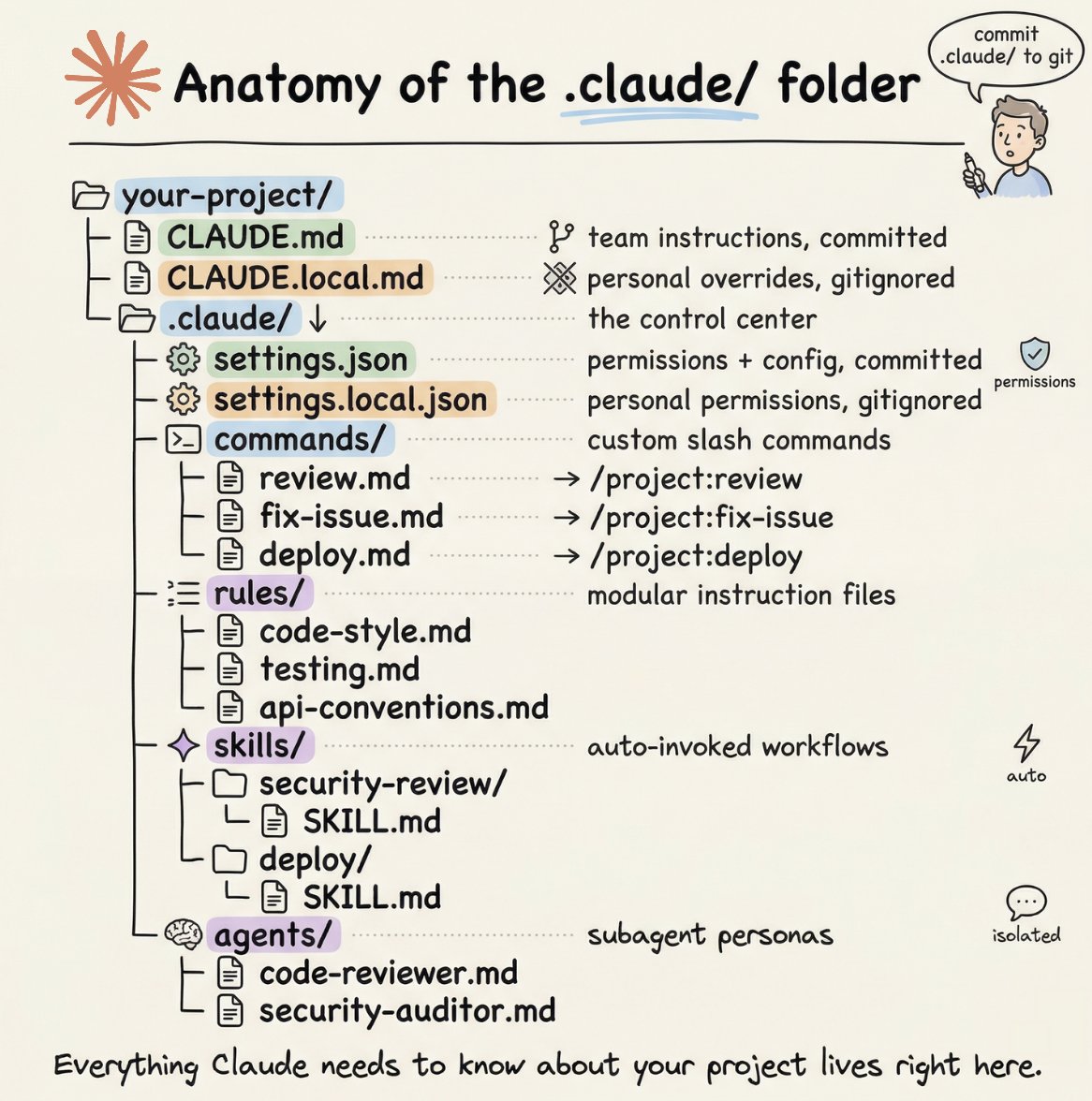
A proper Claude Code project lives inside a .𝗰𝗹𝗮𝘂𝗱𝗲/ folder. Start with 𝗖𝗟𝗔𝗨𝗗𝗘.𝗺𝗱 as Claude's instruction manual. Split it into a 𝗿𝘂𝗹𝗲𝘀/ folder as it grows. Add 𝗰𝗼𝗺𝗺𝗮𝗻𝗱𝘀/ for repeatable workflows, 𝘀𝗸𝗶𝗹𝗹𝘀/ for context-triggered automation, and 𝗮𝗴𝗲𝗻𝘁𝘀/ for isolated subagents. Lock down permissions in 𝘀𝗲𝘁𝘁𝗶𝗻𝗴𝘀.𝗷𝘀𝗼𝗻.
There are two .𝗰𝗹𝗮𝘂𝗱𝗲/ folders: one committed with your repo, one global at ~/.𝗰𝗹𝗮𝘂𝗱𝗲/ for personal preferences and auto-memory across projects.
The .𝗰𝗹𝗮𝘂𝗱𝗲/ folder is infrastructure. Treat it like one.
The article below is a complete guide to 𝗖𝗟𝗔𝗨𝗗𝗘.𝗺𝗱, custom commands, skills, agents, and permissions, and how to set them up properly.
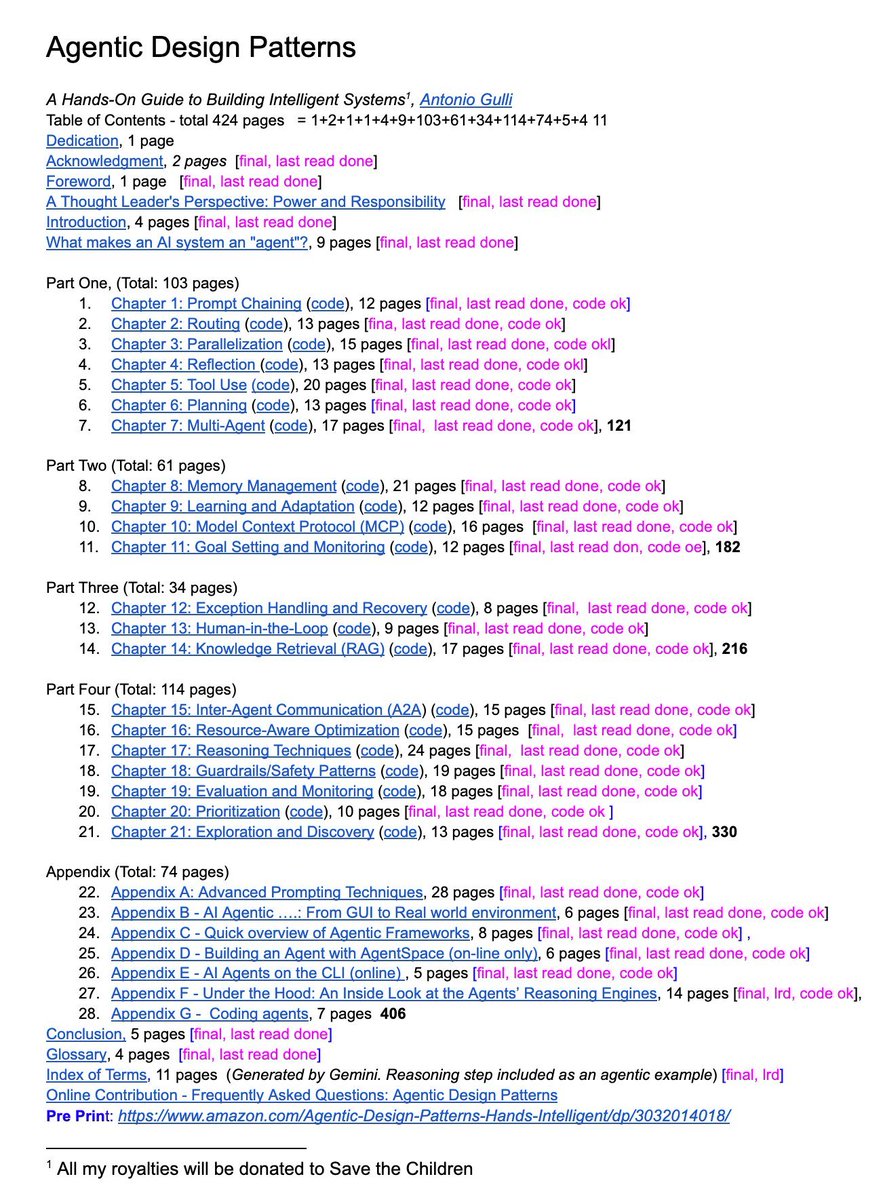
A senior Google engineer just dropped a 421-page doc called Agentic Design Patterns.
Every chapter is code-backed and covers the frontier of AI systems:
→ Prompt chaining, routing, memory
→ MCP & multi-agent coordination
→ Guardrails, reasoning, planning
This isn’t a blog post. It’s a curriculum. And it’s free.
BREAKING NEWS:
CARDANO HAS SHATTERED DECEMBER'S RESISTANCE 🤯🤯🤯
Lark Davis @thecryptolark says "#Cardano just did something big breaking December's resistance forming a golden cross. The last time this happened, $ADA pumped 236%.
Could we be on the verge of another explosive rally?
BREAKING NEWS:
CARDANO APPROACHES CRITICAL BREAKOUT ZONE 🤯🤯🤯
$ADA is now testing the 50-week EMA.
The last 2 times it crossed this line, it went up 212% and 128%.
If history repeats, we will be looking at $1.77 $ADA
Are you ready for the pump?
I’d vote for it if we got real spending cuts. But this bill is the largest debt increase in U.S. history—$5T.
That’s like giving your 16-year-old a credit card, watching them rack up $2K on booze and gambling, then raising their limit to $10K. Irresponsible.