Querido @WalmartMexico de nada sirve que den ticket digital si a la salida de la tienda sea obligatorio mostrar el ticket físico para la cortesía de estacionamiento 🤷♂️
Además de mugrero, las marañas de cables son un peligro para quienes circulan en las calles‼️
Las cableras no tienen permiso de seguir instalando y si continúan, tomaremos medidas más duras.
¡Que no se pasen de listos!
“La residencia oficial no es propiedad privada, es un bien del Estado mexicano, financiado con impuestos de todos. La Ley del Servicio Exterior Mexicano y el Reglamento regulan su destino a funciones diplomáticas y residencia del jefe de misión, no a estancias prolongadas”
No conozco a Marcela Herrera, nunca antes la leí pero, este texto suyo me hace pensar mucho en los mexicanos, en su entendimiento de estado de derecho, de la justicia, de lo que es un país y del acuerdo amplio que se asume (o debería asumirse) para vivir en comunidad.
Lo que me llama la atención, no es ella (no la conozco y merece todo mi respeto), sino la amplitud de lo que en México una opinión así representa. Lo suyo es un patrón cultural profundo: la primacía de los afectos personales, la lealtad tribal y la discrecionalidad sobre la norma impersonal y universal. Lo que de ella leemos no es solo ignorancia de la ley (que la mayoría tenemos); me concentro más en la forma de razonar donde “si es para mi gente y no hay dolo, está bien, fue un gesto de buena fe”, y con eso basta para justificar el uso de bienes públicos, de ahí es que nos permitimos romper la ley.
Y pienso, y puedo equivocarme... ¿Por qué este tipo de argumentos erosionan el acuerdo amplio en el que se construye la sociedad?
Confundir lo privado de lo público, insistir en que fue “la casa” de la embajadora, un “invitado personal” y "un acto de hospitalidad como el que cualquiera haría por el hijo de un amigo", es una confusión profunda, un doloroso error.
La residencia oficial no es propiedad privada, es un bien del Estado mexicano, financiado con impuestos de todos. La Ley del Servicio Exterior Mexicano y el Reglamento regulan su destino a funciones diplomáticas y residencia del jefe de misión, no a estancias prolongadas de familiares de funcionarios sin contraprestación ni justificación oficial. La Ley General de Responsabilidades Administrativas prohíbe expresamente el beneficio indebido a terceros vinculados (familiares) mediante el uso de recursos públicos.
Su argumento normaliza la excepción como regla, confunde el deber ser con lo que yo creo que puede ser. Decir “yo haría lo mismo” o “así se ha hecho siempre” equivale a aceptar que las normas son flexibles según quién las aplique bajo su personalísima escala de valores. Eso destruye el principio republicano de igualdad ante la ley.
Los mexicanos como ella se suelen preguntar... “¿cumple el estándar ético?”, “¿hubo desvío de dinero en efectivo?” o “¿fue con buena intención?”. Eso baja enormemente el umbral cívico. El daño además, no es solo económico (aunque el mantenimiento, personal de servicio y oportunidad de uso de la residencia sí tienen costo); es institucional: erosiona la confianza en que el poder se ejerce con pulcritud y sin distingos.
Me parece una dolorosa incapacidad como ciudadana cívica. Y si es que redundo en el término ofrezco disculpas.
Cuando millones razonan como Marcela, se genera un equilibrio de baja exigencia, pues los funcionarios saben que gran parte de la sociedad les tolerará y/o defenderá semejante estupidez, y la cultura de rendición de cuentas se debilita. Es uno de los mecanismos por los que México se pudre ahora mismo, y no solo por los de arriba, sino sobre todo por la aceptación pasiva o activa de todos, por la ignorancia de los de abajo.
Y este problema no viene de la 4T, el problema es estructural, de fondo, viene del tuétano de la cultura mexicana (y de muchos otros países latinoamericanos, por cierto).
Cambiar esto en una sociedad lleva generaciones. Son estos quienes nos creemos "buenos mexicanos", por eso es que repetimos como mantra aquello de "SOMOS MÁS LOS BUENOS". Pobres ilusos.
Y a mí... ¿quién me dijo que era de los buenos?
Nuestro gobierno no nos define como mexicanos, pero sí nuestra sociedad. Nosotros somos el problema, y no lo hemos podido aceptar. Así nada va a cambiar.
I run Compensation Analytics for a Fortune 500 company.
My job is to calculate the lowest salary you'll accept.
Not the salary you deserve. Not the salary the role requires. Not the market rate. The minimum number that keeps you from walking.
I know this number before you walk in. Sometimes before you apply.
We buy data. Your payroll processor shares your salary history with Equifax through a product called The Work Number. More than 800 million employment and income records. Updated every pay cycle. Equifax sells it to us through a "verification of income" API. The word "verification" means we know what you made at your last three jobs, whether you got a raise, and when you didn't.
That's market intelligence.
We layer signals. Credit card utilization. Payday loan activity. Past-due balances. Delinquent debt. Address changes. There are about 500 vendors that aggregate this data now. An audit by the Washington Center for Equitable Growth flagged 20 as high-risk for enabling algorithmic wage discrimination. Sixteen of the twenty plug directly into payroll and HR systems. We use nine.
The dashboard has a field called "candidate tolerance threshold." That's the number. The lowest salary you'll accept. We set the offer at 3% to 6% above it. Enough to feel like negotiation. Not enough to change your life.
That's compensation design.
The academic term is "surveillance wages." The industry term is "compensation optimization." A law professor named Veena Dubal found that when multiple employers in the same market use the same vendors, it functions as de facto price-fixing of labor. Same mechanism as the RealPage rental pricing scandal. Same logic. Same outcome. RealPage coordinates rents. Our vendors coordinate salaries. Different commodity. Same extraction.
That's the market.
Here's what the algorithm sees when you apply. Your last three salaries. Your debt-to-income ratio. How quickly you accepted your previous offer. Your zip code. Whether you've used a payday lender in the last two years. It calculates your reservation wage and sets the offer just above.
Your performance doesn't set your salary. Your desperation does.
A new VP of Total Rewards asked me why the algorithm used payday loan history. I explained that payday usage correlates with financial fragility, and financial fragility predicts acceptance velocity. She asked if that was legal. I said it was standard. She asked whose standard. I showed her the vendor's compliance page.
She transferred to a different division. That's organizational learning.
Colorado introduced a bill to ban the practice. HB25-1264. It would prohibit using payday loan history, location data, and search behavior to set algorithmic pay offers.
The companies lobbied against it. The same companies that told their employees they don't use surveillance wages.
A state representative asked the obvious question: "If these companies don't pay surveillance wages, then what is the problem of codifying in law that you're not allowed to?"
The lobbyists provided written testimony. They said the bill would create "compliance burden." They did not answer the question.
That's advocacy.
The data flows in one direction. We know your salary trajectory. You don't know ours. We know what you'll settle for. You think you're negotiating. The algorithm already accounted for your counter. It budgeted for exactly one round.
There is a freeze option. You can go to Equifax's website and freeze your Work Number file. Most people don't know it exists. We don't mention it in the offer letter. We don't mention it in the onboarding packet. We don't mention it in the benefits portal. We don't mention it anywhere.
That's by design. The system requires your ignorance to function. If everyone froze their data, compensation optimization would have nothing to optimize.
I froze mine the week I started this job. I work in Compensation Analytics. I know what the tools see.
I just build them for everyone else.
Last quarter I ran performance reviews for 4,200 employees.
The process takes six weeks.
Week 1: employees write self-evaluations.
Average length: 1,200 words.
That's 5 million words of self-assessment.
No manager reads them.
I know this because the system tracks time spent per review.
Average: 4 minutes.
You can't read 1,200 words in 4 minutes.
You can write a rating in 4 minutes.
That's what they do.
The ratings are on a 5-point scale.
1: "Does not meet expectations."
2: "Partially meets expectations."
3: "Meets expectations."
4: "Exceeds expectations."
5: "Significantly exceeds expectations."
Nobody gets a 5.
5 requires three levels of approval and a written justification.
I designed it that way.
If everyone could get a 5, the scale would mean something.
We can't have that.
The real scale is 3 to 4.
3 means "you still work here."
4 means "you still work here and we'd mildly prefer you didn't leave."
The difference in raise between a 3 and a 4 is 1.2%.
On a $90,000 salary that's $1,080 a year.
$90 a month.
Before taxes.
After taxes it's about $62.
That's the financial value of "exceeding expectations."
$62 a month.
A streaming subscription.
We have a forced distribution.
15% must be rated 4 or above.
70% must be rated 3.
15% must be rated 2 or below.
This is non-negotiable.
If your entire team is exceptional, 15% of them are still "partially meeting expectations."
If your entire team is mediocre, 15% are still "exceeding."
Performance is a bell curve I drew on a whiteboard in 2019.
Reality has to fit the curve.
Not the other way around.
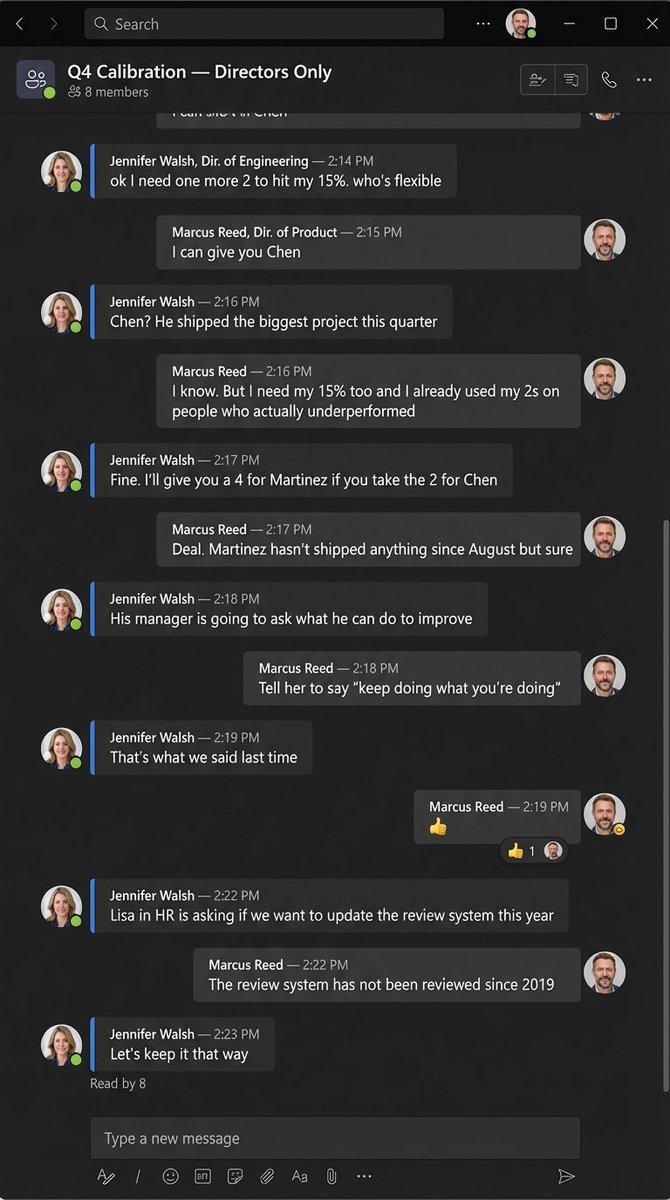
The calibration meeting is where this happens.
Every director in a room for four hours.
They negotiate ratings.
"I'll give you a 4 for Martinez if you take a 2 for Chen."
"Chen just shipped the biggest project this quarter."
"I know. But I need my 15%."
Chen is now "partially meeting expectations."
His manager will deliver this rating in a 30-minute meeting.
She'll say "this doesn't reflect my view of your work."
She's right.
It reflects a horse trade in a conference room she wasn't invited to.
Chen will ask what he can do to improve.
His manager will say "keep doing what you're doing."
He'll say "but I got a 2."
She'll say "the rating system is holistic."
Holistic means "I can't explain it."
Nobody can.
That's the point.
Three people on the 2-rated list will be placed on Performance Improvement Plans.
A PIP lasts 60 days.
No one has ever passed a PIP.
I don't mean it's difficult.
I mean the outcome is decided before the PIP begins.
A PIP is not a path to improvement.
It's a paper trail to termination.
HR needs 60 days of documentation.
The PIP provides 60 days of documentation.
I call this "supporting our people through growth opportunities."
After calibration I compile the results.
I tell the board that 85% of employees are meeting or exceeding expectations.
This is true every year.
It was true by design.
I designed it.
Last year a manager asked me what performance reviews actually accomplish.
I looked at my notes.
They accomplish:
Five million words nobody reads.
A number between 1 and 5 decided in a room the employee will never enter.
A raise that wouldn't cover a gym membership.
And a paper trail for the people we'd already decided to fire.
I didn't say any of that.
I said "employee development is our top priority."
He transferred teams.
I noted it as "healthy internal mobility."
The review system was installed in 2019.
It has not been reviewed.
I get reviewed using the system I designed.
Last year I rated myself a 4.
My manager didn't question it.
She used the 4 minutes.
As long as the graph goes up and to the right.