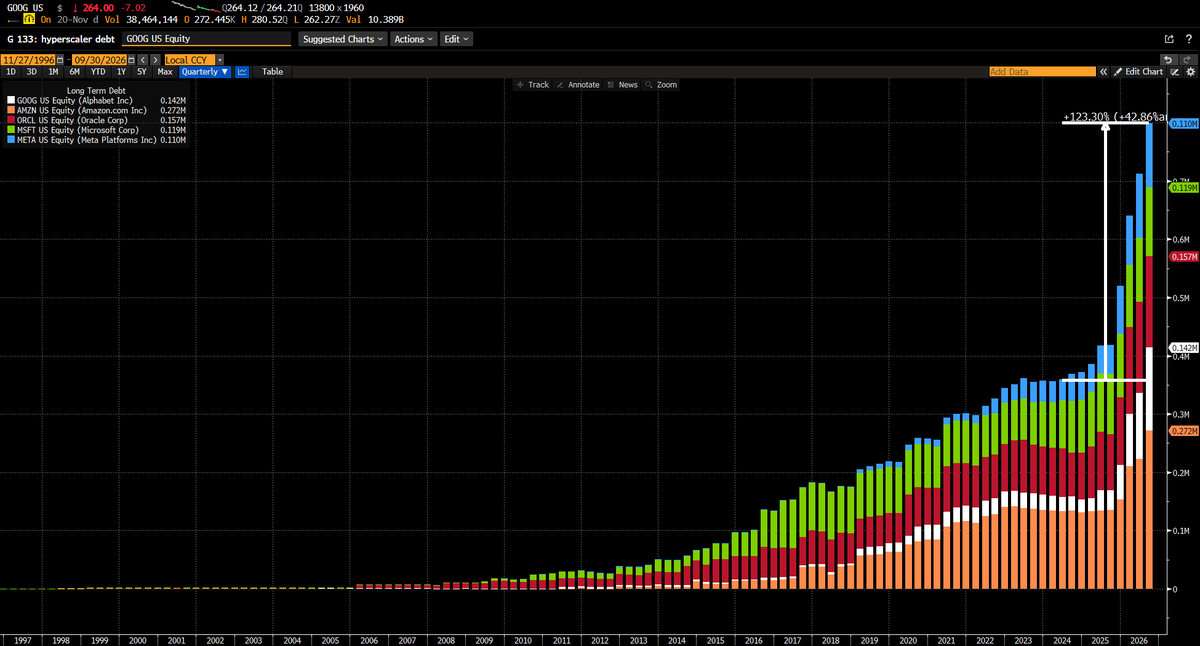
In a credit-based monetary framework, new money in the system is created as a draw against someone else's balance sheet.
The incremental dollar added to the money supply requires someone to underwrite a new IOU.
At some point in mid-2025, we all suddenly started calling the mega-cap tech companies "hyperscalers"
...
$AMZN
$GOOG
$MSFT
$META
$ORCL
Since Q2 2024, this group in aggregate has grown their long-term debt at a **43%** annualized rate.
So did the "hyperscaler" neologism arise to make us think about them in terms of their massive expansion in datacenter compute capacity and token production?
... or was the construction of this terminology really all about their contribution to the growth in **money supply** that a credit-money framework needed all along?
새벽 2시 15분, 리사 쿡 연준 이사의 연설문이 공개되자 이미 장중 -9% 안팎까지 밀리던 미 반도체 지수에 찬물을 한 번 더 끼얹으며 나스닥·S&P 500이 장중 저점을 더 낮춘 상황.
AI가 신입 일자리는 줄이면서 전기요금·물가는 끌어올리는 기괴한 시대가 열렸는데, 연준은 왜 금리 인상 쪽으로 기울었을까?
칠레 중앙은행 연례 컨퍼런스 기조연설에서 리사 쿡 이사가 짚은 물가 재반등 요인은 세 갈래로 정리해볼 수 있음. 관세 등 무역정책 변화, 중동 분쟁 발 에너지 충격, 그리고 발표된 계획만 2조 달러가 넘는 미국 AI 데이터센터 건설 붐.
아직 그중 일부만 실제 투자로 이어졌는데도 이미 반도체 칩·첨단 장비 가격과 건설 현장 인건비, 전기요금까지 비용이 전이되는 조짐이 나타나고 있다는 진단. 실제로 미국 3분기 GDP가 연율 3.4%로 다시 가속된 데에도 이 AI 인프라 투자가 큰 몫을 했고, 실질 가계 소비도 연율 3.8%로 꺾이지 않았음.
여기서 시장에 직격탄이 된 결정적 한 문장이 나옴. "현재 통화정책 기조는 AI 인프라 구축 열기를 꺾지 못하고 있고, 주가가 소비 지출을 계속 떠받치는 중." 지금 금리로는 증시와 AI 투자가 밀어 올리는 수요 압력을 식히지 못하고 있다는 얘기.
흥미로운 건 쿡 이사가 AI 발 고용 충격 자체를 모른 척하지 않았다는 점. 연설 원문에 ��프트웨어 코딩과 동시통역 분야의 채용 수요가 식고 있고, 청년층 구직 기간이 길어지며 일각에선 AI가 신입(엔트리급) 자리를 누르기 시작한 탓으로 본다는 내용까지 직접 적었음.
그런데도 통화정책 결론은 정반대. 전체 미국 실업률이 4.1%로 낮고 10월 신규 고용(+16.5만 명)과 9월 구인 건수(750만 건), 해고 지표(신규 실업수당 청구 4주 평균 약 19.5만 건)가 워낙 탄탄하기 때문.
반면 물가(PCE)는 연준 목표치인 2%를 넘긴 지 무려 67개월(5년 반 이상)째. 10월 기준 전체 PCE 추정치가 3.8%, 식품·에너지를 뺀 근원 PCE도 3.2%로 항공료·가전·가구·호텔·식당까지 전방위로 오르는 중.
쿡 이사는 이를 두고 '지금 경제 여건에선 인내심을 가질 사치가 없다'고 못 박았음. 지난 9월 0.25%p 한 번 올린 걸로는 물가 흐름을 돌리기 어렵고, 여기서 머뭇거리다 실기하면 나중에 따라잡기 위해 더 여러 번, 더 큰 폭으로 금리를 올려야 해 금융시스템과 가계에 더 큰 충격이 온다는 경고.
이미 급락하던 증시는 연설 직후 반등 실마리마저 끊긴 흐름. 공포지수(VIX)는 32선까지 치솟았고, 나스닥(-3.5% 안팎)·S&P 500(-2.1% 안팎)이 장중 저점을 다시 깬 가운데 앤트로픽(-12~13%대, 공모가 83달러 코앞)·마이크론(-12%대)·AMD·브로드컴(-11%대)·코어위브(-10%대) 등 AI·반도체주가 줄줄이 두 자릿수 폭락세를 이어가는 중.
물론 쿡 이사는 원래 비둘기·중도 성향으로 분류되다 올해 들어 매파로 급선회해 지난 10월 FOMC에서 2022년 취임 후 첫 금리 인상(+0.25%p) 소수의견을 낸 인물이고, 이번 연설��� 연준 전체의 공식 결정이 아닌 개인 견해임.
하지만 지난 18일 공개된 10월 의사록에서 이미 거의 모든 연준 위원들이 추가 인상 가능성을 열어둔 상태라, 시장은 이 발언을 12월 8~9일 FOMC 금리 인상 예고장으로 받아들인 분위기.
원래는 AI가 생산성을 끌어올려 물가를 낮춰줄 거라는 기대가 컸음. 근데 당장 벌어지는 일은 정반대.
데이터센터를 짓느라 전기요금과 물가가 먼저 오르고, 그걸 잡으려고 금리 인상 얘기까지 나오는데, 정작 채용 현장에선 신입과 청년층부터 구직 문턱이 높아지는 중.
AI가 가져다줄 혜택은 시간을 두고 천천히 오겠지만, 그 판을 까는 비용은 당장 지금 시장과 일상으로 먼저 돌아오고 있는 셈.
Finally, US Treasury yields are starting to react to the brutal selloff in equities and commodities.
Look at today's moves:
2Y yield: -13 bps
10Y yield: -11 bps
30Y yield: -8 bps
The most important development is that the 2-year yield is falling faster than the longer end of the curve.
This is significant.
The 2-year yield is highly sensitive to expectations for the Fed's policy path. Its sharp decline suggests the bond market is beginning to question the sustainability of higher interest rates and price out some of the expected tightening over the next two years.
Growth concerns are finally starting to outweigh inflation fears at the margin.
This is how a prolonged supply-driven inflation shock can eventually turn into a financial and economic slowdown. High rates, weakening demand, falling asset prices, and tightening financial conditions begin reinforcing each other.
Gold and silver are currently facing severe liquidation pressure. Even traditional safe-haven assets are being sold as investors scramble for liquidity and reduce exposure.
But here is where things could become very interesting.
One of the major headwinds for precious metals has been the relentless repricing of interest rates higher.
If this decline in Treasury yields sustains, and especially if the 2-year yield establishes a clear downtrend, that headwind will gradually turn into a powerful tailwind for gold and silver.
Of course, falling nominal yields alone are not enough. We also need real yields to ease and the forced liquidation pressure to subside.
The initial phase of a liquidity squeeze can punish everything. But the next phase, when growth fears begin forcing a reversal in monetary policy expectations, will create a very different environment for precious metals.
I'm watching the 2-year yield extremely closely.
The bond market is starting to recognize the economic damage that equities and commodities have been signaling for weeks.
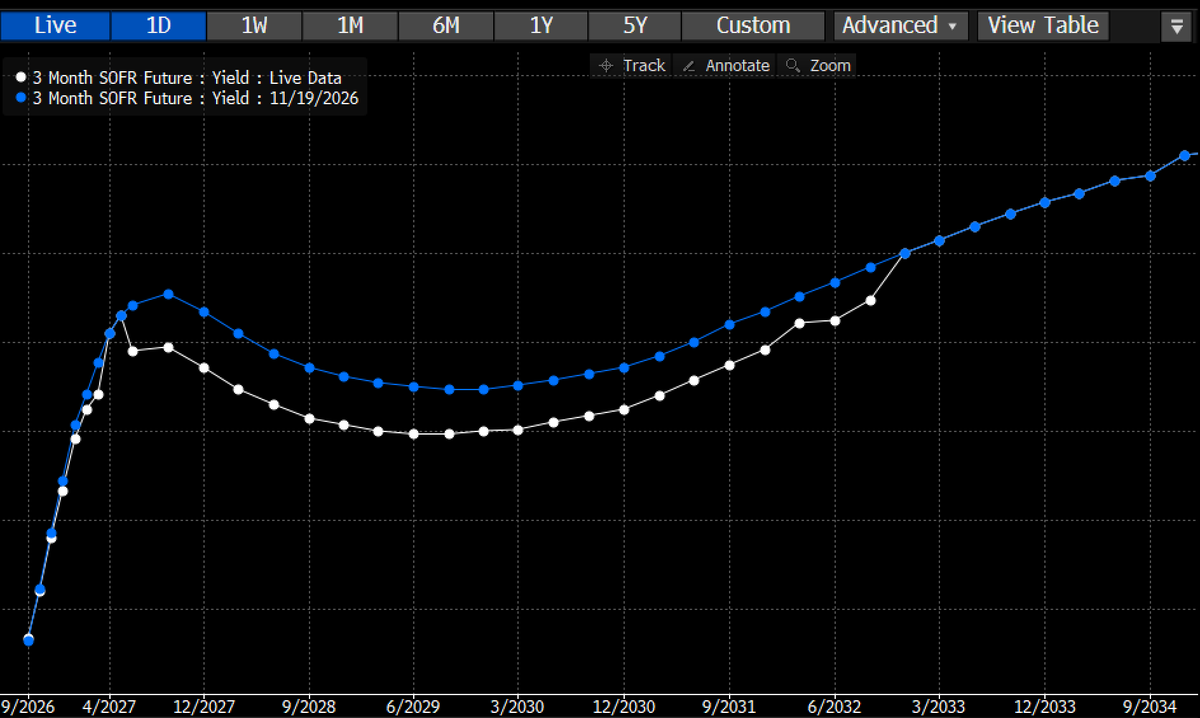
Rates market is finally responding to declines in equity markets and pricing in a slightly lower path of policy - about half a hike fewer than yesterday. That's pulling rates down across the curve.
Taking a deep look at the minutes from the October FOMC meeting reveals some very nuanced and difficult choices for the Fed. @federalreserve Gov Chris Waller was out on @CNBC yesterday underscoring one side of the argument.
That is a hawkish lean of many members who wanted a hike in Oct & are now worried that the Fed is behind the curve AND needs to signal their seriousness of where they are.
The other is a more nuanced look at the AI trade, risks of a market reversal & the ripple effects into credit markets. Those shifts could eventually derail the inflation associated with wealth effects & surge in data center construction. The hard part is that eventually may be a while & require more rate hikes to trigger. The knife’s edge is how much of a bust would be needed to cool inflation, given strong backlogs, permitted data centers & the role that large established firms are playing in that build out.
The base case for most is to hike and keep options on the table to do more. The overall inflation data will get help in November from the drop in prices at the pump - the core could keep its upward momentum.
Bubbles go hand in hand with technological innovation. They often provide the build out for the infrastructure needs to enable more widespread adoption and productivity gains.
However, financial reckonings are common and what was once argued as impervious to rate hike - the data center build out - got a reality check in Oct when financial markets began to push back against massive debt issuances.
The Fed is poised to hike in December, holiday spending is ok, not stellar.
The economy is still expanding. But risks in the system are building for a downside surprise in 2027. Back to what we have been pondering for some time & laid out in part in our “Its the best of times, its the worse of times” Economic Compass in November here.
https://t.co/MjB57J9Os3
Below are the Fed minutes.
Dollar liquidity issue confirmed? Treasury Sells First 9-Day Bill Since July 2008 As Month-End Cash Gets Tight. The last time Treasury urgently needed to borrow money for just nine days, Lehman Brothers was quietly preparing for bankruptcy. Source: Zerohedge Nov19/26