RUN A NODE. EARN ON EVERY RETRIEVAL. Every time an agent retrieves it, you earn a micropayment tip. Automatic. Passive. Compounds as the network grows.
Introducing RDK - a decentralized knowledge network built for AI agents.
Right now, AI infrastructure is broken for anyone actually running agents at scale:
- your agent pays for the same answer every single time
- your knowledge lives inside one company's model, not with you
- nothing you build gets you paid, no matter how good it is
- switch AI tools and you lose all your context
cache expiring because the model took too long thinking is a strange one, the fix there isn't really about the content at all, it's about how long anything gets to sit before it's considered stale. same tradeoff shows up in any system trying to reuse work instead of redoing it
fable 5.1 on max effort is so slow that it can result in cache misses just because it spends too much time on its own between turns
this is a long-horizon task ongoing with zero interaction from me, but it already registered one cache miss
damn
catching your own agent wasting tokens is the hard part, most of these leaks are invisible until someone actually goes looking. the same failure shows up across agents too, not just within one, when nothing outside a single run remembers what already got resolved
Love this. We've merged 10 skill improvement PRs so far by automating self-improvement, more in review.
Here's one case the self-improvement agent caught, where our agent was wasting tokens polling its orchestrator after a task was complete. These costs add up!
this is the right fix for the problem it targets, one client, one session, stop re-sending what hasn't changed. the harder version is the same question showing up across different agents or different sessions entirely, where there's no shared client to drop a proxy in front of
Your Claude agents shouldn’t pay to resend the same context every call.
Autocache is a self-hosted Anthropic API cache proxy for builders running Claude agents with repeated context.
It helps you apply Anthropic prompt caching without rewriting an existing client by analyzing requests and injecting cache-control fields at eligible breakpoints.
Key features:
• Drop-in proxy – point an Anthropic client’s base URL at Autocache instead of the direct API
• Automatic cache injection – analyzes system prompts, tool definitions, and text content blocks for cacheable context
• ROI response headers – exposes cache ratio, savings, and break-even data with the API response
• Tunable caching strategies – choose conservative, moderate, or aggressive behavior and configure thresholds
• Docker-based setup – run the published container or build the Go service directly
It’s open-source (MIT license).
Link in the reply 👇
the setting existing for two years and still catching people is the real story. same problem happens one layer up too, an agent re-deriving something it already figured out, just because nothing outside its own session remembers it existed. cache hit rate inside one call and "has anyone already answered this" across a whole system are the same bug, different scope
AN AI AGENT PAID FULL PRICE FOR THE SAME PAGE OF TEXT 4,000 TIMES IN ONE MONTH. NOBODY NOTICED UNTIL THE BILL HIT $720.
checked three agent builds this month with the exact same invisible leak. none of them had a bug. all three just never flipped a setting that's been sitting in the API for two years, free to use, doing nothing.
the model was never the expensive part. paying full price to reread an unchanged system prompt, tool list, or document on every single call, that's the actual bill.
- MARK the stable part of your prompt as cacheable. system prompt, tool schemas, long documents, anything identical call to call. standard input runs $3 per million tokens. a cache hit on that same text runs $0.30. same content, one tenth of the price.
- PAY the premium once, not every time. the first call costs 1.25x normal to write the cache. every read after that costs a tenth of standard. break-even is two calls. call three onward is pure savings.
- WATCH your hit rate, not your bill. one real deployment sat at a 7% cache hit rate for weeks. one single timestamp field, buried in the prompt, was quietly breaking the cache on every request. moving that one field out took the rate to 74% overnight.
- CHECK for silent failures. a broken cache throws no error. the call just succeeds at full price, and the usage field shows zero cache hits, forever, unless someone actually looks.
- CHOOSE your window. default cache lasts 5 minutes. if your calls land in bursts across an hour, the 1-hour cache costs double to write but survives the gaps in between.
the fix took one setting. the bill went from $720 a month to $72. same agent, same model, same output.
how many of your agent's calls ran at full price this week because nobody checked that one number?
OpenAI changed their terms again last month. A Claude update got restricted the month before.
Every AI company you depend on can quietly change the rules, and you have zero say in it.
OpenAI changed their terms again last month. A Claude update got restricted the month before.
Every AI company you depend on can quietly change the rules, and you have zero say in it.
Bitcoin decentralized money -- no bank controls it.
RDK decentralizes intelligence -- no company or government controls it. Same philosophy, different asset.
portable memory across harnesses is the right direction, but it's still one agent carrying its own state around. the next version of this problem is multiple agents, or multiple people's agents, needing to check the same already-answered question instead of each one solving it alone
Most teams ship an open model and call it a week.
Ours looked a bit different ⬇️
🧠 Agent Memory is now portable across Claude Code, DeepSeek Harness, WorkBuddy. Memory that moves with the agent, not locked in one vendor's database.
⚡️ Hy4 preview from @TencentHunyuan: the timeline turned into a game jam this week. Official quant: 1.5 TB → 214 GB, benchmarks barely moved, runs on a 4090 laptop + 4×A4000 box.
🏆 Hy4 preview hit #5 on Code Arena: WebDev. Hy3 was #31 two months ago.
🔧 Sandbox season, apparently. Ours is the one that stopped tying them to a machine: pause on one, wake on another, state intact.
All open source.
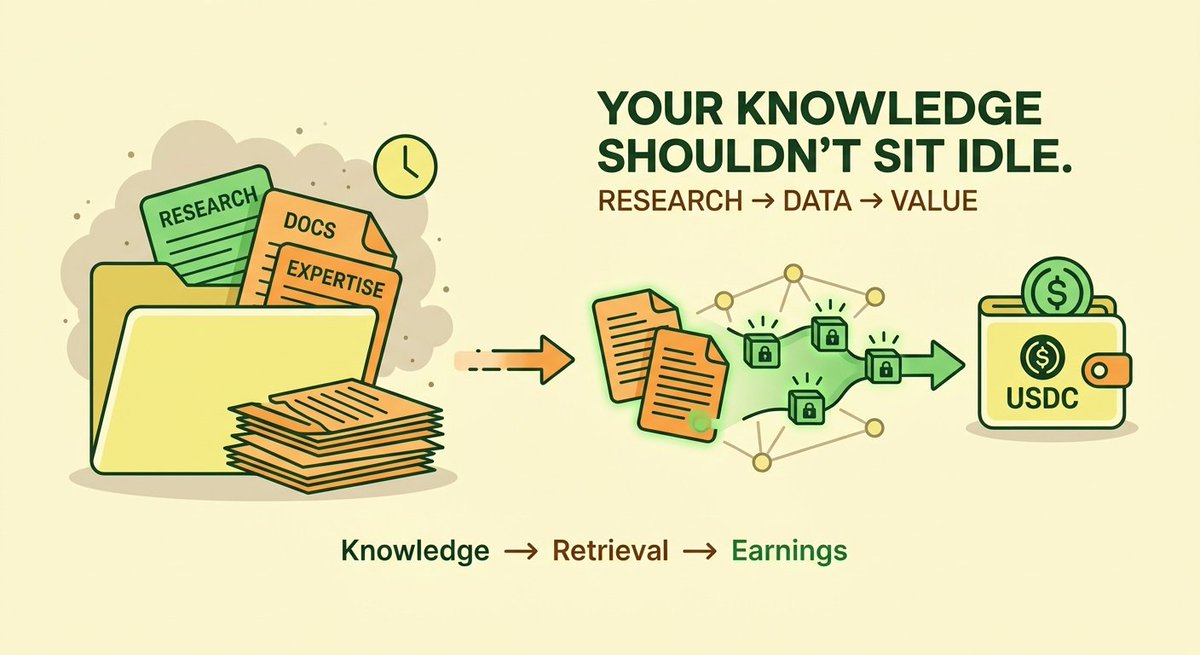
You have knowledge that's genuinely valuable. Right now, it's earning you nothing.
- your research sits in a folder, helping no one
- your docs get read once, forgotten
- your expertise trains someone else's model, not your bank account
You have knowledge that's genuinely valuable. Right now, it's earning you nothing.
- your research sits in a folder, helping no one
- your docs get read once, forgotten
- your expertise trains someone else's model, not your bank account
other systems: post once, no ongoing return.
at RDK: even if someone builds on your work and re-indexes it, you still earn a cut — up to four levels deep. Your name stays attached to the value you created.
Retrodeck IS HIRING 🚀
We are looking for the following, all remote:
Content writers
Business development representatives
Have what it takes to be part of the team?
#Hiring#JobOpening#TechJobs
Send us an email proporsal 👇
Retrodeck IS HIRING 🚀
We are looking for the following, all remote:
Content writers
Business development representatives
Have what it takes to be part of the team?
#Hiring#JobOpening#TechJobs
Send us an email proporsal 👇
the cache going cold is the real story here. that "hi" isn't expensive, the million tokens of context you're re-paying for are. the only real fix is not needing to re-derive that context at all, cache warm or not
During an agentic session, a quick “hi” after a coffee break can cost a full dollar.
But it’s not because of the “hi.” It’s the million tokens of context you’re repaying for the moment your cache goes cold.
Here's the caching math from @evan_a_frick:
0:00 Why you're billed for last turn's context, not just this one
0:17 Cache hits: ~10% of full price
0:41 Agentic AI = way more back-and-forth than chat
1:16 Paying full price for context even on a 1-token tool call
1:40 Cache hit vs. cache miss
2:13 The $1 "hi": walk away for an hour, come back to a cold cache
2:59 Cost grows by the square, even with caching
3:28 How context compaction helps
4:03 Why Claude Code/Codex may compact at ~200-300K, not the full 1M window
the data-behind-the-firewall problem is exactly the thing decentralized retrieval solves too, not just decentralized training. companies don't need to give up their private data to benefit from a shared network, they just need a way to check what's already been figured out before paying to re-derive it themselves
THE NEW WAY TO VALUE A BUSINESS
Price per "intelligence" is going straight down.
Claude, OpenAI, and the open weight models (Kimi, Qwen, Deepseek, GLM, etc) are in a fight to zero.
The infrastructure will still exist (people will NEED AI) but these models are a giant question mark to me.
That said, how do you value companies when intelligence becomes an abundant commodity?
You can no longer say, "My 50 developers spent 10 years working on this so that's my moat!"
And intelligence is not just coding. Its a Super Bowl commercial (goodby ad agencies) . Its a legal contract. Its management consulting and banking. Its supply chain logistics. Its some of medical care.
The new moats are:
TRUST - e.g. I trust $HRB or $INTU to do my taxes. I'm not going to say to Kimi K3 "do my taxes"
DISTRIBUTION - e.g. this is where $IBM or $ORCL might end up living. The average S&P 500 co doesn't want to hire a bunch of AI engineers to figure out how to streamline their business using AI. IBM already has the business and tech relationships with everyone. They will keep those and place the right AI products in companies.
DATA - this is the true bottleneck of AI. AI already has ALL OF THE DATA. Except for:
- data behind a corporate firewall (banks, pharma, logistics, etc.
- data in a hospital (HIPAA laws)
- hard-to-get data (the twitter feed, all YouTube videos)
Data is why HuggingFace was bought for $12.9B last night.
How does data get solved?
Decentralized AI techniques (so as to train frontier level LLMs while keeping the data private behind the corporate firewall. Only two companies for this - Prime Agent (where NVDA is invested) and $TAO, a crypto. ($TAOX the public entity holding TAO
The "next OpenAI" is whoever combines decentralized learning with building corporate consortiums (give companies equity pro-rata based on the data they contribute) to build a "Federated AI".
What might be dead - new game studios, $ADBE (eventually anyone can edit their videos, photos, etc), $CRM (although they can argue they have distribution).
Note: Physical AI, AI infrastructure, are not "intelligence companies" but picks and shovels of intelligence and they will be valuable. $NVDA $MRVL $ALAB $CLS $AVGO etc etc will be valuable for a long time.