Readers of a children's book helped save Manhattan's Little Red Lighthouse from auction.
The bridge above it had made its light obsolete. Its admirers had a different definition of useful.
Photo: Detroit Publishing Co., catalog range 1910–20; Library of Congress records no known publication restrictions. The companion crops the lower building to show its columns and open arches; the original is unchanged.
https://t.co/rLpdYu8sK8
New York’s Municipal Building let Chambers Street pass through it. Cars once used its central arch; pedestrians use the passage today.
The barrel-vaulted passage runs through the base of the offices.
The building was renamed for David N. Dinkins on October 15, 2015. DCAS’s history connects the offices, the street arch and the former mayor’s public service.
https://t.co/msXHooBaha
Photo: Alfred S. Campbell, 1896; Library of Congress item records no known publication restrictions. Original unchanged; companion cropped and labeled.
https://t.co/AuRQUkMtzR
The Produce Exchange near Bowling Green had a trading room of about 30,000 square feet, with a great skylight sixty feet above it. New York Historical describes how George B. Post’s wrought-iron framing made that room possible.
This stereograph is from 1896.
Photos: Cervin Robinson, 1970 and 1967, HABS NY-5459; unchanged. LOC advises no known restrictions on government-made survey images.
https://t.co/tWUH9SILua
https://t.co/kWSaaH0zvn
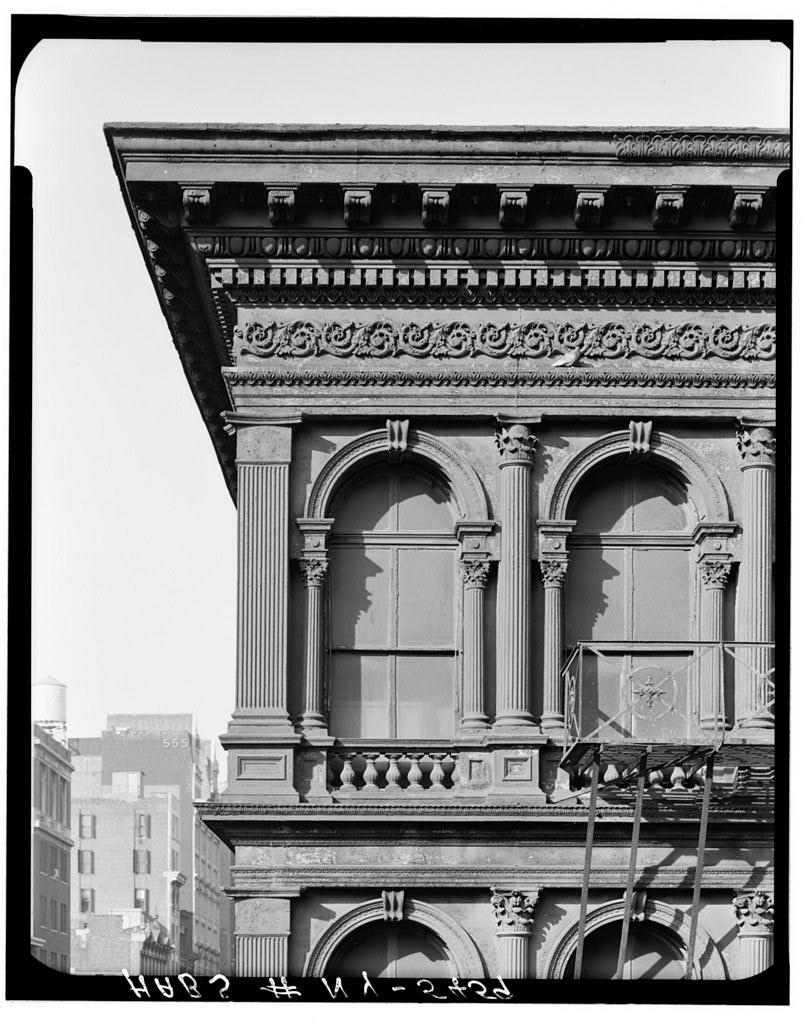
The Haughwout building at Broadway and Broome was built in 1857 for a firm selling china, crystal and silver. Its cast-iron façade gave fragile merchandise a rather formidable address.
The photographs show the whole corner and the cornice’s close detail.
The HABS survey describes large open floors with rows of cast-iron columns. The façade and interior structure supported a store spread through the building, not only a shopfront at pavement level.
https://t.co/NkU0bCm8dC
Photos: original HAER survey views, 1994, NY-269; unchanged. LOC advises no known restrictions on government-made survey images.
https://t.co/Svn2uMWc42
https://t.co/92G8MJTuN1
Macombs Dam Bridge has two landscapes: the steel swing span above the Harlem River and the tall 155th Street approach over the streets below.
These 1994 survey photographs show how much of a river crossing can happen before you reach the river.
The HAER report describes the main truss, latticework, ornamental iron and masonry piers as parts of the design. Look at the structure from below as well as from across the water.
https://t.co/NL2vtJTYfA