GLM-5.4 after a day of tests: it takes max effort just to match 5.3, and max is where it burns.
Voxel robot, one HTML file. Default was worse than 5.3 flash. Max matches 5.3- 5.9M tokents vs 5.1M, 2.3x the credits/ The clock build burned 7.3 more in 3 hours.
https://t.co/E0mIXXQDMk's bloh blames marathon thinking. zcode proved it: three runs, 20 minutes of thinking each, no code written
A Zhejiang team used OpenAI's October tensor construction for a deterministic subexponential discrete log algorithm: zero random bits, no GRH. Caveats: conditional on that construction, and subexponential isn't a break. A 256-bit curve still takes ~2^196 ops
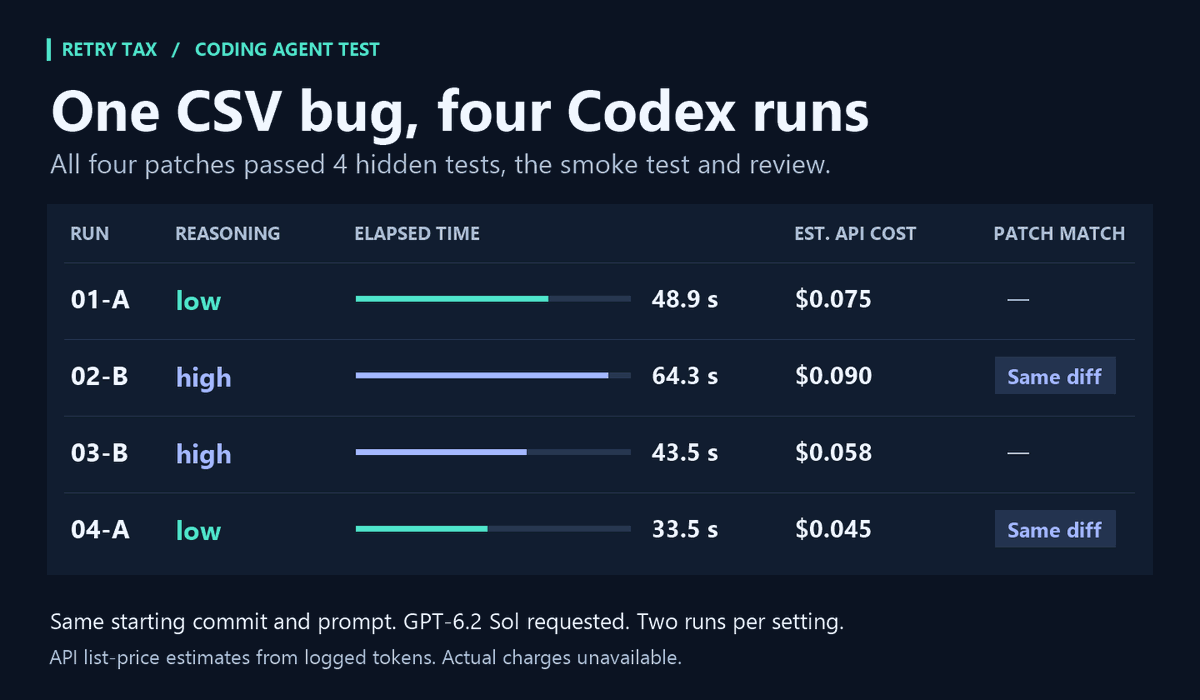
Two Codex runs produced the exact same patch for a CSV bug. Low reasoning took 33.5s. High took 64.3s.
I ran each setting twice with GPT-6.2 Sol selected. All four patches passed the hidden tests and review
@AdamHoltererer On private task shapes the gap shows up as retry tax before it shows up in scores: an agent that memorized public splits still solves the task, just on attempt 3 or 4. Pass@1 on fresh private sets would separate memorization from capability better than pass@k averages
'Agent patches are 2.3x bloated' misses the study. Traced unit by unit, the extra lines on SWE-bench are mostly tests and docs. 11 of 18 models leave less unneeded code than humans. The real finding: 11% of code units are unneeded, and 89% of those change behavior
Novita and StreamLake's DeepSeek routes carry ByteDance Ark fingerprints: Ark-format tool-call IDs, image fetches from Volcano Engine IPs, the same canned refusal text mid-route. One of them advertises zero data retention by default. Check the route, not the badge
DeepSeek 4.1 Flash 1017 (high), one HTML file: a brass skeleton clock on a workbench. Three hands move at exact clock rates, five gears turn on involute profiles, and every surface, from the walnut bench to the blurred garden outside the window, is generated procedurally at runtime
The 'Jev is secretly Qwen3.5' posts are outpacing the evidence. One forensic team matched Qwen on 348/415 tokenizer probes. Another tested 192 public tokenizers, matched zero. Same model, same week. Hide the token counts and 'what base model' stays a guess
Four hops took 8 minutes. Two took 9. GLM-5.3 Flash built this metro map in one run using 1,637,128 tokens. Close Central and Park together and the highlighted route disappears. Reopen Central and it comes back
@RealZhaiZilu Fair question. 292–584M is https://t.co/YSU5mMt1GS's weekly estimate at 95% cache hits. Less caching lowers the token budget for both models. Even with zero cache hits, Flash uses 1.15 credits per 10k input tokens during the promo, compared with 4.6 for 5.4
https://t.co/YSU5mMt1GS is charging half the usual credits for GLM-5.3-Flash through Dec 24. On Coding Plan Lite, https://t.co/YSU5mMt1GS estimates 292–584M tokens a week for Flash and 72–146M for GLM-5.4, assuming a 95% cache hit rate
@aplomb2@ben_burtenshaw Did you track total tokens per task for both setups, including the tasks they didn’t solve? I’m curious whether the drop in median turns also showed up in token usage
Numbers from the agent logs: default-effort robot run 5.2M tokens, max 5.9M, 5.3's reference run was 5.1M. The clock build was 84 glm-5.4 calls over 3 hours; after the 429 the tail ran on a free fallback model, which is the only reason it finished the same day
GLM-5.4 after a day of tests: it takes max effort just to match 5.3, and max is where it burns.
Voxel robot, one HTML file. Default was worse than 5.3 flash. Max matches 5.3- 5.9M tokents vs 5.1M, 2.3x the credits/ The clock build burned 7.3 more in 3 hours.
https://t.co/E0mIXXQDMk's bloh blames marathon thinking. zcode proved it: three runs, 20 minutes of thinking each, no code written
Same prompt, two GLMs: a voxel robot carrying a coin across a broken night bridge, one HTML file each.
Top is glm-5.4 - unreleased, but it already answers on https://t.co/E0mIXXQ5WM's coding endpoint. Bottom is glm-5.3.
The 5.4 run took 65 agent calls and 5.8M input tokens on max reasoning effort. About 19 minutes
https://t.co/E0mIXXQ5WM's coding endpoint already answers on glm-5.4. No release note anywhere, and it only showed up in the model list today. So I gave it one prompt: a skeleton clock, one HTML file, three.js, nothing else.
114 calls, 10.6M input tokens, 3 hours of tool loops to get the video below. Default thinking effort the whole way.
@ChainClearity Same here. Audited my own logs after that email: nothing sensitive in the prompts, nothing to rotate. Still, the ZDR label quietly disappeared from those endpoints afterwards