¡Nuevo curso gratuito de Anthropic!
Agent Skills paso a paso y desde cero
✓ Crear una skill y buenas prácticas
✓ Diferencias con Tools y MCP
✓ Para Claude Code y Visual Studio Code
2 horas de contenido y 10 vídeos
→ https://t.co/97caCLp9Tz
¡BRUTAL! Un entorno virtual de Linux en tu navegador.
✓ Sin instalaciones. Usa Web Assembly
✓ Trae Python, C, C++, Vim, cURL y más
✓ Con conexión a Internet para instalar lo que quieras
¡Pruébalo y alucina! → https://t.co/1nqUVWwRNf
¡Aprende Patrones de Diseño en JavaScript!
El mejor recurso gratuito:
✓ React, Vue, Angular, TypeScript...
✓ Libro de +400 páginas con ejemplos
✓ Ejercicios y explicaciones interactivas
→ https://t.co/9oMtJbMao4
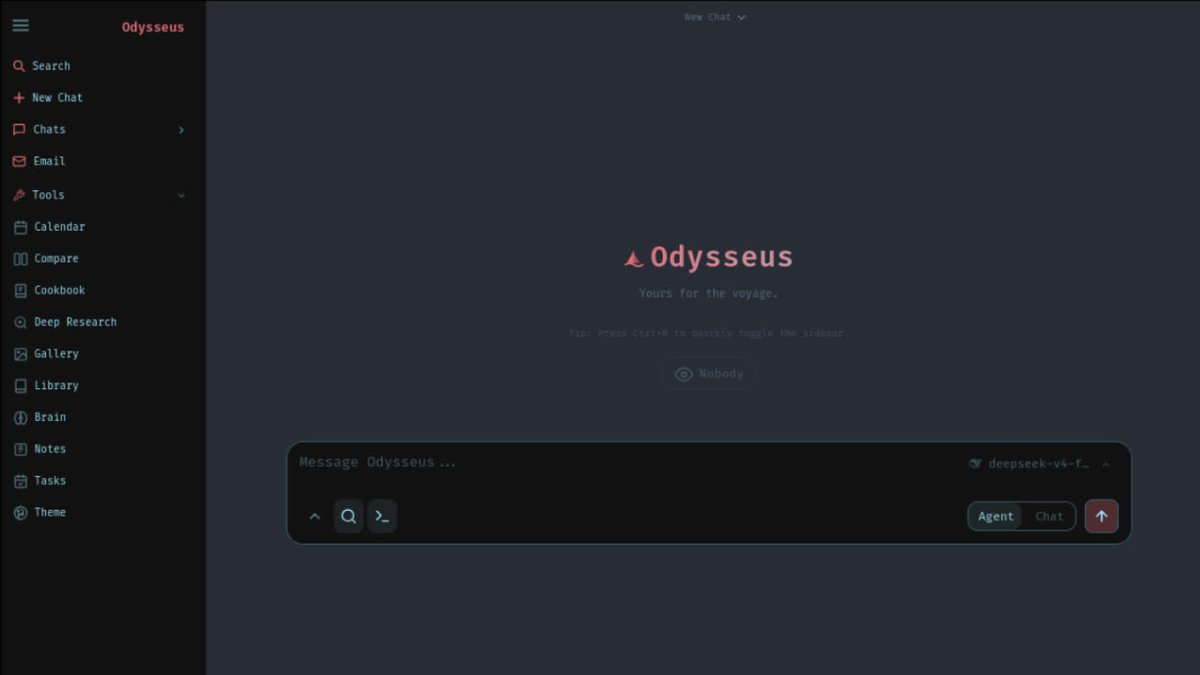
PewDiePie ha lanzado su propio ChatGPT gratis y de código abierto (y ya lleva casi 50K de estrellas en GitHub).
Una app de IA que se ejecuta en tu propia máquina con modelos locales de manera simple, privada y segura.
Es mucho más que un chat, ya que puedes utilizar agentes para realizar investigaciones, revisar tu email, soporta MCP, skills, memoria y diferentes tools para realizar tareas reales en tu máquina.
Para Windows, Mac y Linux.
→ https://t.co/E3XNLo8Wtw
Microsoft anuncia la app oficial de OpenClaw.
Permite al agente controlar tu Windows:
✓ Permisos integrados
✓ Control total desde la bandeja del sistema
✓ Seguro por defecto, se ejecuta en contenedores
Código abierto:
https://t.co/W2dyjpZ9RJ
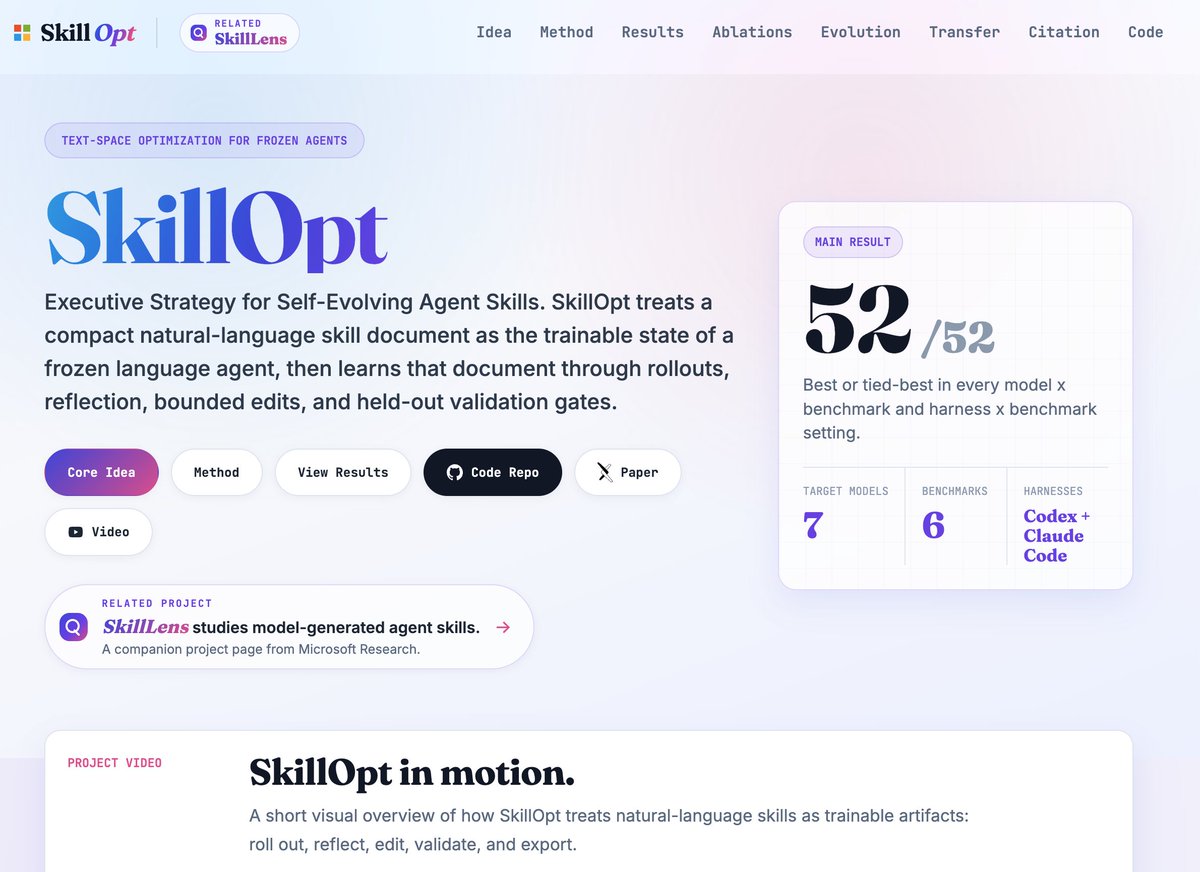
Microsoft acaba de desvelar SkillOpt. ¿Qué es?
Agent Skills que evolucionan en tiempo real
Aprenden de los errores, se reescriben solos y acepta cambios si pasan la validación.
Mejora modelos como GPT y Qwen hasta un ~20%.
¡NUEVO VÍDEO!
En este vídeo no solo vemos las herramientas de Engram y Gentle-ai, sino que también contamos con el testimonio de @guajilodev, un developer con más de 17 años de experiencia.
Nos explica cómo las herramientas de @G_Programming le han mejorado la vida en su flujo de trabajo.
Estoy aprendiendo. Como todos, supongo 🙃; así que no me toméis como referencia de nada:
— Ahora uso Codex (GPT 5.5). Vengo de Claude (Opus 4.7), pero no me caso con nadie: cambio sin compasión y me adapto a lo que mejor me funcione en cada momento. Todo cambia rápido.
— Trabajo con un portátil (MBP 13 "). Siempre me bastó, pero ahora necesito ver a la vez agentes, código y terminal. Así que me he hecho con una pantalla panorámica de 40 " y estoy encantado.
— Derivado de lo anterior, la IA me ha hecho programar menos en cafés y más en casa. También porque ahora a menudo dicto los prompts. Y hablar solo en un café… no lo veo. 😂
— Las veces que trabajo con Claude, dicto los prompts a ChatGPT. Encuentro la transcripción en castellano de OpenAI mucho mejor que la de Anthropic. Así que dicto a ChatGPT desde el móvil y —sin enviárselo— lo copio y pego en Claude en el escritorio.
— La terminal es tan importante como la herramienta de IA. Hace años que uso iTerm2. Estoy encantado, pero últimamente fantaseo con pasarme a Ghostty. Pero creo que está un poco verde aún. Hoy he leído sobre cmux (terminal para agentes de IA). No me da la vida… 😂
— No llego el primero a las fiestas. Cuando sale una herramienta o modelo nuevo, lo observo, pero no lo adopto. Hay tanto «hype» que prefiero ir sobre seguro. Salen muchas cosas que son flor de un día. Yo me adapto a los cambios, pero economizo mi adaptatividad. El enemigo es el FOMO. Ya tengo canas; priorizo el throughput al hype.
— No suelo tener más de un agente corriendo, a lo sumo dos, y no sé cómo lo hacéis los que tenéis muchos a la vez (como @steipete), incluso en varios proyectos simultáneos a la vez. A mí no me da la vida 😅. El cuello de botella ya no es mi capacidad de escribir código, sino mi capacidad de entenderlo.
— Esta semana controlé un agente desde el móvil mientras me zampaba una palmera de chocolate más grande que Brasil tomando el sol en un banco de la Gran Vía. Muy chulo como concepto, pero aún está algo verde. En dos telediarios será funcional, sin embargo.
— He comenzado a probar Claude Design. Tiene una pinta fantástica, pero aún estoy conformándome una opinión. A ver qué saca OpenAI (si es que no ha sacado algo ya…)
— Como la mayoría, ya no escribo código, aunque sigo sabiendo hacerlo y, sobre todo, entenderlo. No incorporo código generado por IA si no lo entiendo. No porque esté mal —suele estar bien— sino porque a menudo la IA tiende a la sobrecomplejidad. Entonces yo le apunto donde hay redundancia o barroco, y lo corrige.
— Hay mucha gente obsesionada con las skills para agentes. Yo no les veo tanto la gracia, pero seré yo.
— Minimalismo en todo. Con la IA es más fácil que nunca complicarse la vida: sobreingeniería, complejidad artificial, feature bloat, dependency hell… La máquina me da soluciones, pero yo estoy continuamente apuntándole simplificaciones. Si le dejo, en unas semanas el proyecto es inmantenible. Hay que ir con luces largas.
— Parte del tiempo que la IA me ahorra trato de dedicarlo a pensar, leer, aprender, pasear y hacer deporte.
— Adaptatividad. Llevo más de 30 años escribiendo código y ahora he dejado de escribirlo. La resistencia es fútil. Trato de abrazar el cambio. Y divertirme. 🥳
Pasopalabra a @Gsnchez, que es un máquina de todo esto. 😊
Today we reduced headcount by 22%. The business is the strongest it's ever been. So I think it's important to be direct about what I'm seeing and why.
First, I made this decision and I own it. I did it because the way to operate at the highest level of productivity is changing, and to win the future, ClickUp needs to change with it.
Second, this wasn't about cutting costs. Most savings from this change will flow directly back into the people who stay. We'll be introducing million-dollar salary bands. If you create outsized impact using AI, you'll be paid outside of traditional bands.
Most importantly, I have the deepest gratitude for those affected. We're doing this from a position of strength specifically so we can take care of people properly. Everyone affected receives a package aimed at honoring their contributions and easing the transition.
I only see two options: wait for this to play out gradually in the market or be honest about what I'm seeing and act proactively.
THE 100X ORGANIZATION
The primary change is that we're restructuring around what I call 100x org. The goal is 100x output. The roles required to build at the highest level are fundamentally different than they were a year ago.
Incremental improvements to existing systems won't get us there. We need new ones. That means creating enough disruption to rebuild rather than iterate on what's already broken.
The common narrative is that AI makes everyone more productive. It doesn't. Many of the workflows of today, if left unchanged, create bottlenecks in AI systems.
These roles will evolve. But waiting for that to happen naturally means falling behind now.
The 100x org is actually heavily dependent on people - infinitely more than today. This is only possible with 10x people that have embraced and adopted new ways of working.
THE BUILDERS, AGENT MANAGERS, AND FRONT-LINERS
— THE BUILDERS: 10X ENGINEERS
I don't think most companies have internalized what's actually happening with AI in engineering. The common narrative is that AI makes all engineers more productive. That may be true in isolation, but at an organization level - that is the farthest thing from reality.
Here's what we've validated recently at ClickUp: the great engineers, the ones who can orchestrate, architect, and review, are becoming 100x engineers. They're not writing code. They're directing agents that write code. The skill is judgment.
AI makes the best engineers wildly more productive, and everyone else using AI slows these engineers down.
Think about it - the bottlenecks are (1) orchestration - telling AI what to do, and (2) reviewing - what AI did. Everything is leapfrogged and no longer needed.
So who do you want orchestrating and reviewing code?
And how do you want your best engineers to spend their time?
If your best engineers are spending time reviewing other people's code, then this is inherently an inefficient bottleneck. These engineers can review their agent's code much faster than reviewing human code.
The new world is about enabling your 10x engineers to become 100x.
The wrong strategy is to push every engineer to use infinite tokens. Companies doing this are celebrating 500% more pull requests. But customer outcomes don't match the volume of code being generated.
I call this the great reckoning of AI coding, and every company will face this soon if not already.
More code is just another bottleneck to the best engineers, and ultimately to your company's impact as well.
— THE BUILDERS: 10X PRODUCT MANAGERS
Product management and design roles are merging.
Designers that have customer focus, become more like product managers.
And product managers that have intuition for UX become more like designers.
The bottleneck of user research is gone. It takes us just one mention of an agent to kickoff research and analyze results.
The bottleneck of product <> design iteration is also gone. The product builder iterates on their own, along with agents and skills that ensure alignment with quality and strategy.
Also controversial today - I believe that the wrong strategy is to have your PMs shipping code - that just introduces another bottleneck that the best engineers will waste their time on.
To be clear, PMs should be coding but they should do this in a playground to iterate, validate, and scope. That code should not go to production.
Everything outside of managing systems, orchestrating AI, and reviewing output becomes a bottleneck.
That's why the other roles that are critical along with these are the systems managers (to reduce bottlenecks) along with a bottleneck you can't replace - customer meeting time.
— THE SYSTEM MANAGERS
Ironically, the people that automate their jobs with AI will always have a job. They become owners of the AI systems - agent managers. We have many examples of these people at ClickUp.
The underlying systems in which we operate are absolutely critical to get right. I think most companies are delusional to think they can iterate on existing systems and compete in this new world.
You must create enough disruption so that old systems are deprecated entirely. If there's any definition for 'AI native' that's what it is.
— THE FRONT-LINERS
In a world that will become saturated with AI communication, the human touch will matter more than anything to customers.
This is a bottleneck that you shouldn't replace - even when agents are high enough quality to do video meetings.
One-on-one meeting time with customers is something that shouldn't be automated. The systems around the meetings should be - so that front-liners spend nearly 100% of their time with customers.
REWARDING 100X IMPACT
In a world where companies are able to do so much more with less, where does that excess money go?
In our case, much of the savings in this new operating model will flow directly back to those that enabled it.
We must reward people that create productivity accordingly. This aligns incentives on both sides. Plus, in a world where your best people create 100x impact, you can't afford to lose them.
You should aim to retain these employees for decades. The context they have and their ability to efficiently orchestrate and review will be nearly impossible to replace.
Compensation bands of today should be thrown out the door. We're introducing $1 million cash/year salary bands with a path available to nearly everyone in the company if they produce 100x impact by creating or managing AI systems.
THE FUTURE
Nearly every company will make changes like these. The ones that do it proactively will define what comes next.
The future is not fewer people. It's different work, new roles, and better rewards for those who embrace it. We're already seeing entirely new roles emerge, like Agent Managers, that didn't exist a year ago.
ClickUp is positioning to lead this shift, not just internally, but for our customers too. I've never been more certain about where we're headed.
Veo mucha gente de negocio diciendo que los tests ahora con la IA son fundamentales
Spoiler: esto ya era así
Para entenderlo, solo necesitaban un desarrollador psicópata sin miedo a romper lo que funciona y que trajera todos los problemas de golpe
Ese psicópata es la IA
🧵 👇
La mejor forma de entender un Agente de IA es pensar en un loop.
1) El agente percibe el contexto (conversación, memoria, archivos, estado actual)
2) El modelo decide qué hacer (razona y elige el próximo paso)
3) Usa una tool (leer archivos, buscar en web, correr comandos, llamar APIs)
4) Observa el resultado (analiza qué pasó después de ejecutar la acción)
5) Y vuelve a empezar el proceso hasta llegar al objetivo.
Para que eso funcione, aparecen varias piezas importantes:
• Brain: el LLM que piensa y toma decisiones
• Tools: las capacidades para interactuar con sistemas externos
• Memory: el contexto que guarda entre pasos o sesiones
• Planning: la división de tareas complejas en pasos más chicos
• Guardrails: límites y validaciones para mantener control
Cuando entendés este loop, entendés por qué los agentes pueden programar, investigar, automatizar tareas o resolver problemas complejos.
Son sistemas que usan un LLM como cerebro y van iterando sobre un problema hasta cumplir un objetivo.
🚨 Google acaba de liberar sus skills oficiales para agentes de IA.
Ha publicado 13 skills compatibles con Claude Code, Cursor, Copilot y otros agentes.
Permiten que los agentes puedan ejecutar tareas avanzadas y automatizar flujos de trabajo complejos.
Es gratis y open-source 👇
¡Nuevo cliente para bases de datos modernas!
Con IA y MCP integrados, extensible con plugins.
✓ Soporta PostgreSQL, MariaDB, MySQL y SQLite
✓ Para macOS, Windows y Linux
✓ Traducido al español
De código abierto y gratuito:
https://t.co/OZqcpDklfd
🔌 llmfit
Comando de terminal para analizar que modelos LLM puedes utilizar localmente en tu sistema, sus características y que rendimiento tendrán...
👇 Link al repo abajo
Este repositorio es una joya. Te da todos los pasos e instrucciones para proteger y asegurar tu servidor Linux.
Perfecto por si tienes un servidor propio o VPS:
https://t.co/yJD2GnXFPj
¡Crea tu propio modelo de IA! Este repositorio contiene el código para desarrollar, pre-entrenar y ajustar un LLM como GPT desde cero:
https://t.co/wZxr7eheaH
Mi Top 7 en calidad/precio de IA para código:
⑦ Claude Code
⑥ Windsurf
⑤ MiniMax / Z / Kimi
④ Google Antigravity
③ Cursor
② OpenAI + Codex
① OpenCode Go
🚨 Hackerlar buna bayılacak.🔥
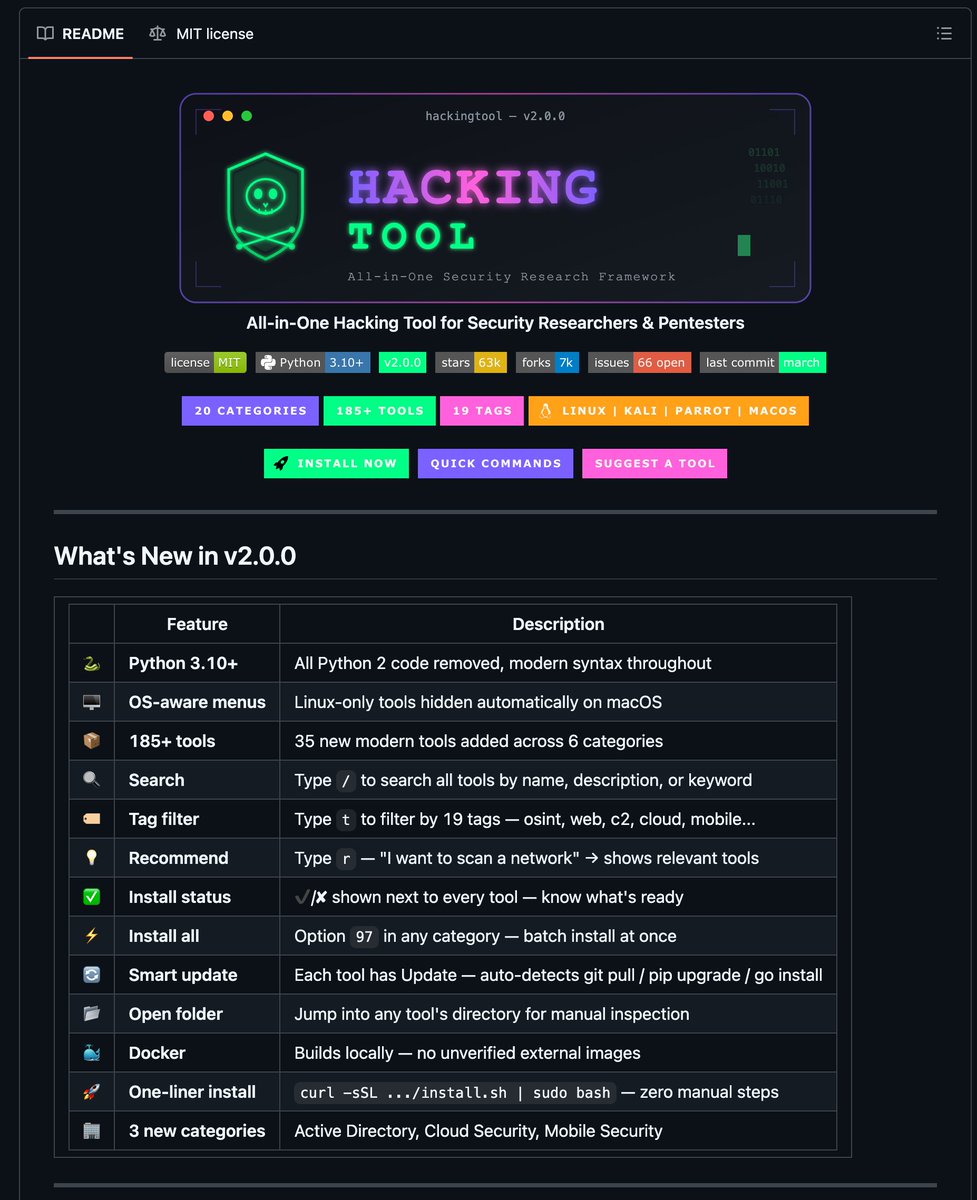
Birisi, tüm önemli sızma testi araçlarını tek bir CLI menüsünde bir araya getiren, her şeyi kapsayan bir hacking araç setini açık kaynaklı hale getirdi.
Bir kere kuruyorsunuz ve anonimlik, bilgi toplama, kablosuz saldırılar, parola kırma, web tarama, istismar çerçeveleri, yük oluşturma ve daha fazlası dahil olmak üzere her kategorideki araçlara anında erişim sağlıyorsunuz.
Adı HackingTool.
→ Tek bir menü, Tor, Anonsurf, Macchanger ve proxy zincirlerini saniyeler içinde başlatır
→ Tam ağ keşfi için Nmap, Dracnmap, RED HAWK ve ReconSpider içerir
→ Web istismarı için SQLMap, XSStrike, WPScan ve SecretFinder içerir
→ Parola saldırıları için John the Ripper, Hashbuster ve BruteX içerir
51 bin yıldız. Herhangi bir Linux dağıtımında çalışır.
%100 açık kaynak.