But since we here, lets see how the country has improved since the low IQ black government in South Africa took over:
National electricity connection:
Apartheid 1994- 36%
Post apartheid 2026- 87%
National paved road network:
Apartheid 1994-7000km
Post Apartheid 2026- 22 000km
National social grants recipients:
Apartheid 1994 - 2,5 million people
Post Apartheid 2026- 18+ million people
National government housing:
Apartheid 1994- N/A
Post Apartheid 2026- 3+ million houses
Economic growth GDP:
Apartheid 1994: $134 billion
Post Apartheid 2026: $400+ billion
National internet connectivity:
Apartheid 1994: 0
Post apartheid 2026: 78-80% (98% 4G coverage nationwide)
National Piped water access:
Apartheid 1994-60%
Post Apartheid 2026-88%
National Sanitation access:
Apartheid 1994-50%
Post Apartheid 2026-84%
With just 30 years this was done, what has your low IQ government done with 60 years besides go backwards?
History rarely repeats word for word, but it does repeat its warnings.
The moment a superpower starts confusing military reach with economic immunity, the clock starts ticking. Britain learned at Suez that force means less when markets, currency, and leverage turn against you.
Empires do not usually fall in one explosion. They narrow, slowly, under the weight of their own overconfidence.
Here's a global comparison of public social expenditure (pensions, health, benefits) as % of GDP, based on latest OECD/World Bank data (~2023-2024):
- France: 30.6%
- Austria: ~30%
- Italy: ~29%
- Germany: ~27%
- Japan: 19.3%
- UK: ~22%
- US: ~19%
- South Africa: ~10-12% (broader; grants ~3.5%)
- OECD avg: ~21%
Sources: OECD, World Bank. Definitions vary slightly by country.
The IMF’s leverage is not about diamonds specifically. It’s about precedent. If a small African country successfully buys back control of its most valuable resource without collapse, it undermines the core myth the IMF relies on, that African states are incapable of managing strategic assets without Western oversight.
That myth is essential because it justifies why ownership must remain external, while risk and austerity remain internal.
This is why conditionality exists. IMF funding is never neutral money. It’s disciplinary capital. It rewards compliance with a global order where extraction is externalized, profits are expatriated, and African states are reduced to regulators of someone else’s wealth...
Congratulations to @StandardBankZA on the official launch of its Cross-border Interbank Payment System (#CIPS), making it the 1st African bank to join CIPS as a direct participant! This milestone will enhance China-Africa cross-border payment efficiency, reduce transaction costs, and deepen economic cooperation.
South African Businesses to Pay Chinese Suppliers in Yuan Instead of the US Dollar
South African businesses will soon be able to pay Chinese suppliers directly in yuan as Standard Bank becomes the first African bank to integrate with China’s Cross-Border Interbank Payment System
As the US-South Africa relationship continues to worsen, South African importers, companies, and businesses can now settle transactions in yuan, reducing their reliance on the US dollar.
The integration was officially launched at an event hosted by the South African Reserve Bank.
South Africa seeks to strengthen its relationship with China and adopt the yuan into its economy.
China remains South Africa’s largest trading partner.
𝗦𝗼𝘂𝘁𝗵 𝗔𝗳𝗿𝗶𝗰𝗮 𝗯𝘆𝗽𝗮𝘀𝘀𝗲𝘀 𝘁𝗵𝗲 𝗨𝗦 𝗱𝗼𝗹𝗹𝗮𝗿 🇿🇦
Standard Bank has become the first African lender to 𝗳𝘂𝗹𝗹𝘆 𝗶𝗻𝘁𝗲𝗴𝗿𝗮𝘁𝗲 𝘄𝗶𝘁𝗵 𝗖𝗵𝗶𝗻𝗮’𝘀 𝗖𝗿𝗼𝘀𝘀-𝗕𝗼𝗿𝗱𝗲𝗿 𝗜𝗻𝘁𝗲𝗿𝗯𝗮𝗻𝗸 𝗣𝗮𝘆𝗺𝗲𝗻𝘁 𝗦𝘆𝘀𝘁𝗲𝗺 (𝗖𝗜𝗣𝗦).
The payment system allows for interbank payments between Africa and China using Chinese Renminbi (RMB) as the underpinning currency, allowing users to completely bypass the US dollar.
𝗔𝘀 𝗼𝗳 𝗛𝟭 𝟮𝟬𝟮𝟱,
Standard Bank’s shareholding was equally split between local and foreign ownership. 50/50.
China accounts for 20.1% of that 50% foreign ownership, 𝘄𝗶𝘁𝗵 𝘁𝗵𝗲 𝗜𝗻𝗱𝘂𝘀𝘁𝗿𝗶𝗮𝗹 𝗮𝗻𝗱 𝗖𝗼𝗺𝗺𝗲𝗿𝗰𝗶𝗮𝗹 𝗕𝗮𝗻𝗸 𝗼𝗳 𝗖𝗵𝗶𝗻𝗮 𝗵𝗮𝘃𝗶𝗻𝗴 𝗮 𝟭𝟵.𝟳% 𝘀𝘁𝗮𝗸𝗲.
Late-stage capitalism is how corporations want to own the machine you buy from them even after you’ve already bought it.
They do this by deliberately designing their products to be “closed systems”, where software locks and proprietary diagnostics force owners into dependence on authorised dealers and restricting self-repair.
John Deere tractors are a striking example. Farmers who’ve maintained their own equipment for generations suddenly need dealer authorisation for repairs, with software locks preventing them from fixing what they own.
Apple, has of course perfected this chicanery more than anyone else out there.
Humans have been repairing their own equipment for centuries. But under neoliberal capitalism, even something as simple as tightening a bolt becomes a “monetisable service”.
Companies argue that modern products are more complex, so you can’t just fix them like in the olden days. Except that much of this complexity is designed specifically to prevent repair.
There is no technical necessity for proprietary screws, software locks and serialised parts that brick devices if swapped.
Ownership is being transformed into perpetual dependency. Instead of just one transaction when you buy a device, every breakdown becomes another revenue opportunity.
Instead of just fencing off land, corporations are now fencing off knowledge and tools.
This is pure rentier vulture capitalism.
Here’s another wild example of the weapons-grade stupidity of the South African government.
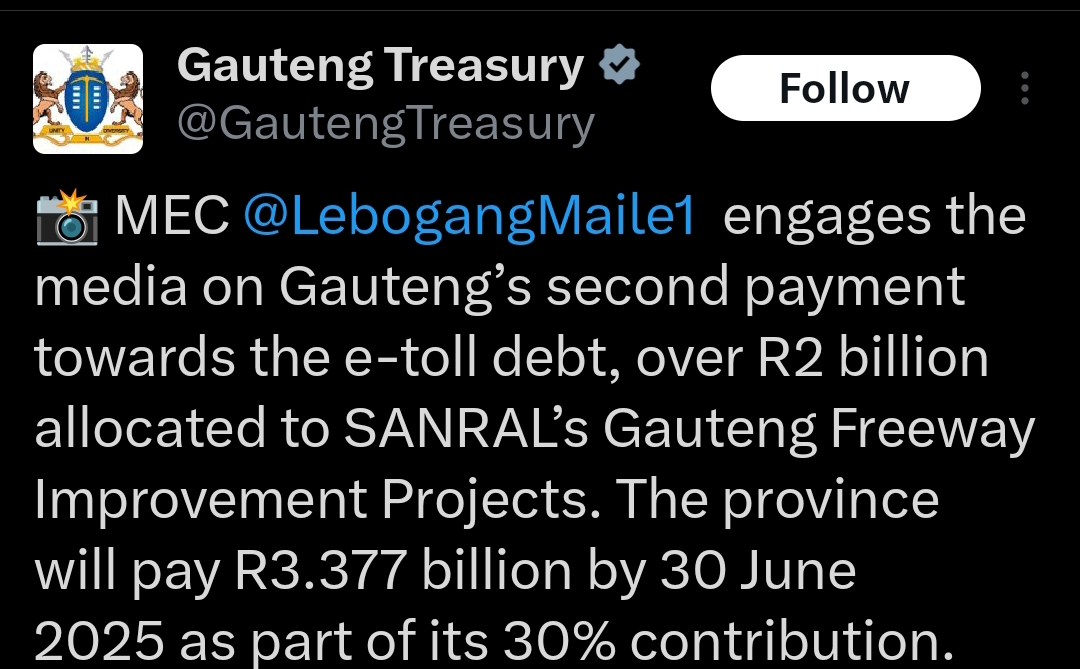
The Gauteng provincial government will today make a second payment of R3.37 billion towards the now defunct e-toll’s debt.
Just to be clear, the Gauteng Department is paying this debt to SANRAL, a state-owned entity. SANRAL, in turn, pays banks, asset managers, and institutional investors. So, while the debt is “intragovernmental” (Gauteng to SANRAL), the real beneficiaries are financial institutions extracting interest payments from the public.
Even as we set aside the fact that they’re paying for a failed project, this isn’t the worst part. The craziest thing is that the debt is denominated in rands.
This is the heart of the issue: South Africa is a currency-issuing state. It has full control over the creation of the rand through its central bank. Yet instead of using this power to finance public investment directly, the state borrows, with interest, as if it were a household or a business. Why?
The reasons are self-imposed. The Public Finance Management Act and National Treasury rules prohibit direct financing from the SARB. Instead, the government must “borrow” rands that it can create.
If you were to ask the suits at the National Treasury and SARB why this is, I can guarantee they have no idea, only that this is how it’s always been done. They will say the guidelines say so. What they won’t and can’t articulate is why these rules say so.
For over four decades now, the South African government has internalised austerity economics. Debt is treated as dangerous despite overwhelming evidence that a sovereign state can never “run out” of its own currency.
So, by borrowing from bond markets instead of using SARB-issued money, the government signals obedience to investor expectations. This prioritises the maintenance of South Africa’s credit rating over the material needs of its citizens. The failed e-toll system is a consequence of this market-first mentality.
South African policymakers boast about fiscal discipline as if it were a moral good in itself, balancing budgets, limiting deficits, and avoiding inflation. But not all discipline is virtuous.
Imagine a man disciplined enough to pay his loan shark every week for a mountain of gambling debt, even if it means ignoring his children’s needs or selling his last possessions. The loan shark respects him. The man has a high credit rating in the underworld. But his life is falling apart. He’s enslaved by a system designed to extract and control.
This is what South Africa has become.
The public is told the country must borrow rands, the very currency the central bank issues, from private investors. The public is further told that the people must “live within their means” even when millions go hungry and infrastructure collapses. The ideology is that trust from ratings agencies matters more than the lives of citizens.
But just like the man in debt to a loan shark, this “discipline” only ensures the country’s permanent underdevelopment.
South Africa has the means to construct roads without burdening future generations with debt. The country could have issued SARB-backed infrastructure bonds to itself, a practice commonly employed by nations like Japan and the US to upgrade the highways.
Alternatively, it could have funded SANRAL directly through Parliament-approved Treasury appropriations, recognising that all government spending is ultimately settled by central bank keystrokes.
Instead, it chose debt. And now Gauteng is paying billions to clean up a mess created not by public-private corruption alone but by a systemic refusal to exercise the full power of the public purse.
Now, this isn’t advocating for unlimited money creation. I am simply pointing out the absurdity of a specific situation: South Africa borrowing its own currency, with interest, to pay for infrastructure that could have been funded directly by the central bank without those interest payments going to financial institutions.
Why enrich private financial institutions with interest payments for creating money that the central bank could create directly? The highways would have been built either way, and the same amount of spending would have entered the economy, but one method involves ongoing wealth transfers to bondholders while the other doesn’t. That’s why.
In summation, foregoing monetary sovereignty is a choice, and the e-toll collapse was never just about bad tolling policy. It revealed the deep flaws of South Africa’s fiscal ideology, which sacrifices monetary sovereignty at the altar of market legitimacy.
South Africa does not lack money. It lacks the vision and courage to assert democratic control over finance and fund public investment without enriching banksters along the way.
🎰🎰 Sun International just posted record breaking online gambling revenue
in six months, online gambling platform Sunbet is up 70% with R874m in revenue
online casino slots are up 129%
on an average day, R23.4m is deposited & signups have doubled in the last year 💔💔
Here’s another reason why South Africa is going nowhere:
Sentech is threatening to cut off the SABC over a billion rand debt, potentially cutting off public broadcasting services to millions of South Africans.
This situation is another textbook example of the state’s stubborn adherence to an absurd economic ideology. It’s almost comical if it weren’t so destructive.
The ridiculousness of this situation lies in how the state has created various “state-owned entities” (SOEs) and arms-length corporations, such as SABC, SENTECH, and Eskom, and then forces them to operate as if they are independent, profit-seeking corporations in a market. This is a fundamental fiction.
The SABC is not a private media company. It is a public broadcaster with a constitutional mandate to inform the nation.
Similarly, SENTECH is not a private signal distributor. It is a state-owned signal distributor.
The fact that one SOE is threatening to cut off the signal to another SOE over a debt is a theatrical performance of a market transaction that is, in reality, an internal accounting problem.
The entire drama is a consequence of the state’s refusal to acknowledge that it is one entity ultimately responsible for funding its own public entities, using money it creates.
Basically, the public broadcaster, which is the main vehicle for information for millions, is held hostage to accounting fictions.
This is even worse than the Gauteng government and SANRAL charade I wrote about here https://t.co/UmYQDQK7TA
Like I said then, the real issue isn’t money, it’s ideology. Just like with Gauteng paying SANRAL’s e-toll debt, the “discipline” here is performative. It’s about enforcing cost recovery and “market realism” inside the state itself, even when it undermines essential services.
The most ludicrous part of this is that the “debt” is denominated in rands, while the sole shareholder of both the SABC and SENTECH is the South African public, represented by the government, and the creator of the rand is the South African Reserve Bank, which is also a public institution.
For SENTECH to cut the SABC’s signal over this “debt” would be like your right hand refusing to write because your left hand hasn’t paid for the paper. It’s a farce that only makes sense within the arbitrary rules the brain (National Treasury) has imposed on the body.
While the state engages in this internal accounting drama, the consequences are devastatingly real for the public, as millions of South Africans, especially the poor and elderly who rely on the SABC for news, weather, and emergency alerts, would be plunged into an information blackout.
But even more appallingly, the state would be actively facilitating the collapse of an institution meant to be a pillar of democracy, all to uphold the fiction of corporate separateness.
And here’s the thing: the rules that force SABC and SENTECH to roleplay as businesses are the same rules that force the state to borrow its own currency from bond markets instead of issuing it directly.
The result is that instead of simply funding public broadcasting as a public good, the government perpetually sets up its own institutions to fail, then borrows, with interest, from private investors to “rescue” them. The beneficiaries are bondholders, who earn risk-free profits from the state’s refusal to use its monetary sovereignty.
The entire focus of this circus is on the illusion of fiscal discipline (“SENTECH must balance its books!”) rather than the reality of public service. It is a pretence of discipline in the service of profit extraction and control, not development.
Just like the Gauteng–SANRAL charade, the SABC–SENTECH crisis reveals the real logic of South Africa’s economic policy: to preserve the flow of interest payments to financial institutions at all costs, even if it means undermining democracy itself.
The ideology of “discipline” is not about efficiency; it’s all about ensuring that banks and asset managers always get paid first, while the public is told there is “no money.”
This is not a market governance failure but a funding failure. The state has failed to adequately fund its own public institutions to fulfil their mandates.
What should happen is that Parliament, through the National Treasury, must provide the SABC with a direct appropriation (a grant) to settle its operational debts, including what it “owes” SENTECH. This is the same as funding the police or the health department.
By doing this, money will have been moved from one state account to another via the banking system. The state’s net financial asset position would be unchanged, and the crisis would be averted without enriching a single private bondholder.
Instead, what will likely happen is a last-minute “bailout” framed as a necessary evil, accompanied by stern warnings about the SABC’s “financial sustainability,” further entrenching the narrative of scarcity and the need for austerity, exactly the ideology that caused the problem in the first place.
This saga is just the state, in a room, arguing with itself over pieces of paper it can create at will, while threatening to shoot its own foot to prove a point. It is, as I said, weapons-grade stupidity.
In the end, this is not technical mismanagement. It’s a political choice to prioritise bondholders over citizens, accounting fictions over democratic obligations, and austerity over development.
Until South Africa breaks away from this ideology, it will remain trapped in a cycle of self-sabotage and funding scarcity in a land of monetary sovereignty.
SASOL REPORTS R6.8BN PROFIT
Sasol has staged a stunning comeback, reporting a R6.8-billion profit in 2025 after a heavy R44.3-billion loss last year.
Its shares have soared 39% as investors welcomed the turnaround.
CEO Simon Baloyi's (pictured) strategy - boosting output, cutting costs, and pushing renewables - has paid off despite rising carbon credit expenses.
The company spent R723-million on offsets and completed a new coal plant to improve fuel quality.
The revival positions Sasol as one of this year’s biggest market winners.
Read more - https://t.co/VMjedZMea0