The power communism threatens is the power of individuals to make their own choices.
Communism doesn't challenge power. It centralizes it. It replaces the decisions of millions of individuals with the decisions of a political class.
The first thing communism takes from you isn't wealth.
It's the freedom to choose.
A new study shows offshore wind farms can alter ocean currents.
By 2050, offshore wind capacity in the North Sea is set to increase more than tenfold.
Researchers modelled the long-term impact.
Turbines slow surface winds, foundations obstruct tidal flow, and those wake effects combine to slow surface currents by up to 20%, not just immediately around the wind farms, but across the North Sea.
That changes sediment movement, water mixing, and marine ecosystems.
This is not a local effect, it is a system-level change, and the full impacts are unknown.
Milton Friedman's greatest regret.
The federal government discovered the perfect crime in 1943: make employers collect taxes before workers ever see their paychecks. You think you earn $60,000 per year, but you actually earn $75,000 and hand over $15,000 to politicians without ever touching it. The psychological difference is enormous.
Before payroll withholding, Americans wrote quarterly checks directly to the Treasury. Picture yourself sitting at your kitchen table, writing a $3,750 check to the IRS every three months. The pain was immediate and visceral. Politicians faced constant pressure to justify every dollar because citizens felt the extraction in real time.
Withholding transforms this concrete loss into an abstract accounting entry. Your employer becomes an unpaid tax collector, and you never experience the actual cost of government. Worse, most people celebrate their tax refunds as government generosity rather than recognizing them as interest-free loans they provided to politicians. The Treasury collects your money throughout the year, spends it immediately, then returns your own cash and receives gratitude.
This system enables the explosion in government spending you witness today. Defense contractors billing $640 for toilet seats, agricultural subsidies for corn syrup, and congressional salaries for 535 people who rarely show up to work. When taxation feels painless, voters stop demanding accountability for how their money gets spent.
Milton Friedman helped design withholding as a wartime emergency measure and later called it his greatest regret. Free market economists recognized that the psychological pain of direct taxation creates political pressure for fiscal restraint. The temporary always becomes permanent in government hands, and the emergency justification disappears while the extraction mechanism remains forever.
Thomas Sowell on government interventions:
“The imperfections of the marketplace have led many to see government interventions as necessary and beneficial.”
“Yet the imperfections of the market must be weighed against the imperfections of the government.”
“It always amazes me that people think that if you say the market is imperfect, that means the government must step in. We’re so much more rational in sports.”
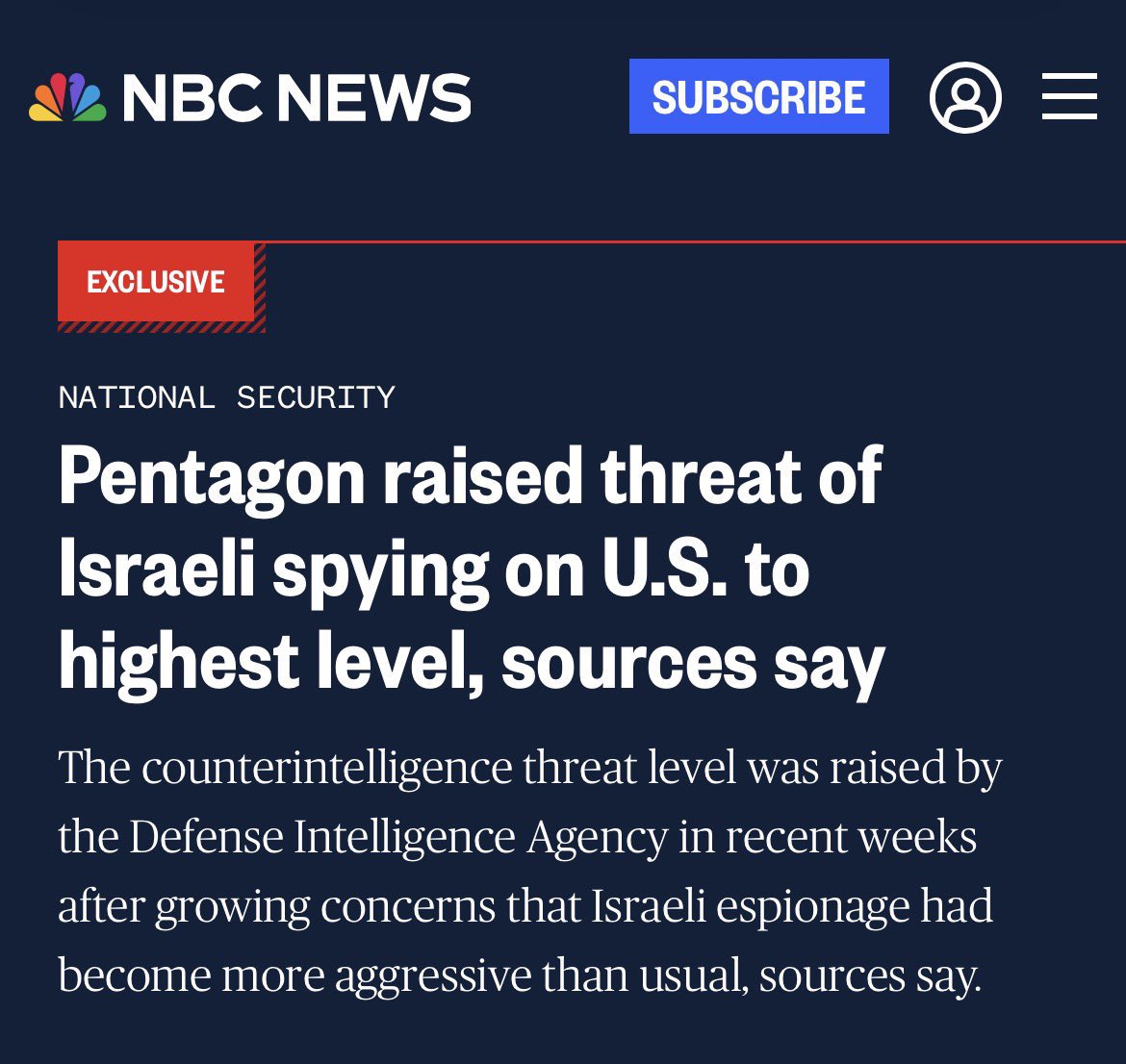
The Pentagon raised threat of Israeli spying on the U.S. to the highest level and AIPAC is openly cheering Republicans for section 224 in the NDAA that merges our military with Israel’s military.
Our government is being captured.
https://t.co/kn27xVrGep
Elon Musk: "If you warm up Mars, you could one day make Mars like Earth, meaning with liquid oceans and life, and where you could walk outside without a spacesuit. I'd call Mars a fixer-upper of a planet, but it's got a lot of potential."
Spain is ripping out centuries-old olive groves for solar farms.
In Andalusia, trees that took decades to reach maturity are being uprooted for panel arrays.
This is a direct land-for-energy trade.
26 terawatt-hours of output from solar requires roughly 130,000 acres, whereas a modern nuclear plant would deliver that same power using just 430 acres. That is a land gap approaching 300 to 1 (and wind farms are even worse).
Solar's footprint is not just panels. It is roads, fencing, substations, transmission lines and backup systems.
Spain has already stress-tested a high renewables grid. In April 2025, a nationwide blackout followed low grid inertia and heavy reliance on inverter-based generation.
The Spanish government is doubling down on this failure.
A staggering 7 to 8 billion solar panels have been deployed globally—but up to 90% of them are currently on a direct trajectory toward disposal.
While modern solar panels are technically made of roughly 95% recyclable materials (glass, aluminum, copper, and silicon), recycling currently runs at a steep economic loss.
* The cost: Processing runs $500–$1,000 per tonne ($10 to $40 per panel).
* The yield: The value of recovered materials doesn't even cover the transport fees.
Compared with minimal landfill fees, economics dictate that burial is the default option. But the world is rapidly running out of room, and governments are beginning to panic.
We are already seeing a preview of this crisis in the wind sector, where an expected 43 million tonnes of turbine blade waste by 2050 has led several European nations—including Austria, Germany, Finland, and the Netherlands—to actively ban decommissioned blades from landfills.
Solar is hitting the same wall. Panels built over two decades ago are reaching the end of their 20-to-24-year lifespans, while many more become economically obsolete and are replaced long before that.
This has created a massive regulatory catch-22: To prevent heavy metals like lead and cadmium from potentially leaching into groundwater, jurisdictions like Victoria, Australia, have implemented strict bans on putting solar panels into landfills, classifying them as hazardous e-waste.
Yet, with recycling remaining economically non-viable, we are creating an impossible bottleneck. While industry bodies like the IEA maintain that leaching risks from broken panels are negligible and within safety limits, the sheer volume of impending waste tells a different story.
If it costs too much to recycle, and it is illegal to landfill, where do several billions of panels go?
The 'clean energy' solution is rapidly staring down the barrel of a multi-generational hazardous waste problem.
Image: Last year, the world built more new solar capacity than every other power source combined - Shutterstock.