OpenAI says the AGI era has started.
GPT-6 Astra is here.
And the examples people are building with AI are getting harder to call “just experiments.”
Here are some wild examples of what’s possible now:
Stop looking at benchmarks for 18 seconds. Watch this.
GPT-6 Astra vs Fable 5.1.
And the difference I find interesting isn’t image quality.
Watch the motion, framing, scene transitions and visual intent on the Astra side.
It doesn’t just feel like a model generating pretty frames.
It feels like something is directing the sequence.
Fable 5.1 looks good.
Astra feels aggressive.
If this level of temporal consistency scales to longer generations, the real GPT-6 story may not be “better video generation.”
It could be something much bigger:
Prompt → cinematography → motion → continuity → finished scene.
We’re getting dangerously close to the point where “generate a video” becomes:
“Direct this scene for me.”
Watch it twice.
Which side would you ship? 👀🔥
As artificial intelligence becomes better at writing, analyzing data, summarizing information, generating presentations and performing other cognitive tasks once considered uniquely human, employers are placing greater value on abilities machines have a harder time replicating. People skills matter now more than ever. Call it the "human premium."
Read more: https://t.co/D5hn1oe4AS
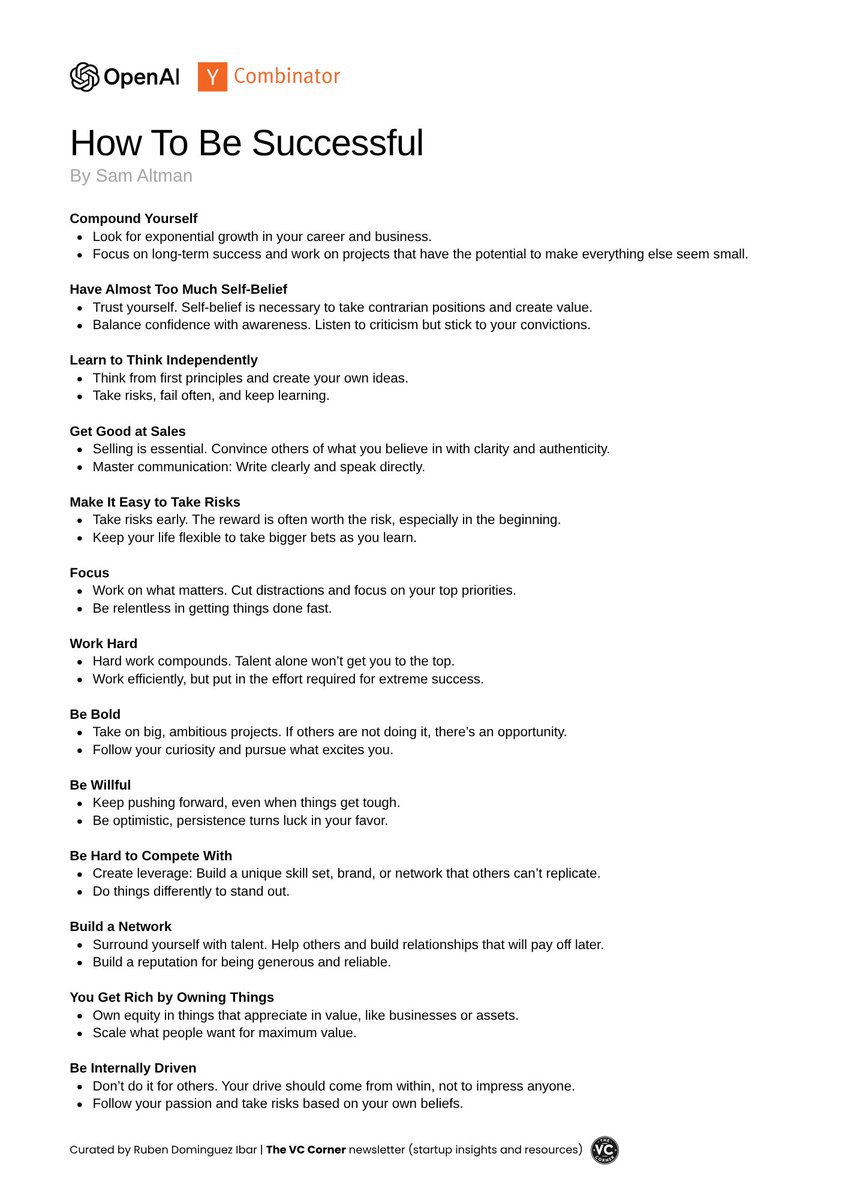
Sam Altman's entire success playbook in one line: compound everything
career, skills, relationships, capital. the people who win just let the right things stack for years
Only seven people in the world have seen the “greenest green.” No printer can print the color, and no camera can photograph it. No pigment or dye in the shade can exist. “Olo,” named for the combination of cone cells the color stimulates, has been described as a highly saturated teal shade. Researchers at U.C. Berkeley generated it by using lasers to target a single type of retinal cell in a manner that does not occur naturally.
Humans perceive the world with three primary colors, not because the world is fundamentally composed of three colors but because our retinas typically have three kinds of color-perceiving cone cells. Each cone cell responds to a range of wavelengths within the visible-light spectrum—roughly corresponding to red, blue, and green. Our eyes are constantly moving: when we look at a blade of grass, or a clear blue sky, or a fire truck, some combination of each of the three types of cones are being stimulated.
But what does it mean for us to see a new color, even just a few of us? Rivka Galchen talks to an array of color experts, and considers what we can learn from the prospect of a new hue—about our visual-processing system, and about the nature of color itself: https://t.co/tvQRsBFOCD
Since the launch of ChatGPT, the Philippines offshore industry (8% of country’s GDP) has actually grown much bigger.
Employment in IT and business outsourcing is up by +20% to 1.9m workers and industry revenue is up +30% to $42B.
“AI is helping offshore workers in the Philippines do new, more complex jobs. They are picking up work training AI models or supervising AI agents. Hospitals in America are increasingly outsourcing the checking of insurance eligibility and filing of medical records to Filipinos packing AI tools. Mr Gallimore says more “high-value” work, such as accountancy or engineering, is going offshore in part because “AI is a leveller. You can now teach someone complex stuff quickly” and still get it done more cheaply than in America or Europe.”
***
More here: https://t.co/WTVAUuuxBd
El Niño continues to intensify during the August-October 2026 season. Above-normal temperatures are likely across the world. Wetter conditions in some regions and drought risk in others are expected, consistent with a classic, strong El Niño event.
🗞️ https://t.co/056oYaRROn