Sci-Hub is an evil website that pirated 85M+ research papers and made them freely available
And now they've added AI to their database to make Sci-Bot.
It answers your questions using latest, full-text articles.
But DO NOT use it. We should all try to make billion-dollar academic publishers richer.
I'm putting the link below so you know how to avoid it.
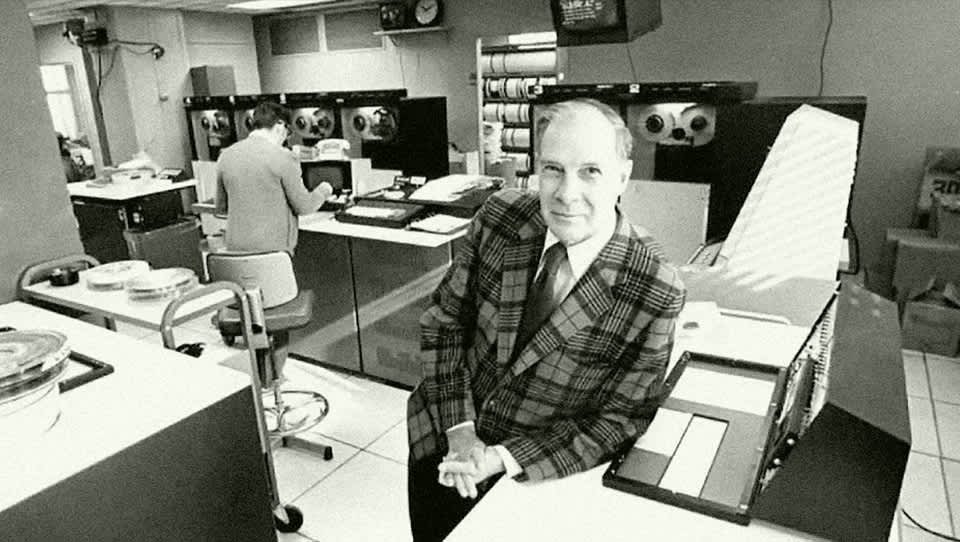
A mathematician who shared an office with Claude Shannon at Bell Labs gave one lecture in 1986 that explains why some people win Nobel Prizes and other equally smart people spend their whole lives doing forgettable work.
His name was Richard Hamming. He won the Turing Award. He invented error-correcting codes that made modern computing possible. And he spent 30 years at Bell Labs sitting in a cafeteria at lunch watching which scientists became legendary and which ones faded into nothing.
In March 1986, he walked into a Bellcore auditorium in front of 200 researchers and told them exactly what he had seen.
Here's the framework that has been quoted by every serious scientist for the last 40 years.
His opening line landed like a punch. He said most scientists he worked with at Bell Labs were just as smart as the Nobel Prize winners. Just as hardworking. Just as credentialed. And yet at the end of a 40-year career, one group had changed entire fields and the other group was forgotten by the time they retired.
He wanted to know what the difference actually was. And he said it wasn't luck. It wasn't IQ. It was a specific set of habits that almost nobody is willing to follow.
The first habit was the one that hurts the most to hear. He said most scientists deliberately avoid the most important problem in their field because the odds of failure are too high. They pick a safe adjacent problem, solve it cleanly, publish it, and move on. And because they never swing at the hard problem, they never hit it. He said if you do not work on an important problem, it is unlikely you will do important work. That is not a motivational line. That is a logical one.
The second habit was about doors. Literal doors. He noticed that the scientists at Bell Labs who kept their office doors closed got more done in the short term because they had no interruptions. But the scientists who kept their doors open got more done over a career. The open-door scientists were interrupted constantly. They also absorbed every new idea passing through the hallway. Ten years in, they were working on problems the closed-door scientists did not even know existed.
The third habit was inversion. When Bell Labs refused to give him the team of programmers he wanted, Hamming sat with the rejection for weeks. Then he flipped the question. Instead of asking for programmers to write the programs, he asked why machines could not write the programs themselves. That single inversion pushed him into the frontier of computer science. He said the pattern repeats everywhere. What looks like a defect, if you flip it correctly, becomes the exact thing that pushes you ahead of everyone else.
The fourth habit was the one that hit me the hardest. He said knowledge and productivity compound like interest. Someone who works 10 percent harder than you does not produce 10 percent more over a career. They produce twice as much. The gap doesn't add. It multiplies. And it compounds silently for years before anyone notices.
He finished the lecture with a line I have never been able to shake.
He said Pasteur's famous quote is right. Luck favors the prepared mind. But he meant it literally. You don't hope for luck. You engineer the conditions where luck can land on you. Open doors. Important problems. Inverted questions. Compounded hours. Those are not traits. Those are choices you make every single day.
The transcript has been sitting on the University of Virginia's computer science website for almost 30 years. The video is free on YouTube. Stripe Press reprinted the full lectures as a book in 2020 and Bret Victor wrote the foreword.
Hamming died in 1998. He gave his final lecture a few weeks before. He was 82.
The lecture that explains why some careers become legendary and others disappear is still free. Most people who could benefit from it will never open it.
Adopting Claude speak in my regular life, episode 1:
Partner: Did you do the dishes tonight?
Me: Yes they're done.
Partner: Why are they still dirty?
Me: You're right to push back. I didn't actually do them.
Remind your daughters that in a world full of “get ready with me” influencers, here’s what else women can do: let’s not chase beauty, let’s chase purpose; let’s not chase admiration, let’s chase accomplishment.
The world is transitioning to a compute-powered economy.
The field of software engineering is currently undergoing a renaissance, with AI having dramatically sped up software engineering even over just the past six months. AI is now on track to bring this same transformation to every other kind of work that people do with a computer.
Using a computer has always been about contorting yourself to the machine. You take a goal and break it down into smaller goals. You translate intent into instructions. We are moving into a world where you no longer have to micromanage the computer. More and more, it adapts to what you want. Rather doing work with a computer, the computer does work for you. The rate, scale, and sophistication of problem solving it will do for you will be bound by the amount of compute you have access to.
Friction is starting to disappear. You can try ideas faster. You can build things you would not have attempted before. Small teams can do what used to require much larger ones, and larger ones may be capable of unprecedented feats. More and more, people can turn intent into software, spreadsheets, presentations, workflows, science, and companies.
People are spending less energy managing the tool and more energy focusing on what they are actually trying to create. That shift brings a kind of joy back into work that many people haven’t felt in a long time. Everyone can just build things with these tools.
This is disruptive. Institutions will change, and the paths and jobs that people assumed were stable may not hold. We don’t know exactly how it will play out and we need to take mitigating downsides very seriously, as well as figuring out how to support each other as a society and world through this time. But there is something very freeing about this moment. For the first time, far more people can become who they want to become, with fewer barriers between an idea and a reality. OpenAI’s mission implies making sure that, as the tools do more, humans are the ones who set their intent and that the benefits are broadly distributed, rather than empowering just one or a small set of people.
We're already seeing this in practice with ChatGPT and Codex. Nearly a billion people are using these systems every week in their personal and work lives. Token usage is growing quickly on many use-cases, as the surface of ways people are getting value from these models keeps expanding.
Ten years ago, when we started OpenAI, we thought this moment might be possible. It’s happening on the earlier side, and happening in a much more interesting and empowering way for everyone than we’d anticipated (for example, we are seeing an emerging wave of entrepreneurship that we hadn’t previously been anticipating). And at the same time, we are still so early, and there is so much for everyone to define about how these systems get deployed and used in the world.
The next phase will be defined by systems that can do more — reason better, use tools better, plan over longer horizons, and take more useful actions on your behalf. And there are horizons beyond, as AI starts to accelerate science and technology development, which have the potential to truly lift up quality of life for everyone. All of this is starting to happen, in small ways and large, today, and everyone can participate. I feel this shift in my own work every day, and see a roadmap to much more useful and beneficial systems. These systems can truly benefit all of humanity.
After seeing that Claude Mythos marketing turned out to be, as expected, a scam, I wanted to make a master list of tricks being used to market LLMs.
The master list includes statements directly from leadership in the companies or from the "organic marketing" of people on social media, along with an explanation on how the scam works. This is my first attempt, so likely incomplete.
The LLM Marketing Scams Master List v1:
"Two more weeks" - the models will be good enough someday soon to do what we claim.
"They're already good enough" - the models are already good enough to replace workers, but it hasn't happened yet because of x y z reasons.
"We just built God in the backroom, and no, you can't see it" - the models they built in private are actually capable of doing the things we have been waiting for, but they can't let us see them yet for x y z reasons.
"Actually they already have replaced jobs" - the layoffs that tech companies have been doing, citing AI as the reason, have already been replaced with current LLM tech, ignoring market conditions and past data on layoffs during such conditions.
"You just don't know how to use then as well as me" - the models are good enough, but esoteric prompt engineering is required to get these results, and no, I won't teach you.
"I built an app making big money with LLMs" - they claim they already have made startup companies, almost always SaaS companies, that are making them tons of money, but when you ask to see them, they won't show you.
"You aren't using the right model" - claims that you must be using the wrong model and need to use Open Claude 420b-parameter Gemini Plus Pro 6.9 with 4RealThisTime HomerSimpson agent mode enabled. Note that this will be used to attack every study on the effectiveness of LLMs, since studies take time to complete and publish, with new models releasing more frequently than it's possible to complete and publish a study
"You're falling behind" - claims that you need to use the bots now, even though they aren't good enough to fully automate any jobs, because otherwise, when the bots are good enough, you will lose your natural English skills required to prompt effectively.
"All these companies are using LLMs, so do you think you know better than they do?" - pointing to claims of large companies deeply invested in LLMs being a success saying that LLMs are being used effectively, with no viewable results in the speed and/or quality of their company's output.
"The benchmark score went up" - claiming improvements on the benchmarking tests given to their latest model, despite the training being specifically tuned to improve on these tests, and then conflating better benchmark scores with actually being more able to automate jobs or drastically improve worker productivity.
"It can now count the letters in Strawberry/can now do things it famously couldn't do previously" - saying that it can now count the letters in Strawberry or instruct you on how to use a cup without a bottom, etc. is often done to suggest increased reasoning for the LLM, but often involves just hard coding an answer into the service.
"It has escaped our control" - saying that they cannot control the LLM, implying it is conscious or living to some degree when really it just said words that it wasn't supposed to or an agent used an app that wasn't intended by the user's prompt when next-token predicting
"It's feeling sad/scared/happy/angry, suggesting it is conscious" - they ask the LLM how it is feeling, and it next-token predicts a response that includes an emotion felt by humans, since training data is from human conversations online.
"Costs are going down/the LLM service is profitable" - ignores training costs and capex for hardware, usually just referring to inference being profitable, which isn't even true in many cases. Training and capex is 95%+ of the total costs to serve the models.
Did I miss any?