This broke me.
Baby Punarvika. SMA Type 1. A rare, fatal condition. One injection can save her life. That injection costs ₹16 crores.
₹16 crores for a baby to live.
But here’s what hit me harder. People didn’t look away. Strangers, families, regular people came together and have already raised over ₹1 crore under #SavePunarvika. No noise. Just action.
I’m appealing to @PMOIndia@TelanganaCMO@AndhraPradeshCM. Please step in. This child needs immediate help. Time is not on her side.
A small request. Given how fragile her condition is, please don’t visit her. Your prayers and contributions matter more right now.
If this little one makes it, it’s not just her family that wins. We all do.
#SavePunarvika
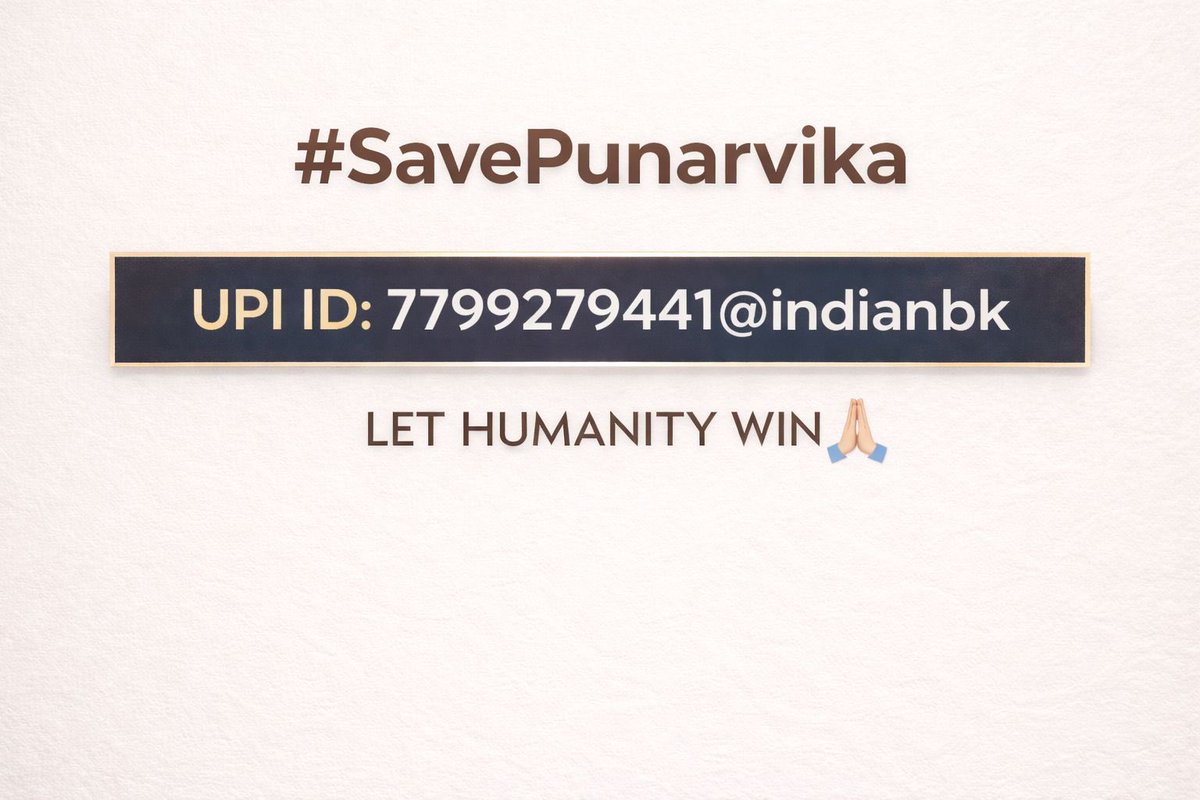
UPI: 7799279441@indianbk
@miryalasrikanth@naaperusai మీకు నచ్చినట్టు ఉహించుకుని వేదం మీద పిచ్చి రాతలు రాసే హక్కు ఏ కవికి ఉండదు. ప్రామాణిక మైన వేదాలకి వెర్రి ఊహలు అద్దటం కవి కి మంచిది కాదు.
#SavePunarvika - 16 Crores Injection
10 months papa ni kapadaniki inthamandi munduku ravatam🙏
Crossing all border’s, other states influencers coming forward for donations 🥹
kalyan sir ithe nyayam chestaru ani andaru antunnaru pls look into this @APDeputyCMO@JanaSenaParty
🚨⚡️A drilling company that dug this well lowered a camera to a depth of 100 meters and tracked the water's path until the point where it began to flow. And finally, they were able to record that stunning scene.
I just turned 55.
And finally understand what actually matters.
Took me three decades to learn what I'm about to teach you in 5 minutes.
Here are 55 life lessons I wish someone told me at 25:
If you want to kick off with system design (in 2026), learn these 16 concepts:
1 Saga Design Pattern
↳ https://t.co/2CffTodOHL
2 How Idempotent API Works
↳ https://t.co/afe7ACuSYE
3 The Entire Computer Science Stack, Simply Explained
↳ https://t.co/qfZnlyCSN5
4 How JWT Works
↳ https://t.co/SZXXrlBsWH
5 How RPC Works
↳ https://t.co/yeIgcmAxQx
6 How Consistent Hashing Works
↳ https://t.co/7d6EipPcKF
7 How Service Discovery Works
↳ https://t.co/BcL3tgxx1u
8 Frontend System Design 101
↳ https://t.co/ViPOQrLZzA
9 How Bloom Filters Work
↳ https://t.co/ntZXq7LxVn
10 How Databases Keep Passwords Securely
↳ https://t.co/KSfIhpAT2j
11 Modular Monolith Architecture
↳ https://t.co/VVV6v3KGHJ
12 API Design Best Practices
↳ https://t.co/I2ejJ0kbYq
13 Cybersecurity Terms for Software Engineers
↳ https://t.co/t7X3mJb5Bm
14 Concurrency vs Parallelism
↳ https://t.co/BwRHeuJ5AF
15 Distributed Systems 101
↳ https://t.co/yi0K5K5RIE
16 How Model Context Protocol Works
↳ https://t.co/wgf8gHnnkn
(What else should make this list?)
——
👋 PS - Want my System Design Playbook for FREE?
Join my newsletter with 200K+ software engineers right now:
→ https://t.co/ByOFTtOihX
———
💾 Save this for later & RT to help others ace system design.
👤 Follow @systemdesignone + turn on notifications.
If you want to get started with SYSTEM DESIGN (in 2026), learn these 20 concepts:
1 How Idempotent API Works
↳ https://t.co/afe7ACuSYE
2 Saga Design Pattern
↳ https://t.co/2CffTodOHL
3 Redis Use Cases
↳ https://t.co/hZ571ruVeA
4 How JWT Works
↳ https://t.co/SZXXrlBsWH
5 How RPC Actually Works
↳ https://t.co/yeIgcmAxQx
6 How Consistent Hashing Works
↳ https://t.co/7d6EipPcKF
7 How Service Discovery Works
↳ https://t.co/BcL3tgxx1u
8 Monolith vs Microservices Architecture
↳ https://t.co/KwVAEGVkA9
9 What Happens When You Type a URL Into Your Browser
↳ https://t.co/P3SiURMFlW
10 Microservices Lessons From Netflix
↳ https://t.co/XgS7VQoBFv
11 Frontend System Design 101
↳ https://t.co/ViPOQrLZzA
12 How Websockets Work
↳ https://t.co/JfT6mj4mrv
13 How Bloom Filters Work
↳ https://t.co/ntZXq7LxVn
14 How Databases Keep Passwords Securely
↳ https://t.co/KSfIhpAT2j
15 How Does HTTPS Work
↳ https://t.co/r5rUtVpw0O
16 Modular Monolith Architecture
↳ https://t.co/VVV6v3KGHJ
17 API Design Best Practices
↳ https://t.co/I2ejJ0kbYq
18 How DNS Works
↳ https://t.co/H7hcZnws8N
19 System Design 101
↳ https://t.co/DgL8xz0KTQ
20 API Versioning - A Deep Dive
↳ https://t.co/OHAtKSUgVN
(What else should make this list?)
——
👋 PS - Want my System Design Playbook for FREE?
Join my newsletter with 200K+ software engineers:
→ https://t.co/ByOFTtOihX
———
💾 Save this for later, and RT to help others learn system design.
👤 Follow @systemdesignone + turn on notifications.
How Kafka Works Internally? 👉
Kafka acts as a distributed event streaming platform that stores data in topics.
A topic is a category or feed name to which records are published.
Topics are split into partitions to allow for parallel processing and scalability.
Each partition is an ordered, immutable sequence of records that is continually appended to.
Every record in a partition is assigned a unique sequential ID number called the offset.
Producers write data to the tail of these logs, and consumers read from them at their own pace.
Partitions allow a topic to hold more data than a single server could handle.
Partitions are distributed over the servers in the Kafka cluster to share the load.
Each partition has one server that acts as the "leader" and zero or more servers as "followers."
The leader handles all read and write requests for the partition.
Followers passively replicate the leader to ensure data is not lost if the leader fails.
Kafka uses a commit log structure where data is written sequentially to disk.
Sequential disk I/O is much faster than random access, which gives Kafka high throughput.
Data is retained for a configurable period, regardless of whether it has been consumed.
Consumer groups allow a pool of consumers to divide the work of processing a topic's partitions.
@grok how far is the progress of Cloud AI Agents development by different cloud service providers which are aware of cloud context ?
Is there any agent development in progress that can launch , monitor , trace and maintain distributed systems in cloud context ?
Here are some main caching strategies you'll actually use, with real examples:
1. Read-through cache:
your app always asks the cache first. If it's not there (cache miss), the cache itself fetches from the database, stores it, then returns it to you.
Real example: when someone views a product page, you check Redis first. If it's not cached, Redis grabs it from your database, caches it, and returns it. The next person gets it instantly from cache.
When to use: When you want simple code and don't mind slightly slower first requests for uncached data.
2. Cache-aside:
this is the most common pattern you would likely use. Your app checks the cache, if there's a cache miss, it fetches from the database and updates the cache.
When to use: this is great when you want fine control over what gets cached and when, or when different data needs different cache logic.
3. Write-through cache:
every time you write data, you write to both cache and database simultaneously. Cache is always in sync.
Real example: user settings or preferences. When someone updates their theme preference, you update both Redis and PostgreSQL at the same time. Anyone reading settings always gets fresh data.
When to use: if consistency matters more than speed, this strategy works
4. Write-behind or write-back cache:
here you write to cache immediately, then write to the database later (whether batched or delayed)
When to use: when you have a high write case where speed matters and you don't mind potential data loss if cache crashes before database syncs (things like logs o metrics)
5. Refresh-ahead:
this strategy is good for many dashboards or homepages. Before the cached data expires, you refresh it in the background.
Real example: homepage content where your homepage data expires in 5 minutes but at 4 minutes, you refresh automatically. Users would never experience a cache miss
Quick guide:
- mostly reads, some occasional writes? = Cache-aside with TTL
- need consistency? write-through cache
- high write volume? write-behind cache
- frequently needed data? refresh-ahead
- you just want a simple implementation? read-through with TTL
In reality, you would mix these strategies in one project, just know when to make the right calls.
Happy caching!