We are 54 days out from midterms, and the Senate is a coin flip.
Democrats need three holds and four flips from a list that includes states they haven't won the Senate in since 1988.
It's also irrelevant if you're positioning your portfolio around it.
https://t.co/WP5uhdj7sZ
Now the refunds are drying up right as the Federal Reserve has started to hike interest rates.
This issue of BuyPartisan covers where tariffs actually stand, the court date that decides what comes next, and what both outcomes mean for markets.
Since May, the U.S. government has refunded about $115 billion in tariffs to the companies that paid them.
It has worked like stimulus, and it landed in an economy that has been dealing with an inflation problem for years.
Read More 👇
https://t.co/hTf6TH6t9F
Refunds landed in an economy where inflation was running hot. Now the refunds are drying up, right as the Fed starts tightening.
Tomorrow's BuyPartisan discusses where tariffs stand, how much the refund stimulus mattered, & the market impact.
Subscribe: https://t.co/w5MzO5alja
Last week, the Fed raised rates for the first time since 2023.
The usual suspects got most of the attention: oil prices, a labor market at full employment, and unbreakable consumers.
I don't blame anyone for having tariff fatigue, but it keeps getting left off the list.
They hit the inflation story from two separate directions. The effective tariff rate is still triple its 2024 level, and that is a tax that lands on U.S. consumers.
The second has gotten less attention. Since May, Washington has refunded ~$115 billion in tariffs to companies.
2. Hikes Are Not (Usually) A Sell Signal
First hike to last hike, the S&P 500 finished higher in five of the last six hiking cycles with an average gain of 9.4%. The one miss was basically flat. Even 2022–23, the fastest tightening in four decades, ended up 4.8%.
The market currently thinks there is a roughly 93% chance of a Fed hike today.
If this does end up being the start of a rate hiking cycle, there's two stats I want you to remember.
1. The Fed (Usually) Doesn't Hike Just Once 👇
There have been six tightening cycles since 1987. Every one ran at least six hikes, and the average length has been eleven hikes. The lone exception, was the single hike in March 1997, which needed the Asian financial crisis to become the only one-off.
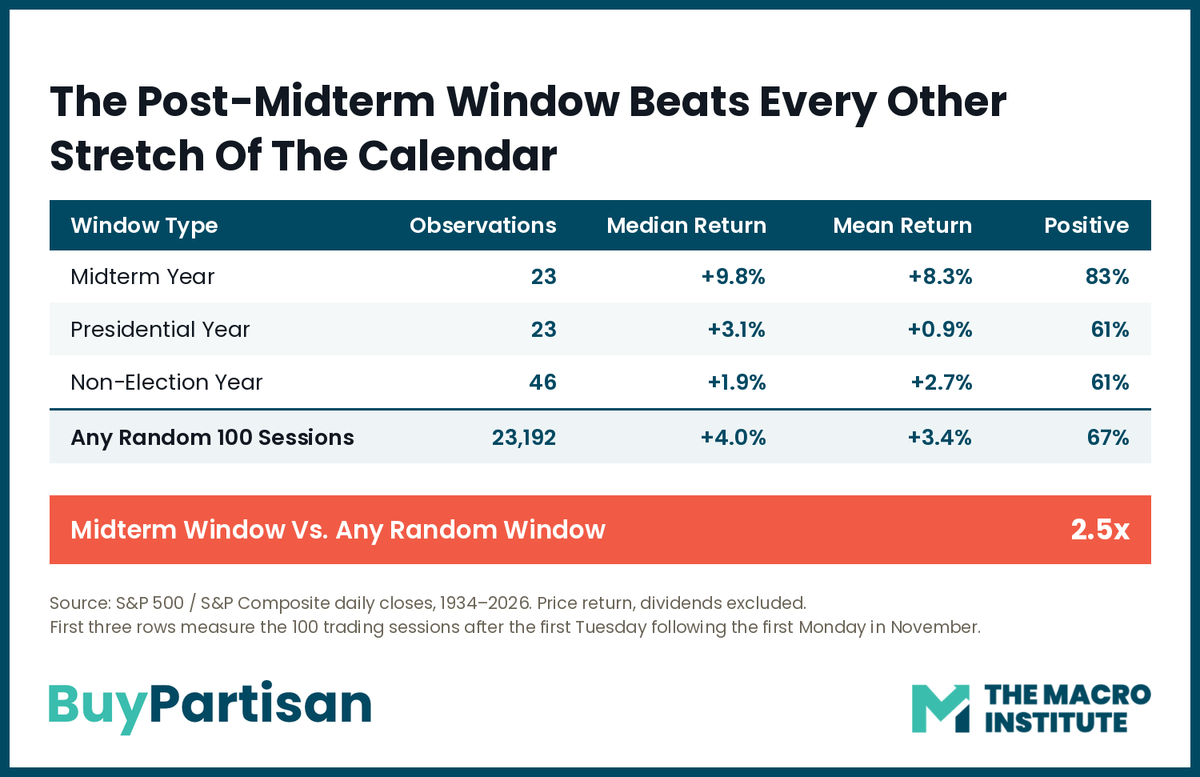
I pulled S&P 500 returns around all 23 midterms since 1934, and every outcome produced similar results.
Something did surprise me...
If you run that same window across every year, midterm years return +9.8%, Presidential years return +3.1%, and non-election years return +1.9%.
We are 54 days out from midterms, and the Senate is a coin flip.
Democrats need three holds and four flips from a list that includes states they haven't won the Senate in since 1988.
It's also irrelevant if you're positioning your portfolio around it.
https://t.co/WP5uhdj7sZ
There are only 55 days until midterm elections.
I’ve heard plenty of commentary on how you should position your portfolio around it, so I went back to 1934 to see whether midterm elections are even worth trading at all.
The results surprised me!
Next BuyPartisan out tomorrow.
Long rates are up ~400 bps off their lows and mortgage rates have followed.
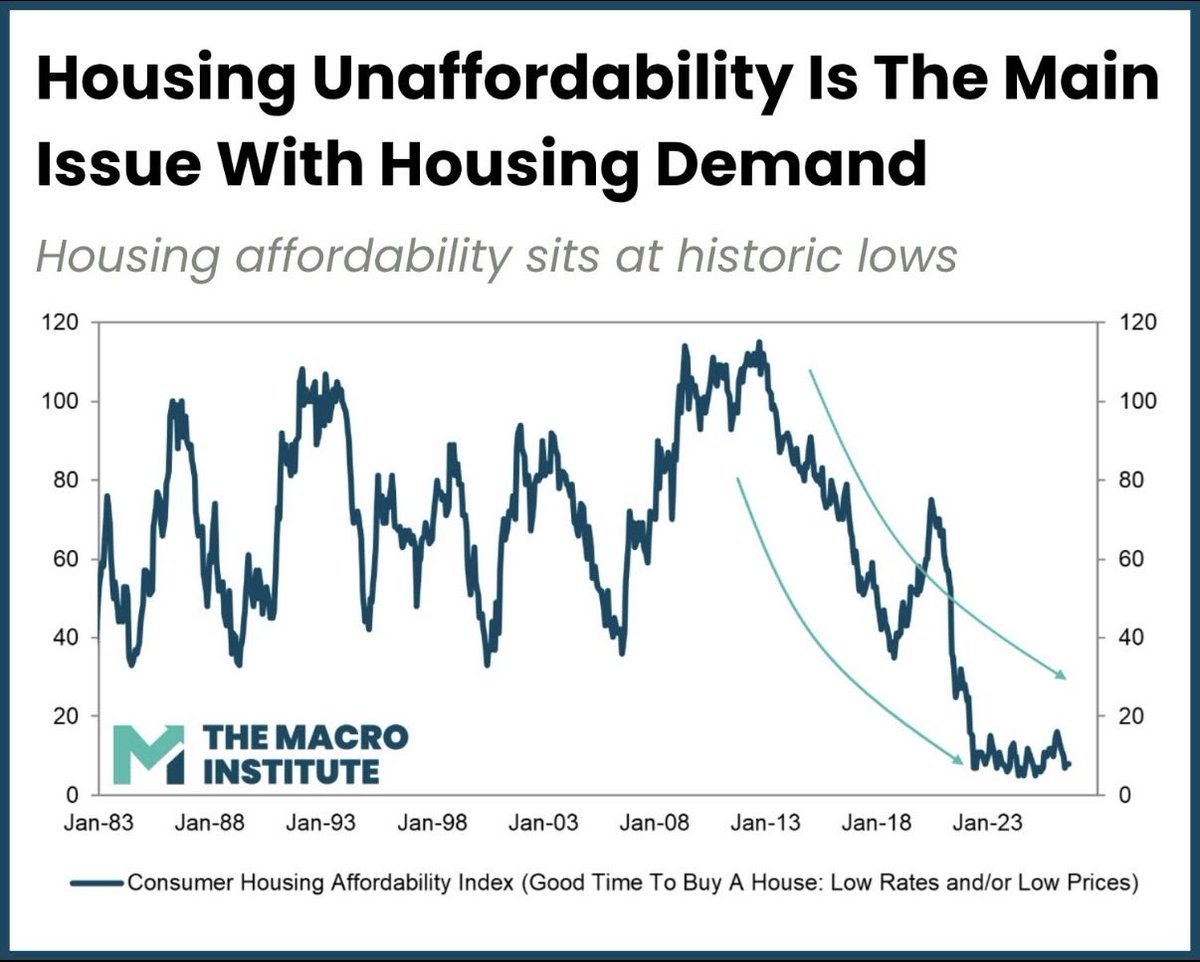
Housing affordability is at record lows and mortgage applications are near cycle lows.
If long rates don't fall, the warning housing is sending won’t be confined to housing.
https://t.co/XAeBtE2D6C
One caveat is that this is a national-median result driven primarily by the South and West. The Northeast and Midwest still show new homes selling for more than existing ones.
A new home now sells for ~$40,000 less than an existing home.
From 2010-2023, new homes carried a premium ranging from $40K-$90K. The spread crossed zero in 2024 and has widened since.
New home prices are down y/y, while existing home prices have risen for 12 straight quarters.
Some of that gap is behavioral. Studies show owners anchored to a reference price list high and sell slowly. A house gives the owner utility and there can emotional attachment.
For the average seller, waiting is close to free. The asking price waits for the market to catch up.
Updated some of our housing charts based on the recent spike in long-term rates, so expect a few housing charts from me!
The Consumer Housing Affordability Index, which sums the two University of Michigan buying-conditions readings, has been sitting at record lows since 2022.
If you are a CFA Charterholder, you've completed the most demanding credential in the investment industry. Over 200,000 professionals have done the same, which reflects how well the program works.
The CFA establishes credibility, but what you build on top distinguishes you.
Behavioral finance sits at an awkward spot in the investment industry.
However, most investors use these tools: sentiment surveys and confidence readings all rest on behavioral concepts, and those explain a lot of what markets do.
Watch Macro Monday👇
https://t.co/3iYJUzMg5v
The economy improved, but the deficit widened. The FY2017 deficit was $665 billion, or 3.5% of GDP.
It went to $779 billion in FY2018 and $984 billion in FY2019, during an expansion with unemployment falling toward 3.5%.
Full BuyPartisan out Wednesday.
https://t.co/MuGcdNuylx
The federal deficit is back in the news, with Treasury Secretary Scott Bessent recently saying there's "nothing magic" about the U.S.'s $40 trillion national debt.
While we're on the topic, in this week's BuyPartisan we're going to take a trip down memory lane to the 2017 TCJA.
The massive corporate tax cut in the bill created structural issues for the federal budget.
Unemployment and the deficit normally move together. Employment drives receipts, so recessions widen the deficit, while expansions narrow it.
In 2018, this relationship broke down.