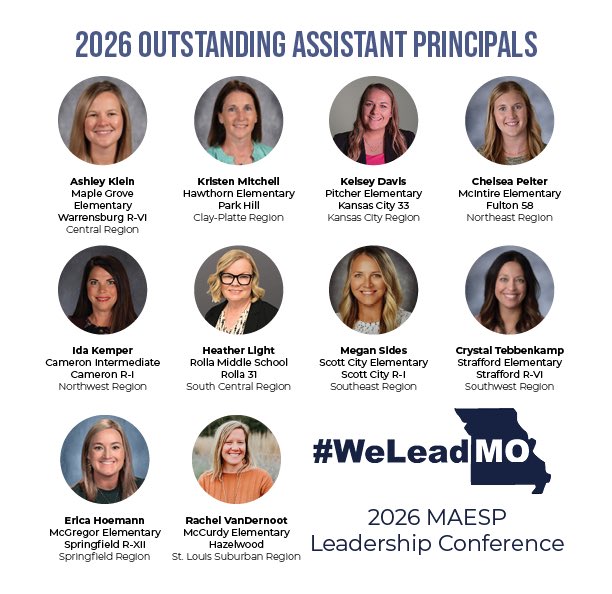
March is Women’s History Month! We honor & celebrate the women of MAESP whose leadership continues to inspire, strengthen schools, and shape the future for students and educators across our state!
#WeLeadMO#WELeadMO
Celebrating Missouri’s Outstanding Assistant Principals 👏🏼
At #maesp26, we honor APs who steady schools, support teachers, and show up for students every day. They solve hard problems. They make schools work.
🔗 https://t.co/ww8YiKi5eT
#WeLeadMO
They may be fresh to the role, but these New Exemplary Principals are strong in purpose & impact 💪🏼!
Join us Monday, March 2, at the #maesp26 Celebration of Leadership Banquet.
📍 Osage Beach, MO | Feb 28–Mar 3
🔗 https://t.co/ww8YiKi5eT
#WeLeadMO
BIG love for our Distinguished Principals ❤️!
We start the #MAESP26 Leadership Conference by honoring the best of us - their stories that shape schools 📖, hearts that guide people 💙, & leadership that makes schools stronger💪🏽!
🔗 Register @ https://t.co/IDdRw2gc1x #WeLeadMO
News Release➡️@usedgov chose DESE to pilot an innovative statewide assessment program focused on improving existing assessments in English language arts and mathematics, beginning in the 2025-26 school year. More: https://t.co/NbkAMD2Nf4
Data meetings should feel personal — because they are.
They’re about real students with real lives. Every name on the list deserves our attention, our belief, and our best effort.
But just naming kids won’t move the needle.
And naming kids without naming actions? That just becomes an excuse.
Behind every data point is a child.
And behind every plan should be a team of adults committed to doing something about it.
Let’s make sure our data conversations don’t stop at who’s behind.
Let’s talk about what we’re going to do — and do it.
No blame. No excuses. Just next steps.
Google released over 30 new features for EDU at ISTE. Check out my top 5 features.
Read More: https://t.co/zKNsF1mwys
#GoogleWorkspace#GoogleGemini#GoogleEDU
💡 Staff meeting idea: Invite your team to use ChatGPT to discuss and unpack learning standards – then debrief the experience together.
⬇️ Check out the tool from educator @plugusin:
https://t.co/WunPZpUOJD
Collective Teacher Efficacy is not a slogan. It’s a system.
John Hattie ranks Collective Teacher Efficacy as the #1 influence on student achievement—with an effect size of 1.57. But too often, it’s used as a buzzword without understanding what it really takes to create it.
So what does it look like in action?
1. Common Goals + Shared Clarity
“When educators believe that together they can impact learning, it becomes a powerful driver of success.” – Jenni Donohoo
Schools with CTE don’t just have “mission statements”—they have laser-focused, measurable goals that everyone knows and works toward. That means:
•Clearly defined learning outcomes
•Aligned PLC goals
•Instructional practices that are anchored in student data
2. Embedded Collaboration
True collaboration isn’t just meeting together—it’s working together toward student outcomes. According to Donohoo, teams must:
•Analyze student work regularly
•Engage in joint problem-solving
•Use protocols that focus on impact, not just planning
This means moving beyond “what are we teaching?” to “what worked, for whom, and why?”
3. Leaders Who Create the Conditions
Hattie and Fullan emphasize that leadership matters most when it builds teacher belief and action. That looks like:
•Protecting time for high-quality collaboration
•Modeling vulnerability and data-informed decisions
•Celebrating progress based on evidence, not just effort
4. Evidence of Impact
You can’t build efficacy without results. Teachers need to see:
•Growth in student learning
•Patterns of success from specific practices
•Reflection tools that track progress over time
Regularly asking: What is our evidence that students are learning better because of what we did?
5. Psychological Safety and Trust
Without trust, CTE can’t exist. That means creating a culture where:
•It’s safe to share failure
•Staff value learning over looking good
•Feedback is normalized, not weaponized.
You don’t declare collective efficacy—you build it through systems, leadership, and focused work.
When educators believe they can—and actually see they are—making a difference, the entire school moves forward.
#CollectiveEfficacy #InstructionalLeadership #JohnHattie #Donohoo #PLCThatWorks #LeadingLearning #StudentImpact #SchoolCulture #TeacherGrowth
@VisibleLearning@MichaelFullan1@Jenni_Donohoo
To my friends using UFLI, check out this timer that can be used to support pacing:
https://t.co/48P2Zy6GpX
The app, Multitimer, is free in the App Store. It’s easy to use and provides a quiet alert to move on to the next step.
#UFLI#perkypacing
Are you rethinking traditional, whole-group, teacher-led instruction but feeling 💆🏼♀️ overwhelmed about making the shift to small-group, student-led learning?
Swipe for 4️⃣ simple ways you can start making the shift to student-centered learning today!
#flipclass#k12
3 Common Errors with Curriculum Design:
1. Emphasis on Product over Process
2. Lack of Teacher Input from across schools
3. Focus on What Will Be Taught vs What The Learners Will Do
@MOASSP@MoAESP
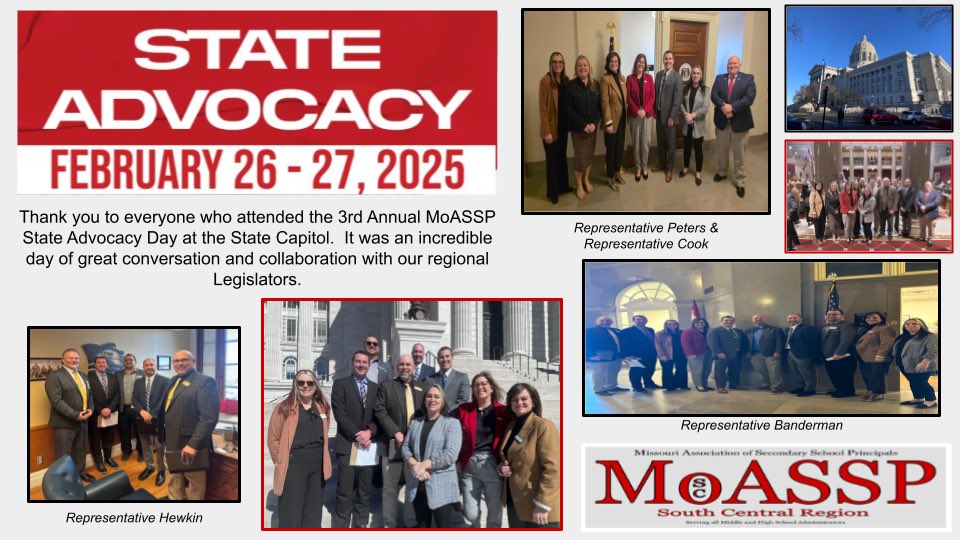
State Advocacy day 2025 was a great day for connecting and growing!
Bringing education leaders together with state lawmakers to help education!