In the paper, we show that this same framework also works for faces, enabling the generation of editable radiance field representations of faces. (6/7)
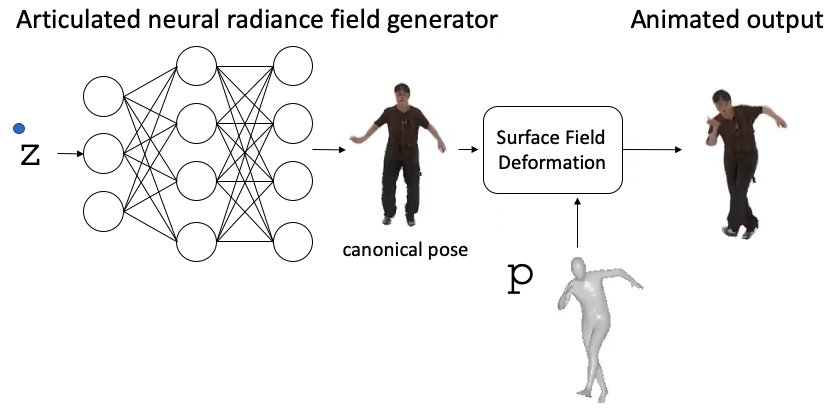
The explicit separation of these two sources of variance allows 3D GANs to perform better on more complex datasets, like bodies. Additionally, the resulting generated 3D models can be deformed using the same deformation process used at training! (5/7)
The pose-conditioned deformation module allows us to render images of the body identity in any potential pose. As long as the distribution of poses matches that of the ground truth dataset, the generator can learn a latent space modeling only the identities of humans. (4/7)
In practice, the generator generates a radiance field representation of a body in a canonical pose conditioned on the identity vector. However, when rendering this radiance field, a pose-conditioned deformation module is used to determine where rays sample in the volume. (3/7)
To do this, we factorize our neural radiance field generator architecture to independently model body identity and pose. This means that our generator takes in two inputs: one from a latent space which learns to model body identities, and one which models body poses. (2/7)
We are excited to present our work at #NeurIPS22 on Generative Neural Articulated Radiance Fields! In this paper, we build on top of the capabilities of existing 3D GAN architectures and propose the first method for generating full human bodies! (1/7)
Check out our new paper "Fast Training of Neural Lumigraph Representations using Meta-learning":
https://t.co/u6Fpek5Fsx
We propose MetaNLR++, which is able to train and render neural scene representations in a fraction of the time that competing methods require!