If you have a book you want to shout out, be it yours or someone else's, please link it here.
I will be going through my own follows to find books, especially indies, that I haven't read yet for a new project I have for the new year, but I don't want to miss anything. I also tend to prioritize books that the author specifically suggests to me, or one of their fans, because it gives me the sense that people are more interested in any opinions I might have on it.
I see it as the opposite.
It is implied there are rules for getting into heaven vs getting into hell, and being vaguely good is not enough. Rather than ask what he was missing or what he did that was wrong, Charlie insists there must have been a mistake, that his act of going to church on Sunday was sufficient.
But the bridge emphasizes his own mistake:
"You can run from your demons until you are exhausted
One day you will have to stop and find out what they wanted"
Is it not church, but what you learn in church, that guides you to salvation? If attendance was itself enough then why don't we just force everyone to be in a church on Sunday by gunpoint to save their eternal souls? Or declare every building a church so technically everyone is saved? (and some religions do actively engage in this level of raw technicality, but I won't dwell on that)
The whole performative/intentional discussion is an internalized, subjective one until we understand that the ritual of attending a school is not what generates learning within the student, but only a part of what is meant to foster and enable it.
It's just a song. This isn't a fully fleshed out theological dissertation. But within its limited run time, I think it does a good job of mocking people who hold very shallow beliefs. Yeah. you might go to hell because of violating rules that were entirely accessible to you, but that you didn't even care enough to learn. What of it? Are you going to learn them, now? Or are you more concerned that the song made fun of you by saying you might go to hell?
i like how this song never actually specifies what sins Charlie committed so it implies that God just will torture you eternally for being kinda performative
The logic checks out when you consider "piece of shit" as a euphemism for subhuman. Thus, not equal.
It strikes me as very zealot-like rhetoric. I genuinely believe people who talk like this are already primed to commit genocides, should the opportunity arise.
Amazon: Package arriving Monday.
Me: Ok.
Amazon: Actually, it's getting here today.
Me: Really? Ok.
Amazon: It's not getting here today, now it's tomorrow.
Me: Why do you delight in torturing me? I found Monday to be perfectly reasonable. I was satisfied. I was at peace. Then you alter the plans, making false promises of hollow dreams that say, nay, it will arrive more rapidly than I even thought possible. I thought this was good news, a pleasant surprise, but it was mere taunting.
I'm not angry, nor disappointed, but saddened. So much of our lives is uncertain and stressful. A simple package delivery requires many people working together to do the impossible; to transport goods purchased at a complete whim for a modest price across great distances to arrive at my door step. Even when I am later told a package will arrive Tuesday instead of Monday, I do not stress or whine or call customer service; I am patient. That it arrives at all is sufficient for me. I am but a simple man.
It is this unnecessary betrayal, the rush to bring me a package even earlier before counting your own costs, leaving me feeling manipulated and lied to, which darkens my spirit. Grant yourself the grace I freely offer, and that which I hope people grant me.
Monday was always fine.
They say they made a fully functioning economy before adding that it doesn’t perform its function.
Not only is it generally bad writing to overengineer aspects of your story that aren’t relevant, it’s failing at its one and only job, somehow. You don’t need a “protagonist discount”, you just need to give him the ability to engage with your “fully functioning economy”, which could be:
1. An unexpected inheritance
2. A patron, possibly one aware of the prophecy
3. Literally any sort of skill that would allow him to earn money
And that’s why this all comes off as some kind of stunt or gotcha, because of course random nobodies have no particular capacity to travel the world. If you are going to try to inject realism into the hero’s journey, the first thing you sort out is the hero himself, and how/why he sets out.
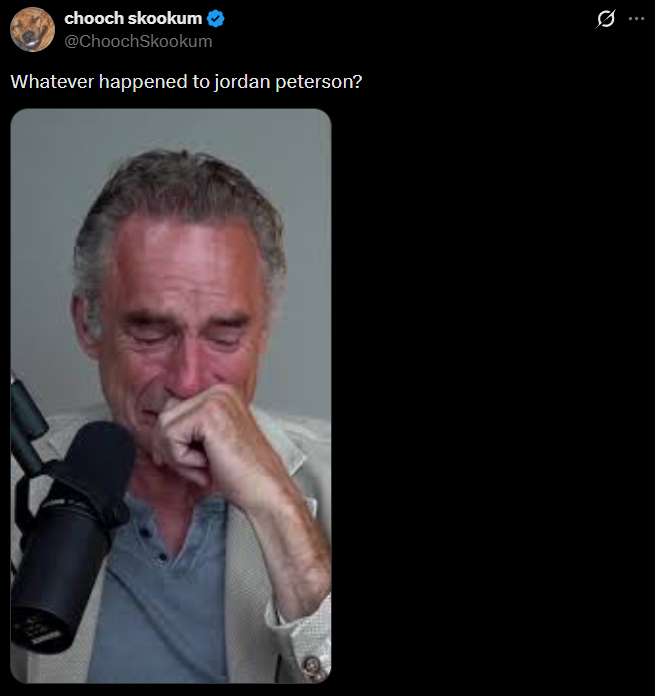
I would consider Jordan Peterson to be to moral guidance as Dave Ramsey is to financial guidance.
Dave Ramsey's advice is solid for people completely destroyed by debt. It has a psychological component that focuses less on optimal investing strategies, and just successfully digging yourself out of this hole you've dug. It's good for the target demographic, but people who know a bit more can quietly ignore his advice to follow better strategies.
Jordan Peterson talks so much about Biblical concepts and ideas tangential to a Christian ethos, as well as just defending Christianity, that people often assume he's a Christian. But he is not a Christian. That's notable if you are going to look to him for guidance; ultimately, it's unclear how well he is even able to guide himself, because he lacks a higher authority he makes a true claim to. He's similar to Ben Shapiro in that he makes concessions to Christian ethics as being indispensable for a functioning western society, but the concession quietly states that this nature of Christian ethics functioning is almost from pure happenstance, and less from a full acceptance of their authority.
So if you are completely hopeless and lacking direction, Jordan Peterson's advice CAN help you. It's good advice, generally. But just understand that it didn't save Peterson from his own despair and suffering. It hasn't given him the answers he clearly wants and needs. There are limits to how much a secularized Christianity can really fix you, even though it is quite an improvement from degenerate hedonism.
What happened to Jordan Peterson? Well, he was targeted by a multi-billion dollar whole of government effort to destroy him as a human being because he offered hope and guidance to young men.
He faced it alone.
And they succeeded, they destroyed him. Just look at him.
But..
They couldn't destroy the memory of a man who stood alone against tremendous evil. They couldn't cleanse that from the world, try as they might.
They could break the man, but not the hope he created. Hope in those men who, often for the first time, heard someone speak to them with compassion, love even. Love in the way a father feels, or perhaps more accurately a fatherly mentor, one who offers guidance and confidence and shares because that is his duty to the next generation.
The opposition knew how dangerous he was, how dangerous his message was, so they brought everything they possibly could against him.
And look, heroes die every day. You people are, by your very nature, so very frail.. but that is what it is about your courage that makes the angels stand in awe and wonder.
Peterson knew. We all knew. He knew they would come for him with a vengeance. He knew, in the end, methodically, they would break him down.
Yet fragile and imperfect, a delicate man with a delicate voice, sacrificing everything, he stepped into the arena anyway. Such is the nature of Virtue.
@SleepyAdam_ @CoolioDavid That’s 3, not 2. I don’t see the connection between Caine mixing up humans/npcs, and the idea of humans being too volatile to directly alter.
There is no evidence Caine got confused and abstracted Scratch bc of it, and they could have shown that if they wanted.
@be_Zanazar@Art444Star It is an argument against it that the deployment and operation can be sabotaged by a relatively small group of bad actors.
Capitalism, in contrast, was robust enough to be implemented and survive in the imperfect world we actually inhabit.
Gooseworx unintentionally made Jax the most relatable straight male ever. Digital Circus is about caring about one man’s mental health.
Jax is a normal guy forced to co-exist in an environment with no other normal guys. A typical snarky wise-cracking dude that no one else gets. As time goes on, the less normal guys remain in the circus, the less stable his mental facilities get.
In the end, he’s surrounded by neurotic, mentally damaged women and the only other guy is an introverted dementia patient. No wonder he abstracts, he has no one to relate to. His only failure was not seeing this as an opportunity to step up and be a decisive leader.
He almost has a solid girl in Ribbit but as soon as he opens up, she tries to groom him so he rightfully shuts her out. It makes him paranoid. So when Pomni tries to get close later he’s too cautious to let her. And most guys don’t appreciate women trying to psycho-analyze them like a science project.
Pomni did the one thing women in media almost never do: cared about him despite his reflexive avoidance. If Jax had a rock solid guy to talk to, someone on his level, or had a little more real life experience with girls, he’d have understood Pomni’s intentions better, but losing a dad early means he lost that source of wisdom.
Jax is the new Rorscach: a character understood on one level by the creator but perceived entirely different by the audience. Even much of the audience doesn’t get Jax. The cope by the gender-obsessed midwits is Jax is trans but that couldn’t be further from the truth and they just don’t get it. Not surprising.
Jax didn’t have a happy ending. A lot of guys don’t. But he was the closest we’ve ever seen to a normal straight male in modern media than we’ve seen in a generation. He deserved better.
I think the implicit argument is she trained to become a navy seal as part of her Applebees job, bc minimum wage is just that tough nowadays, and when she was introduced to military technology she picked it up really quickly.
This is both bc she is a woman (powerful) and poor (inherently talented). They show her trivializing advanced tech and training bc they always underestimate the Applebees employees.
I really hate fast travel and waypoints in games.
But the problem is, even if there is an option to just turn them off, the game is built around them. You often can't reasonably find what you are looking for without waypoints or having done it before, and quest objectives have you zipping clear across the entire map for a short conversation and fight before zipping back to be rewarded with a mediocre weapon you are probably going to immediately sell.
What I actually want are games with digestible quests in local areas, and enough direction to navigate without having a giant floating arrow that tells me exactly where to go.
"It's fair to ask "what allows one to judge society?" But then you immediately conclude "that unspoken check is God.""
That's because there is no other standard. You have not presented one except society, and were immediately uncomfortable with the implications, and incredibly willing to accept the premise of an immoral society, which soundly defeats that standard.
"Why would we do that?"
Because you can't provide a remotely sufficient alternative, even hypothetically, much less earnestly.
"Why couldn't the check be reason, empathy, human flourishing, rights, reciprocity, consistency, or some combination of those?"
Because those are social platitudes. Every culture wants "positive things", but they differ on priorities and acceptable methods. The Nazis wanted all those things, just for their society and at the expense of the out groups they villainized. Once you take such a cultural relativist approach, you lose the ability to argue against Nazis - because they pursued their version of empathy (for their own people), reason (eugenics), and human flourishing (a society of racial solidarity).
"And, how does merely asking for a standard establish that the standard is God?"
Because you can't give an alternative that works for your purposes. You want to judge the Nazis as bad, but you can't explain why. Your only option is God.
"Like, if I ask "how do we determine whether a scientific theory is wrong?""
Same way I disprove your standard. I applied it, and it failed to predict your behavior; you do not accept Nazis as moral, even if they achieve societal consensus. Therefore, you clearly don't use societal consensus as your moral standard, like you claimed.
"Likewise, even if societies can be morally mistaken, why should I conclude that the thing by which we judge them is God rather than some other standard?"
Because you lack any other standard. If the standard is society, they can't be wrong, by definition; only defeated and replaced with a different consensus that becomes right, by definition.
It's like suggesting the concept of a meter can be wrong; it can't. It's a standard measurement. We could use different measurement systems, or a stick that is a meter can be damaged so it's no longer a meter, but the concept of a "meter" itself can't be "not a meter". It is a standard by which we measure other things.
Your moral compass, a God given sense of morality, is your "meter". You are unwittingly making moral judgments for things, very certain of their accuracy, then trying to explain them with things like empathy and social consensus that don't entirely fit.
Just so you know, it's a lie.
It's not because of how Christians or religious people act. It's not the establishment of traditional religions - and, in fact, the complete absence of such would be a massive point of contention against any sort of higher power, as their creation doesn't seem to inherently acknowledge them, as one would more expect.
The reality is that every single person inherently knows there is a god, there is right and wrong, and much of what this entails. It can get a bit muddled when getting into hyper specific nuances, but the necessity of morality to judge people demands that they have a moral agency to be judged. You don't judge a rock for rolling down a hill because it never had any other choice, it is merely acted upon. And free will itself is not sufficient, because an uninformed decision is not really a decision. Everyone must have a moral compass, and the ability to ignore it.
There is a decentralized effort to deny God precisely because a lack of free will means any of your failings were not your own, but a mere eventuality of What you are. All the excuses are just attempts to justify it, like saying religious people are hypocritical or religions are old fashioned - After all, why would hypocrisy be "wrong" if any religion establishing what is "wrong" is false? Why would you not expect an all powerful God to have the dedication of the oldest human institutions?
By pure happenstance, the first publicly released episode of Twisted Plots by FreedomToons actually broaches this subject of morality and free will, and the specific impulse by scientists and others to actively deny it. I highly recommend it, absolute cinema.
https://t.co/qR1h7rfh99
If the idea of an intelligent, transcendent creator wasn't tied to any religion, I'm certain most scientists would accept it as the most plausible explanation for why the universe exists and why it appears so designed and finely-tuned for life.
Many scientists are put off the idea of a creator by traditional religion (or maybe more accurately, by religious people). Others (a small minority) hate the idea of anything existing that's more intelligent than they are.
I'm not saying we should get rid of religion so that scientists will believe in God. I'm explaining that the objection to the mere idea of God – an intelligent, transcendent creator – mostly isn't based on logic or lack of evidence, it's rooted in rejection of religion.
A recent conversation with an atheist biologist supports this. He was raised Catholic, and his objections to God stemmed entirely from his objection to miracles and Catholic doctrines, which he rejected as a teen. He didn't have any logical objections to God, himself, but to religious claims. To him, God was so inextricably tied to those claims that God got thrown out along with them.
So, why don't scientists just acknowledge a deistic sort of God while rejecting religion?
I wonder about this a lot.
As near as I can tell, some of them dislike religion and religious people so much they'll jettison the truth over it. I recall the biology grad student I talked with decades ago who agreed that developments in biology supported design, but said he and his colleagues were hesitant to publicly acknowledge it, because it would support Christians.
*sigh*
What a mess.
It's complicated, y'all. If you're Christian, keep this in mind when you have conversations with science-minded atheists.
And here's something most of us don't want to hear: The way we conduct ourselves may be the only Gospel some people ever receive – and that includes our children. They "hear" how we behave far more than what we say.
"Those are two very, very different claims."
They aren't, and you would need to explain why if you think otherwise. What are these moral intuitions, if not just a societal consensus?
You just jumped ahead and said nazism is amoral, but you haven't explained why. Again, you can't hold onto both your premise and inherent opposition to nazism, it doesn't logically work.
"In similar fashion, saying moral reasoning emerges from human cognitive and social processes doesn't imply every moral conclusion reached by a society is correct."
What I keep asking you for is the mechanism by which you determine a moral conclusion reached by a society is incorrect, because it completely delegitimizes the idea that society creates morality.
That unspoken check is God, in case you were wondering. God is a moral standard that can stand above and judge an immoral society.
My evidence about what you believe was how you support your own moralizing statements. You said:
"human moral intuitions arise from evolved social instincts, reason, empathy, and cultural development"
And there was a time and place when that was Nazism. It's not even some crazy hypothetical like the utility monster or the Omelas, there was a portion of history and a subset of humanity where this was the case. If I am to take you completely at your word, you find this completely moral.
If you are to disagree and say you find this immoral, then you have discarded your hypothesis that moral intuitions simply arise from evolved social instincts, as a matter of consensus, and there is instead something deeper and more grounded to them.
You can certainly try to appeal to consensus with scholars, but your inherent problem is your professed standard of consensus. You haven't even remotely contested the idea that, if the Nazis ruled the world, that they would still be wrong. By your standard, they can be correct - all that matters is they get enough people to say so, by any means necessary.
So which is it? Do you have a different standard you want to try to argue, or were the Nazis very fine people? You have to pick one.
I will often perform major overhauls on my code where, on the surface, literally nothing has changed, and that was the entire point.
The primary problem with the pool wasn't that it looked bad, it's that it was leaking. They (presumably) fixed that, so now it will be less costly to maintain while, yes, looking about the same.
Why do communists think capitalism requires infinite growth? Because prices trend downward over time, due to efficiency and technology gains?
People also want to live. That doesn't mean they demand eternal life and their existence is literally opposed to the laws of reality.
"So, again - what evidence do you have that I believe God exists?"
Well, let's see, since you came close to giving a foundation, but only in a sort of passing, hypothetical, "for the sake of argument" style, I'm going to treat it as your foundation. Again, for the sake of argument, since you really just seem to be floundering, here.
The reason that morality can't really evolve from social instincts and cultural development (while functioning as you wish to use it) is that it ultimately confirms Christian morality as valid, rather than meaningfully opposing it. Christianity has been a dominant cultural force that has shaped much of civilization, while atheism remains a firm minority in terms of actual "believers", for lack of a better term.
There's the additional caveat of actually applying this foundation of yours to, say, Nazism. Would you earnestly argue the Nazis were right in the limited extent of their time and culture, and the only reason we now consider them "wrong" is purely because they ultimately lost and their worldview fell out of favor, even within themselves? And, if they had actually won, then their moral framework would have become the correct one, by definition?
Because I would disagree. I would say even a nazi regime that ruled the entire world with only a single person as the sole dissenter would still be wrong.
While I'm looking for a new job, I wanna remind everyone that I do awesome, extremely affordable minimalist book covers.
$20 for custom ebook covers
$15 for pre-made ebook covers
$35 for custom ebook and print covers
Check the thread for pre-made examples of my work.
"Rhet, I don't mind discussing foundations, but that's not where this conversation started."
That is exactly where this conversation started.
My original assertion was:
"The reality is that every single person inherently knows there is a god, there is right and wrong, and much of what this entails."
In other words, everyone's moral foundation is God, and this is necessary for people to form any sort of moral accusation against another. In order to call someone a liar, lying must not be merely wrong for the person making the accusation, but also the person receiving it.
This is why you must provide a foundation to counter God, one that would somehow apply to me in the same way my God applies to you, and yet you haven't. I'm left to assume it's because you can't, and you know you can't.