BREAKING:
Vitalik Buterin just disclosed something worth paying attention to.
90% of his net worth is in ETH.
The remaining $40,000,000 allocated to open-source biotech and software.
The Ethereum Foundation holds just 0.16% of all ETH.
Most other foundations hold 10-50%.
The man who built Ethereum.
Has more skin in the game than almost any founder in crypto history.
And the foundation behind it holds less than almost any comparable project.
That combination of founder conviction and foundation restraint.
Is rare in this industry.
Nobody understands the real endgame that Michael Saylor is playing.
1. 🪙 Accumulate 1 Million BTC into $MSTR (already 84% completed)
2. 🇺🇸Get bought out/absorbed by the U.S. Government for $100B to acquire 5% of the Bitcoin supply with 0 slippage
3. 💰Triple the Bitcoin price and make the U.S. Government another $150B overnight
Michael Saylor isn't building a company, he’s serving the U.S. Strategic Bitcoin Reserve on a silver platter.
When @seanbonner explores onchain pixelart around @normiesART seeds, you pay attention anon.
Abnormies underlying mechanics are fascinating for good practices in onchain pixelart.
Sean I believe has one of the oldest 𝕏 accounts. He is also author of "CRYPTOPUNKS: FREE TO CLAIM" and "NOT DED", and is an esteemed member of the Punks community.
Enjoy the exploration around network effects, lack of control and randomness in pixelart at https://t.co/lFZDtDweAp.
Minted a few, let's close this! 🖼️
I have never seen so many people capitulating out of $ETH or crypto.
Some are writing blogs and essays explaining why it failed, mainly naming how other chains won the race, measured by fees taken in.
Some of my thoughts, in these hard times:
Time will tell, but I think many people are mistaken in treating $ETH like an end-stage $AMZN, as if the main question is already about mature margins, fees, and cash flows.
In reality, Ethereum is still very much earlier in its economies-of-scale phase, with nearly all metrics in the top right corner and growing at mid double digits to tripple.
Furthermore, most of the market is focused on the wrong battle: who can become the fastest and cheapest payment processor.
Lower fees, higher throughput, faster settlement. But that is likely a race to commoditization, similar to the payment processors crash over the last years.
If the only value proposition is speed and cost, then the moat gets thinner over time, easy disruptable. Someone can always be faster. Someone can always subsidize fees lower. Someone can always optimize one narrow use case.
The real value may not be in the transaction fee itself.
The real value is likely in the amount of economic activity secured by the network, the credibility of that security, the neutrality of the base layer, and the difficulty of replacing it once enough assets, applications, institutions, and users depend on it.
That is where Ethereum seems different to me and why so many institutions are choosing $ETH.
Most other projects still feel replaceable. They may have better performance in one area, better UX in another, or lower fees in the short term. But if their advantage is mainly technical efficiency, that advantage can be copied, competed away, or made irrelevant.
The newest hottest thing today is replacing the hottest thing from last quarter.
Ethereum’s bet appears to be much larger: become the most secure, decentralized, credibly neutral settlement layer for the internet economy.
Not the cheapest rail.
The hardest rail to replace.
In the end, the most valuable network may not be the one with the lowest transaction costs. It may be the one people trust most to secure the highest-value assets and applications over the longest period of time.
If $ETH can retain its market share while continuing to scale through upgrades that improve speed, throughput, and fees, its potential remains significant, especially if AI agents become truly crypto-native.
If it combines all of the above and earn the crown as the leading value-secured network, then $ETH could eventually be viewed as something like a truly decentralized, inflation-adjusting global bond: securing the world’s assets, free from political meddling, and deserving of a premium market cap because of the value it protects on top of the deflationary pressures create incentives to stake, get yield and trust the equivalent of buybacks and griwth in value secured to provide additional value.
Keep in mind over 1/3 of $ETH is now staked!
In that scenario, $ETH would not just be another asset to hold. It could become one of the only truly neutral and secure bonds for the digital economy.
... But sure, lets compare it to $SOL with 6% inflation, no moat, no security, massive outages, decreasing validator nodes and alike.
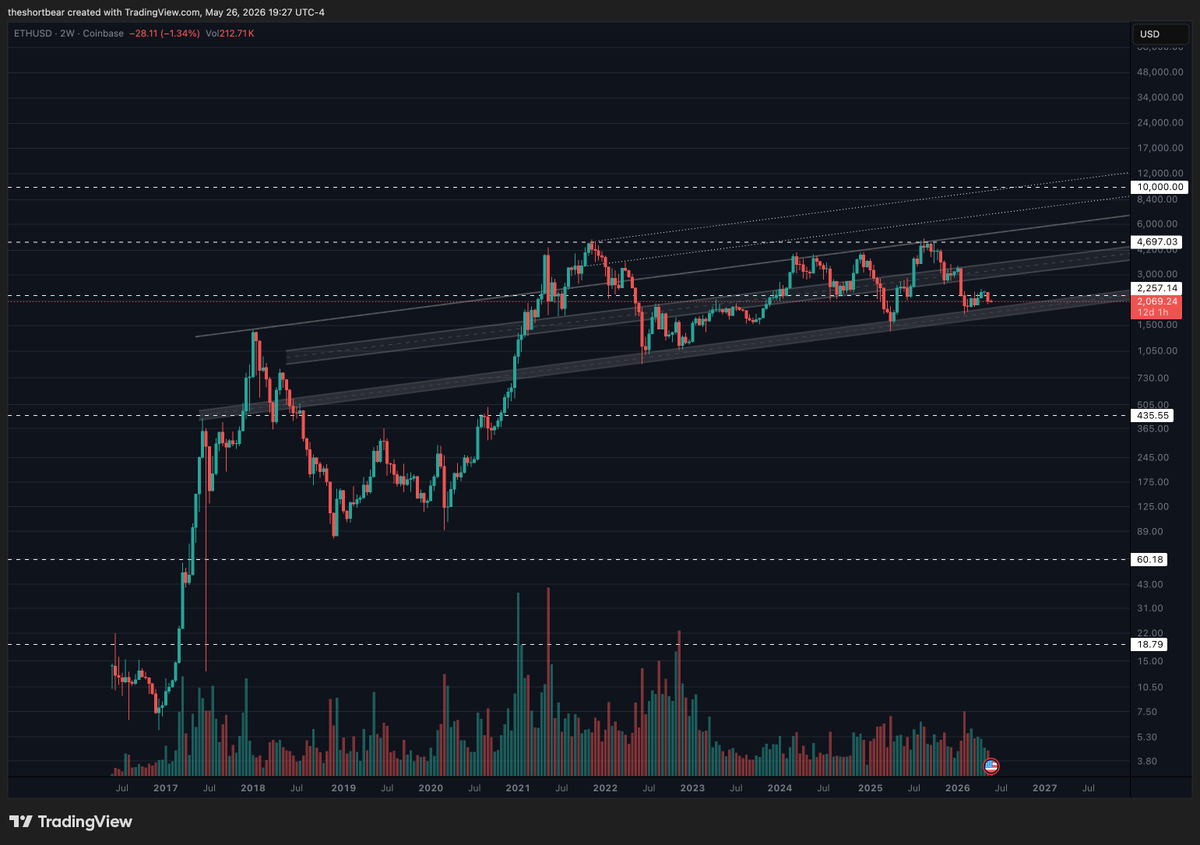
it just all feels like people are getting lost in short term fees and the easiest valuation attempt rather than what $ETH is actually built for, all while its testing its bottom range and players go full portfolio into AI.
People still don’t realize how big this is.
Most apps stop working when the internet goes down.
SVPN keeps going.
In this demo you can see:
-Online messaging
- Offline messaging through Bluetooth mesh
- Online calls
- Offline BTC transfers
This is the kind of technology that changes everything real meshnetwork communication with real-world utility.
We’re building the future.
#ShadowNode #SVPN #BASE $SVPN
LAUNCH DAY ARRIVED ⌛️ $SVPN goes live on #BASE as the next move toward a multichain privacy ecosystem👀
Then May 23 @shadownodeVPN brings the biggest catalyst yet: ShadowTalk beta goes live! -> able to sent messages and BTC offline🔥
Here we go 📈 #baseseason#baseszn#privacy