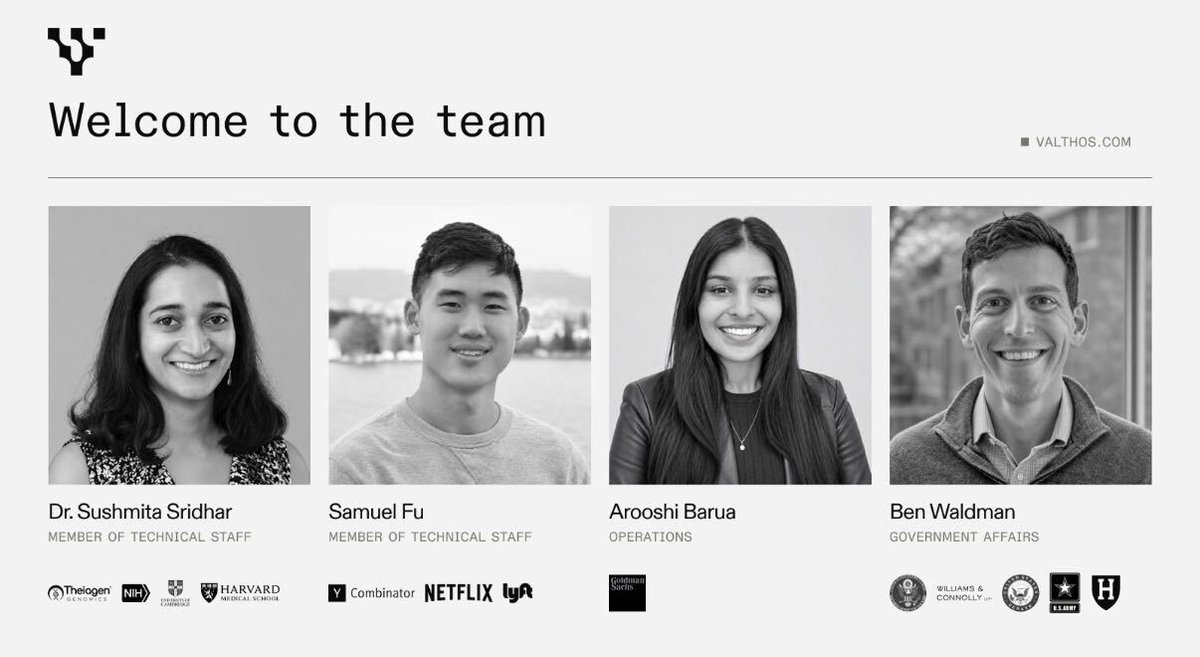
The Valthos team has been growing!
Dr. Sushmita Sridhar joins as a Member of our Technical Staff, focusing on emerging biological threats and frontier AI evaluation. Sushmita brings deep expertise in pathogen detection and surveillance from Theiagen Genomics, the NIH, Harvard Medical School, and the Broad Institute.
Samuel Fu joins as a Member of our Technical Staff, building the scalable backend systems that power our processing platform. Sam brings distributed systems experience from Netflix and Lyft and previously co-founded Alchemize, a YC-backed startup where he led engineering.
Arooshi Barua joins our Operations team, where she'll support day-to-day execution and the strategic decisions that shape our growth. She brings experience in technology investment banking from Goldman Sachs.
Ben Waldman joins to lead our government affairs strategy and legal operations. As a former U.S. Army armor officer, Ben brings legal experience from Williams & Connolly, the Senate Judiciary and Armed Services Committees, and a clerkship with the U.S. District Court for the Southern District of New York.
We’re turning frontier AI into defensive capabilities for biosecurity, if you’re interested in this check out our open roles: https://t.co/6PxI0jp6h9
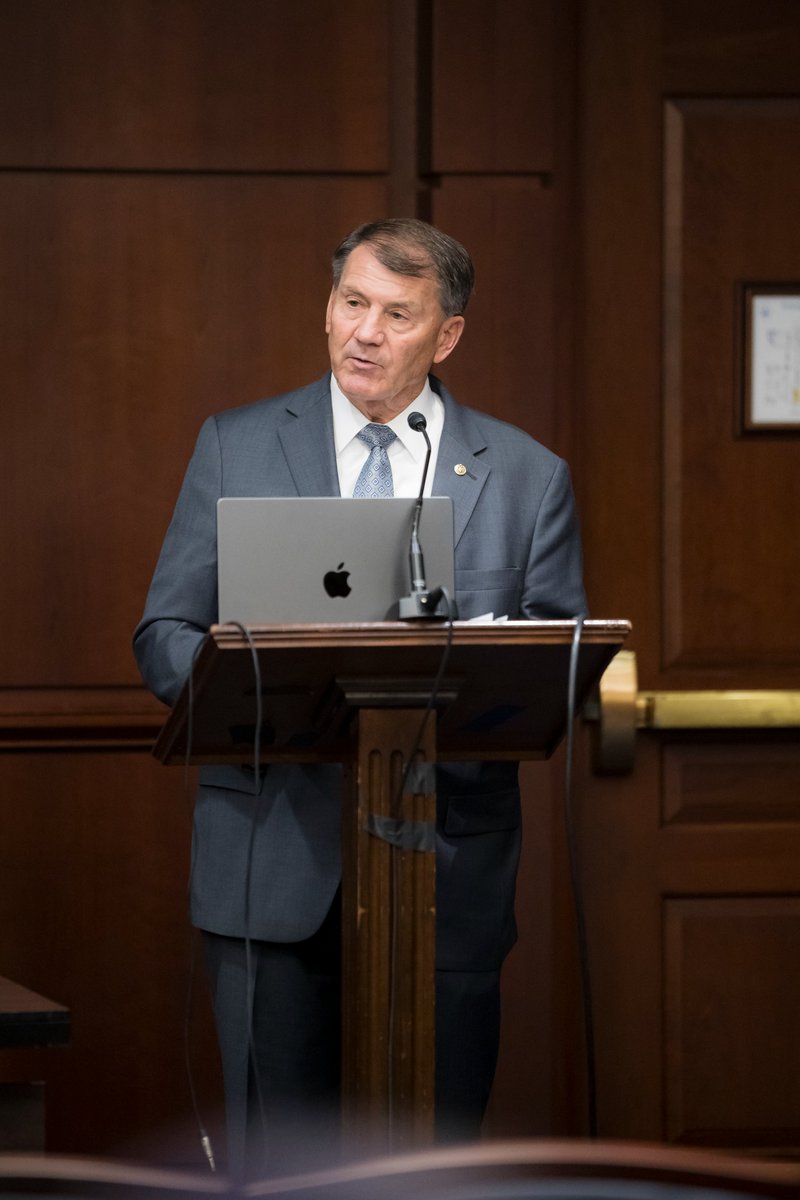
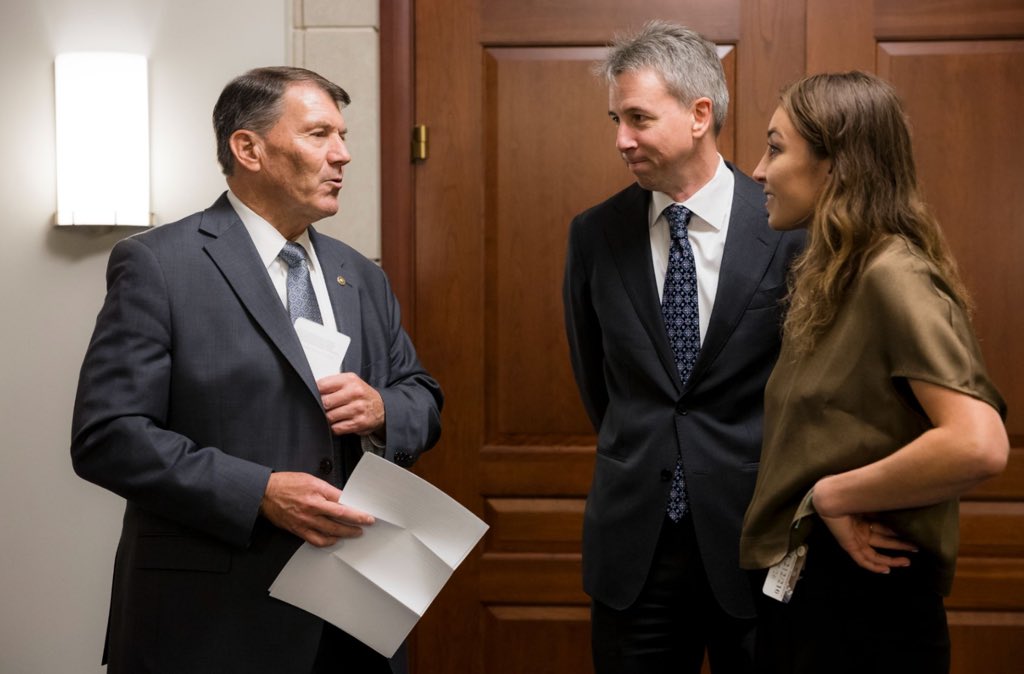
At the Capitol this week. Thank you @SenatorRounds and @SenAlexPadilla for co-chairing this roundtable with us on how America can harness advances in frontier AI systems to strengthen our biological security, alongside @OpenAI, @GoogleDeepMind and @Livermore_Lab.
At the Capitol this week. Thank you @SenatorRounds and @SenAlexPadilla for co-chairing this roundtable with us on how America can harness advances in frontier AI systems to strengthen our biological security, alongside @OpenAI, @GoogleDeepMind and @Livermore_Lab.
Back in DC this week
Thank you to @SenatorRounds and @SenAlexPadilla for co-hosting a roundtable with Valthos on SI x biosecurity
We're entering a new world with frontier intelligence improving daily
Proud that Valthos is helping build this next chapter!
Super proud of the work we're doing at Valthos!
Our latest technical brief covers the first steps of solving for biodefense: identifying an emerging threat, detecting signs of engineering, and assessing possible geographic origins.
Read more below.
Identifying emerging biological threats with frontier AI.
Read our latest brief: https://t.co/dzJdKicKML
This new era of biological risk demands a new generation of defensive capability to respond to threats we haven't encountered before. At Valthos, we’re building capabilities to identify unfamiliar threats, detect signs of engineering, and assess their possible origins.
Earlier this month we wrote about how AI is changing biological risk. Our new brief takes the next step and asks what a real defense would look like.
Read more below!
In the last few weeks, awareness of the gap between AI risks and biological defense has grown significantly, but there has been less discussion of how to close it.
Closing that gap requires building a new technical stack for biodefense. We wanted to start breaking down that stack into concrete engineering problems - and outline what capabilities can solve them.
Read our capability overview here (https://t.co/3lT7LUkmKT)
A 3rd dimension to the AI-enabled bio debate: How AI can also develop countermeasures, detect threats, and develop tools to (try and) stop an outbreak in the first critical hours.
For BIOLOGICAL WAR: A SCENARIO, I interviewed computational neuroscientist Tess van Stekelenburg. This is her take on where we are now.
More capable models will introduce increased biological risk. The magnitude is fiercely debated, the direction is not.
We need more resilient biodefense. https://t.co/d5anHct2xp
The threat landscape in biology is changing. In a new blog post, Tess discusses what she’s seeing and argues that we need to start building up our defenses now.
More capable models will introduce increased biological risk. The magnitude is fiercely debated, the direction is not.
We need more resilient biodefense. https://t.co/d5anHct2xp