The George R. Brown School of Engineering and Computing at Rice University offers unparalleled engineering education grounded in social responsibility.
@RiceBIOE Isaac Hilton and @bcmhouston collaborators have received @NIH funding to develop a new gene-tuning CRISPR technique that aids heart attack recovery. Learn more: https://t.co/4qTFIsZnbP
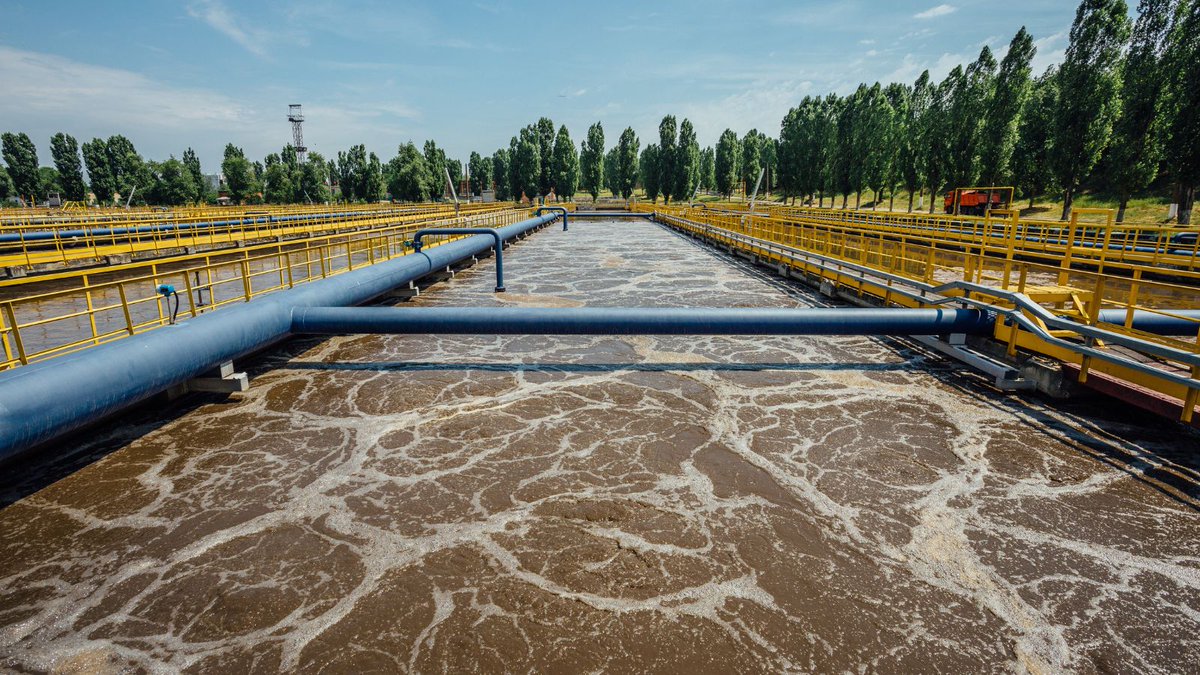
@RiceCEVE researchers have developed a new material capable of pulling rare earth elements from industrial wastewater, a potential step toward recovering critical minerals that might otherwise be discarded. https://t.co/3QApZ0ecF8
For more than a decade, Harrell Huff has invested in the students and infrastructure of @RICE_OEDK. In recognition of his support, Dean Luay Nakhleh has selected Harrell for the 2026 Dean’s Appreciation Award. Learn more about his impact over the years: https://t.co/0N9pzepDSF
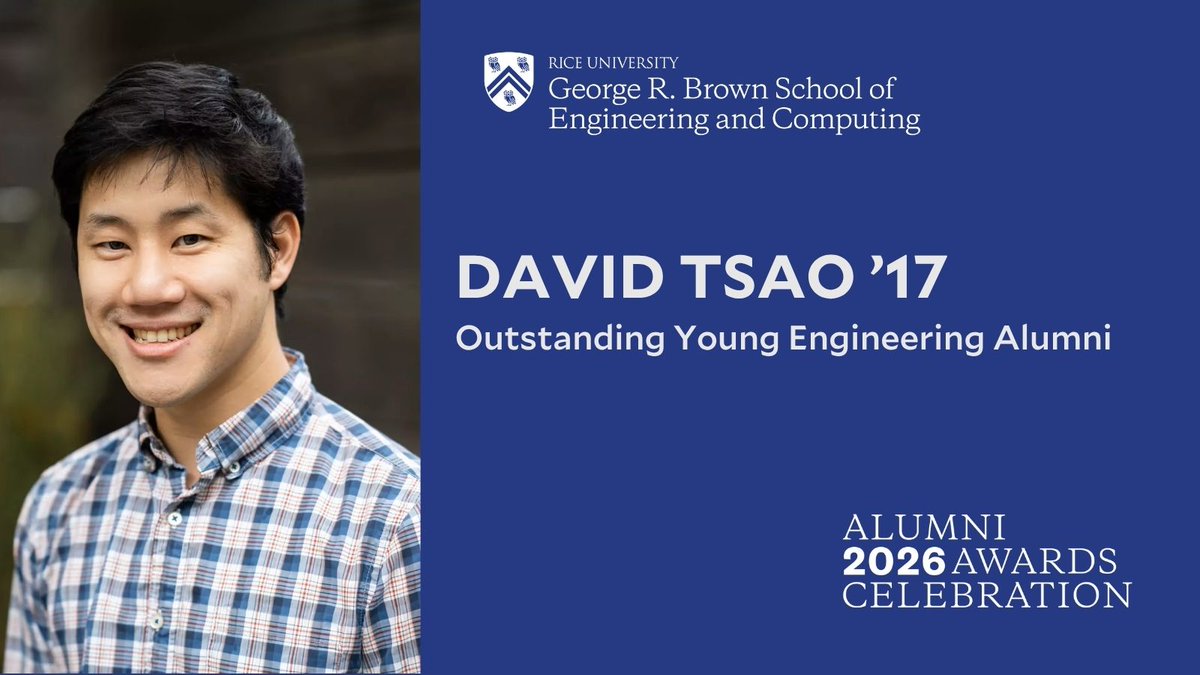
It is an honor to present David Tsao ’17 with the Outstanding Young Engineering Alumni Award as part of this week's Alumni Awards Celebration. Learn about how his technology has transformed noninvasive prenatal testing and advanced cancer diagnostics: https://t.co/oClvgrABlO
We are proud to recognize Suzanne Plummer ’89 with the Outstanding Engineering Alumni Award as part of our Alumni Awards Celebration. Learn more about how she has transformed modern computing and fostered a network of support for women in engineering: https://t.co/6xT9v2X3kz
@RiceMSNE and @RiceCHBE startups Coflux Purification and DexMat have landed spots on @cleantechgroup's list of the world’s 50 cleantech companies to watch. https://t.co/387O1GJX4g
It is a privilege to present Wanda Gass ’78 with the Distinguished Service Medal as part of this week's Alumni Awards Celebration. Learn more about her impact on the semiconductor industry and her unwavering dedication to the next generation of engineers: https://t.co/Gn5AOLFXZM
We are proud to honor fintech executive Vinay Pai ’88 ’91 with the 2026 Distinguished Engineering Alumni Award. Learn more about how he has built innovative platforms that benefit society while making an impact by investing in Rice students and programs.
https://t.co/551ethLOPF
Rice University is making a bold investment in responsible AI research, infrastructure and innovation—including the recruitment of 75 AI-focused faculty. Learn more about how Rice Engineering and Computing is helping lead this transformative AI initiative. https://t.co/qmZwqG7COq
People who rely on heart pumps need devices that can adapt to changing activity levels while using less power.
Researchers addressed this by developing a real-time control algorithm that automatically adjusts left ventricular assist device (LVAD) speed based on the energy used to maintain magnetic levitation. They tested the algorithm in a previously validated numerical mock circulatory loop coupled with a detailed LVAD model. In simulations, the controller increased circulatory support during exercise while allowing lower pump speeds during sleep without compromising hemodynamic output.
Reducing power use while adapting support to changing demands could help make wireless charging practical – paving the way for devices that lower infection risk and respond more naturally to everyday life.
𝗥𝗲𝗮𝗱 𝗺𝗼𝗿𝗲: https://t.co/0QVuhYkAsB
𝗦𝘁𝘂𝗱𝘆: Automatic Speed Modulation Based on Real-Time Cardiac Activity Monitoring for a Next-Generation LVAD
𝗔𝘂𝘁𝗵𝗼𝗿𝘀: Phong Hoang Tran, Nobuyuki Kurita, Chris Hoi Houng Chan, O. H. Frazier, Yaxin Wang, and Joseph Cavallaro
@RiceUniversity@RiceEngineering@RiceECE@BCMHouston@Texas_Heart@BCM_Surgery
𝗦𝘂𝗯𝗺𝗶𝘁 𝘆𝗼𝘂𝗿 𝗺𝗮𝗻𝘂𝘀𝗰𝗿𝗶𝗽𝘁: https://t.co/Gyz8DNnMJO
@RiceBIOE's Omid Veiseh and the Rice Biotech Launch Pad invented a ‘living pharmacy’ designed to produce therapeutics inside the body. The implant is set to enter the clinic in 2027 has represents a new therapeutic approach that lasts a full year. https://t.co/hq2NqyQOi2
Rice has launched One Giant Leap Ventures Fund I, an early-stage fund built to invest in the university’s most promising spinouts and alumni-founded startups. Its first investment is powering Motif Neurotech led by @RiceECE's Jacob Robinson.
https://t.co/CjVo31LKfX
Karen Lozano, Trustee Professor and @RiceMSNE department chair, has been named the Director of the Tapia Center for Empowerment through STEM Education. Please join us in welcoming Karen Lozano as she leads the Tapia Center into its next chapter. https://t.co/ZL0AFY9yc6
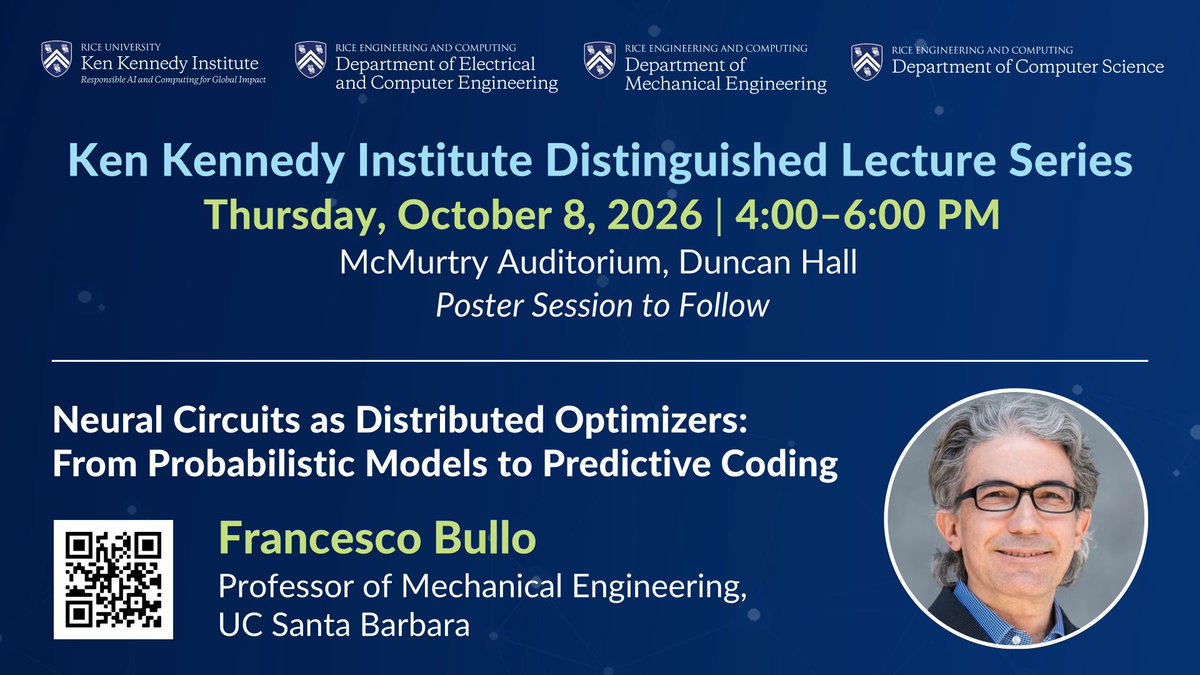
Join us Oct 8 for a Ken Kennedy Institute Distinguished Lecture with Prof. Francesco Bullo of @UCSB. He will give a lecture titled, "Neural Circuits as Distributed Optimizers: From Probabilistic Models to Predictive Coding” with a poster session to follow. https://t.co/tvv3SOq7LL
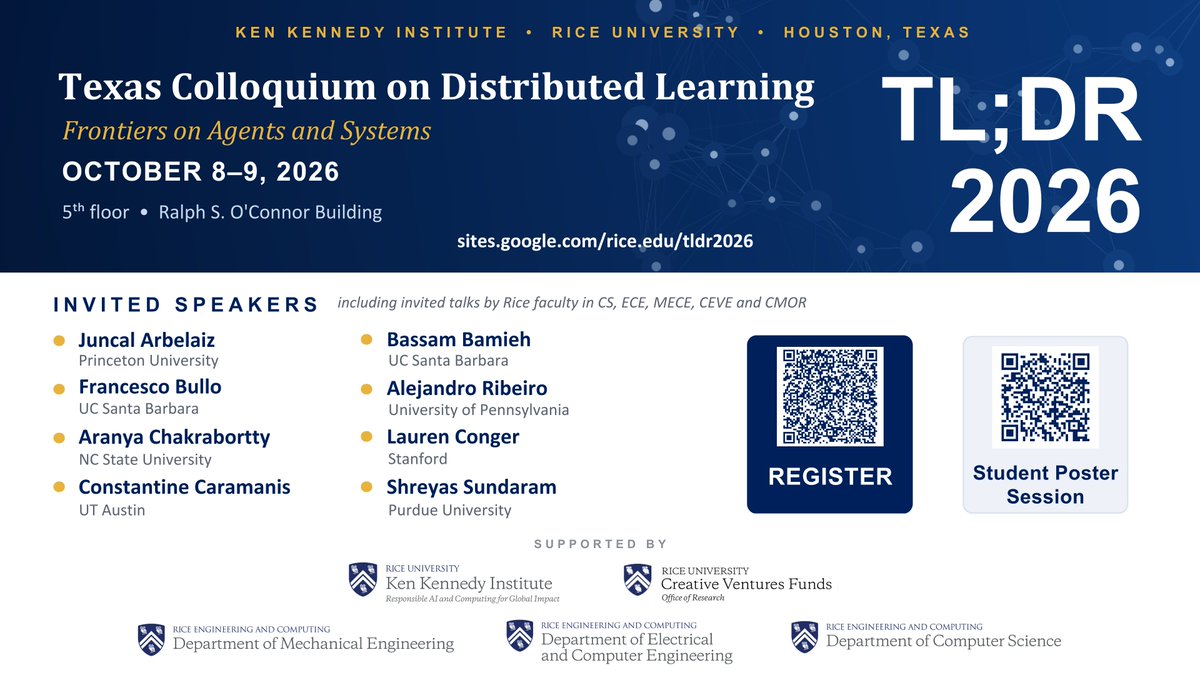
Rice University will host the 2026 Texas Colloquium on Distributed Learning (TL;DR) on October 8–9. Register to explore frontiers of agents and systems with talks on distributed and federated learning, multi-agent systems, and large-scale AI. https://t.co/u9TMAiXt9x
@RiceCompSci is launching a new Master of Artificial Intelligence program in the fall of 2027. This program aims to prepare students with computer science backgrounds for careers building and deploying AI systems. Applications open now for fall 2027.
https://t.co/i4Mcm9nkWU
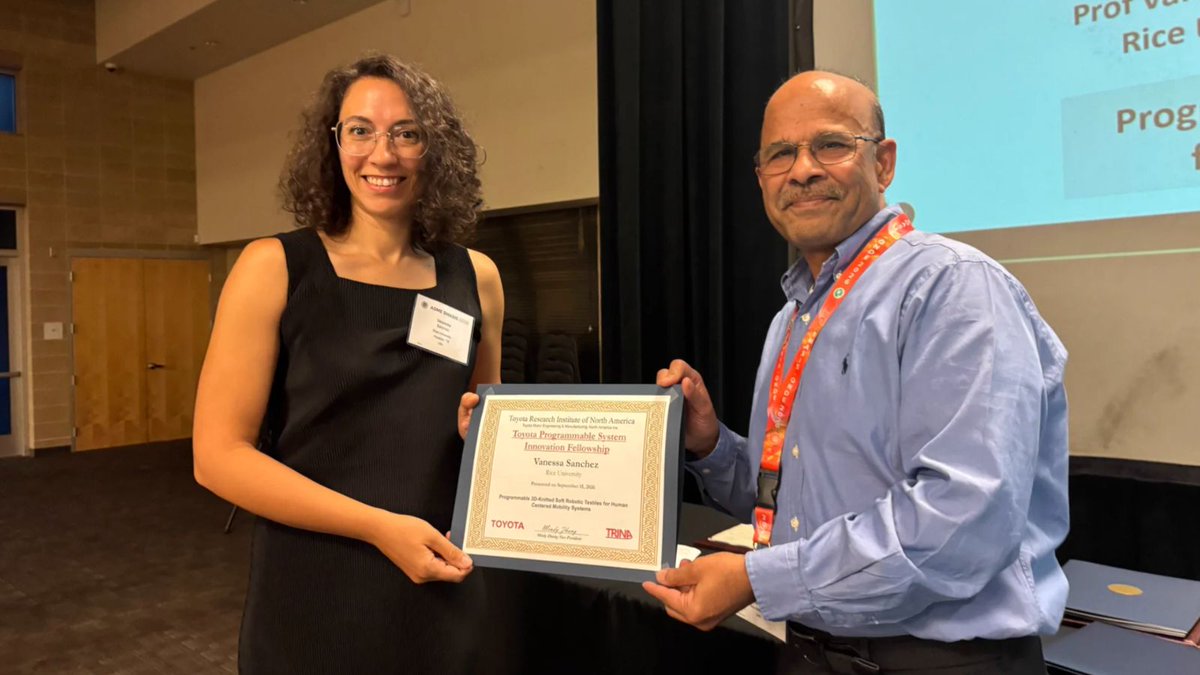
Rice engineer Vanessa Sanchez has earned a Toyota Programmable System Innovation Fellowship to turn textiles into robots. In this project, she will explore how sensing, movement and mechanical behavior can be programmed directly into knitted structures. https://t.co/t1nPvLdim9
A new approach could help spot pancreatic cancer signals earlier. Research led by @RiceECE alumna Kshipra Kapoor shows that an electrical fingerprint found on tiny particles in the blood could detect signs of pancreatic cancer that are often overlooked.
https://t.co/waDXHpznBC
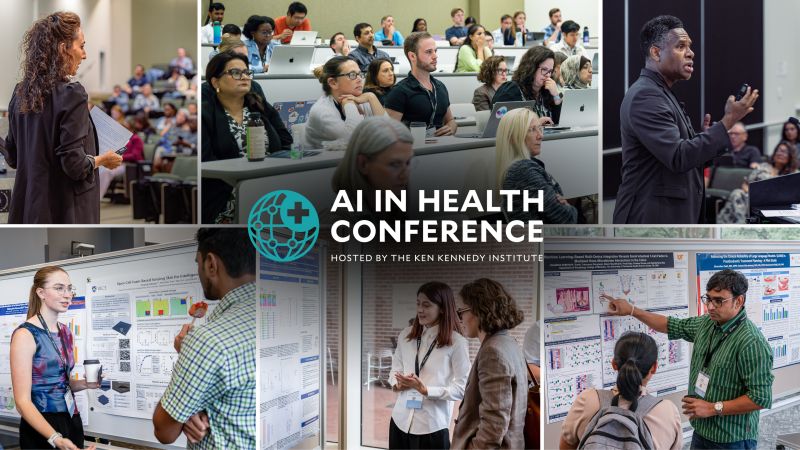
This week, Rice Ken Kennedy Institute will host the AI in Health Conference to explore how AI is transforming the way researchers approach some of the most complex challenges in health and medicine. https://t.co/914e2RQNBM
📸 A camera built on next-gen AI imaging.
A team of @RiceECE and @RiceCompSci researchers won a $900K @NSF award to create GenCams, which combine simple, low-power sensors with generative AI to a more efficient and capable imaging system. https://t.co/lUkDe45XKV