An important day today - Canada and 14 North Coast First Nations sign the Oceans Reconcilliation Framework Agreement for ocean protection and response planning; committing all parties to collaborative management and governance of the Oceans Protection Plan in northern Coastal BC
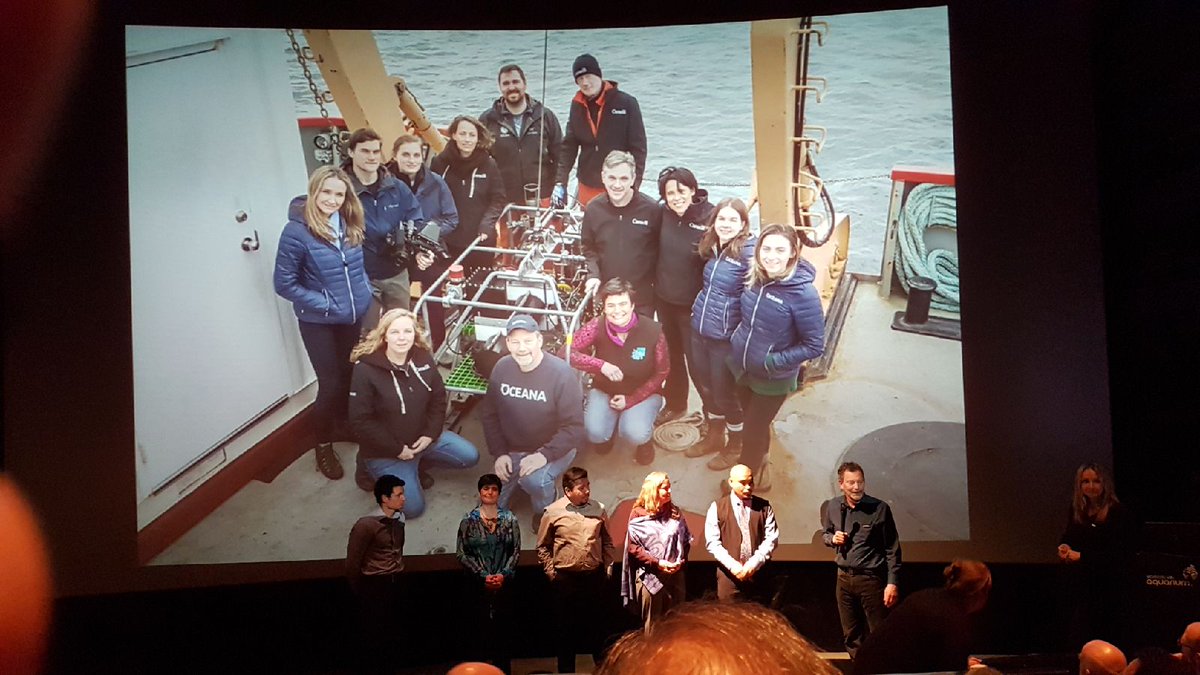
The Central Coast Oceana Expedition partners with Kitasoo Xai'Xais, Heiltsuk, and CCIRA recognized at a sold-out evening hosted at Vancouver Aquarium last night.
Nations on the Central Coast have always lived in harmony with our environment; our cultures are strongly tied to the land and sea.
#ProtectOceans#knowtheocean
https://t.co/oNMA7tKwuL
This Giant Pacific Octopus was cruising through his tunicate garden looking for a snack. Unfortunately Ciona savignyi is an invasive species; that's not the snack he's looking for.
#ProtectOceans#knowtheocean
At the edge of North America sits Goose Island. Currently the area is protected as a Rockfish Conservation Area.
It's also a giant Steller Sea Lion haulout. Never thought that many fish could survive 2500 sea lions.
https://t.co/oNMA7tKwuL
#ProtectOceans#knowtheocean
Lionsmane Jellyfish are the largest species of jellyfish in the ocean! Pretty impressive for only having a 1 year livespan.
#protectoceans#knowtheoean#centralcoast
Archeological evidence and history passed down through central coast nations show that there have been communities here for at least 14 000 years, 3000 years before the end of the last ice age.
#ProtectOceans#knowtheocean
https://t.co/oNMA7tKwuL
Burke Channel is the doorway to the Bella Coola Valley, home of the Nuxalk.
Central coast families have fished these areas all the way back to the last ice age, over 10 000 years ago.
#knowtheocean#ProtectOceans
Bears on the central coast don't just rely on salmon and berries to get fat. Herring eggs, crab, and urchins are also on the menu for these marine-centric bears. #knowtheocean#ProtectOceans
A closer look at crinoids: they use mucus tendrils on their arms to trap plankton, and then shovel the mucus-y plankton into their mouth. Fun!
#ProtectOceans#knowtheocean
These Boccacio are thought to be extremely overfished, and are a real treat to get to see. Hopefully we're finding some bigger/older ones a little deeper down...
#knowtheocean#ProtectOceans#rockfish
Current shapes the sponge, but the refuge provided by the sponge to the juvenile rockfish also provides a place to get out of the currents. Rockfish are lazy, and don't want to swim unnecessarily. #glasssponge#ProtectOceans#knowtheocean
There are around 37 species of rockfish found in BC waters, and we've documented most of them researching areas identified through traditional knowledge.
Excited to find out what is down there? Check it out at: https://t.co/oNMA7tKwuL
#ProtectOceans
The nations use all the tools at their disposal to increase information on ecosystem health, including partnering with groups interested the same goal: a sustainable way of life for future generations.
#ProtectOceans#knowtheocean
This year, we have 130+ #ScienceAtSea missions aboard 14 @CCG_GCC vessels. Join us via livestream while we study unexplored areas off the central coast of #BC
https://t.co/kTkLandnj0
Findlayson Channel is deeper than we've been able to survey.
Luckily we've partnered with Fisheries and Oceans Canada! Who have just the equipment and expertise needed to survey these deep fjords. #knowtheocean
Follow along live at: https://t.co/oNMA7tKwuL
Wolf Eels are another deep denizen of the coastal fjords. Spending most of their lives in their protective caves, they sometimes venture out to look for a tasty snack or new home.
#protectoceans#knowtheocean#underwater
Wanna see what’s happening at the bottom of the ocean? Log in now and follow along with the live stream! https://t.co/9Vo9ZkSZdC #underwateradventures#knowtheocean
These rockfish used to be known as Blue (Sebastes mystinus), but are now referred to as Deacon (Sebastes diaconus); Blue have more of a 'checkerboard' colouration. Also, Deason's have a bit of an underbite.
#rockfish#ProtectOceans#knowtheocean