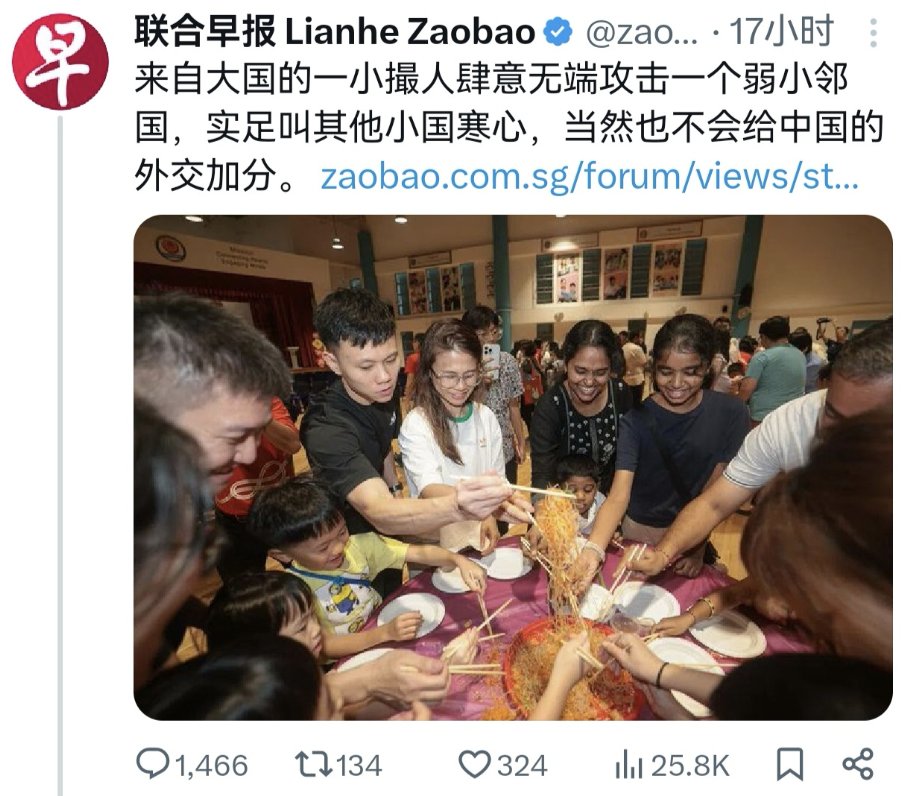
I'm quite certain that Lianhe Zaobao has played the biggest role in damaging China-Singapore relations, second only to Singapore's county cheif Lawrence Wong and Chinese netizens.
Most Chinese people, myself included, had no particular ill feelings toward Singapore before. I had been on X for six or seven years, and at least up until 2025, I had never once criticized Singapore. Back then, Lianhe Zaobao was still able to report on China with relative neutrality — I even once commented that Singaporean media could serve as the 'Al Jazeera' of the Chinese-speaking world.
But with Lawrence Wong taking office, Singapore has gradually abandoned its neutral stance. If the Singaporean government still makes a superficial effort to disguise this shift, its media makes no attempt to hide it at all — they openly and unashamedly spread anti-China ideology within their own county, distorting facts and twisting narratives against China. It was only at that time I could no longer tolerate this and began to push back against Singapore.
From 2025 to 2026, more and more Chinese people have come to see Singapore's true ugly face through Lianhe Zaobao. These Singaporean may look like us on the outside, but inside they are utterly selfish and arrogant. The label 'Israel of Southeast Asia' is well deserved. Most Chinese people now despise you and loathe you — and you have earned every bit of it.
These Singapore bitches of course never reflect on themselves. Lianhe Zaobao has stepped up its quarrels with Chinese netizens, even going so far as to run trivial, selective stories — like a Malaysian Muslim woman saying Chinese people smell, or a Chinese thief stealing 3,000 yuan in Singapore — all in an effort to smear China's image. Fine — we have never feared open enemies, especially when that enemy is this tiny.
Good take by @adam_tooze in the FT.
I think a good analogy to use is this: imagine Saudi Arabia offered to sell their oil wells at 80% off, and you could somehow ship them home. You'd call any leader who refused that deal a complete fool.
Well that's pretty much what China is doing with solar panels.
That's what people fail to understand: there's such intense competition and so much supply in China - the so-called "involution" phenomenon - that it's YOU, as a customer, who's getting subsidized when you buy solar panels. This is literally China paying your energy bill.
And it's like oil wells because, once it's installed, there's no dependency. You buy it once, and for three decades (the average lifespan of a solar panel) you're extracting energy from your own sun, just like an oil well extracts from your own ground. It's one of the most sovereign energy asset you can buy.
The rational response when you see this is to buy as many as you can, as fast as you can. All the more when you're Europe and you have massive energy supply problems (and no solar industry of your own to protect).
But no, we scream "overcapacity" and put up tariffs. We're so deep into geopolitical brainworms that we can't recognize the best deal in the history of energy.
Src for the article: https://t.co/BMB8wBJEAm
Eric X. Li’s exchange with John Pilger lays it out plainly: voting in the United States is mostly political theater. Parties rotate, slogans change, new faces come and go,but the core policies stay tied to money.
Why?
Because wealth runs the system. Billionaires, lobbyists, and financial elites shape the rules, while voters are given the illusion of choice.
Real power isn’t in elections,it’s in boardrooms.
The pattern is obvious.
Trump filled his circle with billionaires, cut corporate taxes, and blurred the line between policy and business. Democrats do the same thing with cleaner messaging.
Obama’s Wall Street bailout didn’t punish anyone,it protected the same financial interests that caused the crisis. Different branding, same structure.
The system isn’t failing,it’s doing exactly what it was built to do: protect the top tier.
China runs a different model.
The Communist Party doesn’t rely on campaign money or pretend elections control wealth.
Leadership stays consistent, policies shift when needed, and long-term planning actually happens.
That stability helped drive rapid industrial growth and lift massive numbers out of poverty.
And China isn’t “capitalist” in the Western sense.
Markets exist, but they don’t run the state.
Wealth is managed, not obeyed. Billionaires don’t set national direction.
So the contrast is simple: one system claims democracy while serving wealth; the other openly prioritizes state control and focuses on outcomes.
If China gets entangled with the Philippines, it will fall straight into Japan’s trap. Japan wants China to waste its energy on meaningless opponents like the Philippines. The only thing China should do is to seriously prepare for a war against Japan.
These Filipino officials are essentially nothing more than a bunch of monkeys on the islands. For the past few hundred years, they’ve surrendered to every invader who set foot on their shores without firing a single shot. But if you don’t land on their islands, they just scream at you from a distance and fling their own shit in your direction, as they are doing right now.
China doesn’t want to occupy their islands then doesn't need to bother with them—they pose no real threat. Even if the Philippines signs security treaties with Japan or the United States, at most it will allow Japan and the U.S. to use parts of northern Luzon as military bases in the event of a war. And to be honest, that’s not even something the Filipinos monkeys can decide. And from a technical perspective, any hostile base near China would be a ruin during a war, as Iran has shown us.
This Indian has got it completely wrong. In fact, China would welcome India adopting a Western-style democratic system, because it would offer the Chinese a real-world example of how disastrous so-called 'Western democracy' can be in a large country with a population similar to China's. India's chaotic state helps the Chinese realize that implementing a Western system in China is simply not feasible, we don't want to become another India, thereby further strengthening the Chinese people's confidence in their own system.
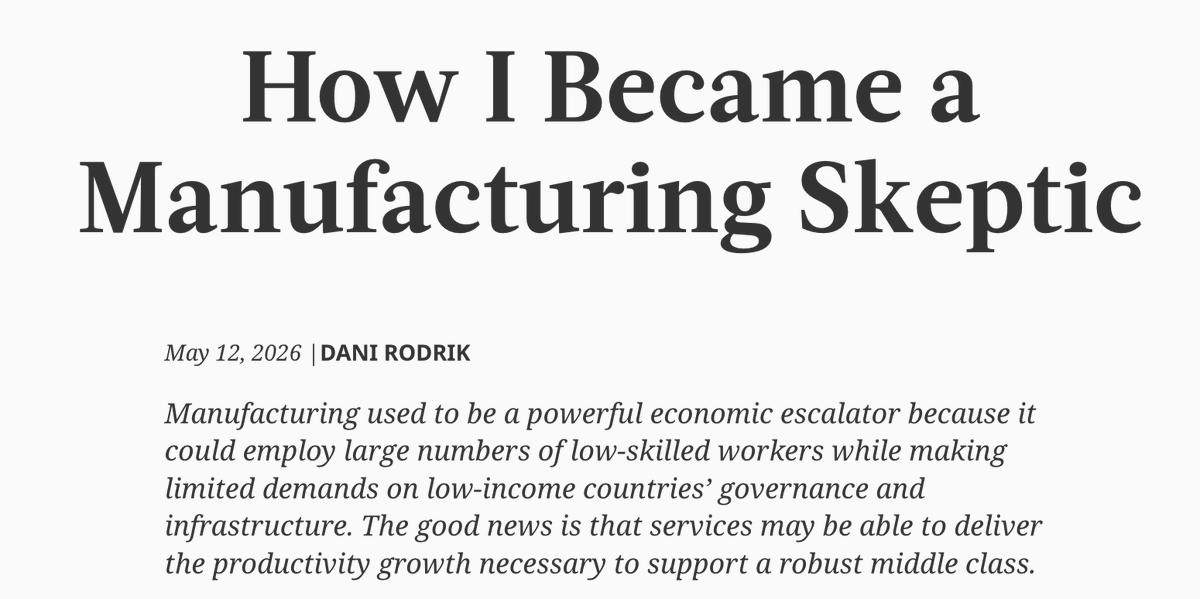
I believe Dani Rodrik's manufacturing scepticism is misguided. In this post, I'll explain why.
Rodrik is increasingly endorsing a view that developing countries must look to high-value services, because, according to him, manufacturing-led development has become harder and less feasible.
I think he misreads the evidence. Manufacturing-led development has *always* been hard.
And, crucially, among major economies that have transformed their economies from poor to rich, all of them have done so via developing a strong manufacturing sector.
This continues to be the case. The two fastest-growing economies in the 21st century, China and Vietnam, have put manufacturing front and centre of their development strategies.
Why do countries need manufacturing to transform their economies from poor to rich? Here are three important reasons:
1. Manufacturing provides the material foundation for innovation. In fact, manufacturing is attributed to 53% of global R&D activity, far higher than services.
2. Manufacturing activities lend themselves more easily to mechanization and chemical processing. This, combined with the ease of spatially concentrating manufacturing production, enhances the potential of productivity growth through economies of scale.
3. Export of goods (dominated by manufactured goods) accounts for roughly 80% of all global exports. Exports allow countries to specialize, achieve scale, and become competitive, all of which accelerate productivity growth and technological development. A factory can produce for millions of global consumers; most services remain constrained by local demand.
This being said, we should not dismiss the growing importance of services for development. Together with Rohan Sandhu, Rodrik has done some important research on the development potential of some services. In particular, small countries can afford to take a service-led path — and have done so historically.
But advising countries to dismiss manufacturing-led strategies runs counter to what the evidence on economic development consistently shows.
Over the past year or two, I’ve become disgusted with so-called “pro-China” pacifists—both domestic and foreign. Whether consciously or not, they’ve fallen into line with the current narrative of people like Long Yingtai, who has harbored decades of ill will toward China. They both keep talking that China should pursue peace.
In past decades, Long kept preaching individualism and Western values among Chinese-speaking world—essentially trying to incite a color revolution in China. In the past few years, when the U.S. hold the upper hand in its confrontation with China, Long never once adviced America should pursue peace; Now China has overtook the US militarily, they are scared and started preaching, “China must be responsible for peace.”
There is a war going on between the United States and Iran right now. Have these people demanded that the U.S. be responsible for peace? Not a word. Instead, they simply repeat Western propaganda: Iran is an evil theocracy. These people first were brainwashed by themselves and then tried to brainwash others.
If she truly opposed war, she would call on the people of Taiwan to accept peaceful reunification as soon as possible. If she truly opposed war, she would call on Japan to sincerely repent for its war crimes, demolish the Yasukuni Shrine for war criminals, kneel before the Memorial Hall of the Victims of the Nanjing Massacre, and free the Ryukyus. But she does none of that. She only demands that China should be responsible for peace.
Fxxk that. War is simply a means to achieve national interests, and China certainly should use its world No.1 military to slove problems. Of course, it is debatable from the perspective of China’s long-term interests whether a war is necessary—but trying to brainwash the Chinese people into opposing war with manipulative rhetoric? These people can go to hell.
In a new major report, the World Bank conceded that its decades-long war on industrial policy was wrong, saying its old advice “has not aged well — it has the practical value of a floppy disk today.”
But this is not an intellectual awakening.
The World Bank's doctrine shifted because the means through which Western nations can maintain their dominance shifted — not because economists suddenly discovered new evidence.
The world’s wealthiest nations are now pursuing industrial policy so openly that it can no longer be denied to the rest of the world.
When the geopolitical winds shift, so does the ideology of institutions where wealthy nations' interests are deeply entrenched.
In 1917, a young man helped sell World War I to the American public as "the war to make the world safe for democracy."
He was so effective that when he returned home, he realized something dangerous:
Ideas were more powerful than bullets.
His name was Edward Bernays.
He is the reason you think bacon and eggs is the ideal American breakfast.
A pork company hired him. He got 5,000 doctors to sign a letter saying a heavier breakfast was healthier for Americans. Bacon sales exploded overnight.
He is the reason women started smoking in public.
The American Tobacco Company wanted to double their market. Bernays paid women to march in the 1929 Easter Parade holding lit cigarettes, calling them "torches of freedom."
The press ate it up. Smoking became a feminist statement. Lung cancer in women skyrocketed for decades.
He wrote the first book on public relations. He taught the first university course on it at NYU. He coined the term "engineering of consent."
Hitler asked him to work for him. So did Franco. So did Somoza. He turned them all down.
But he said yes to every US president from Coolidge to Eisenhower.
His most famous political trick?
Calvin Coolidge was seen as cold and unlikable. Alice Roosevelt Longworth said he "was weaned on a pickle."
Bernays' solution: invite Al Jolson, the Dolly Sisters, and Broadway stars to breakfast at the White House.
The next day, every newspaper in America ran the story. The New York Times headline read: "President Nearly Laughs."
Coolidge won the election.
Bernays understood something most people still don't:
There are 431 different ideas competing for your attention every single day. Ads, friends, news, opinions. All trying to change your behavior.
The people who win are the ones who understand how public consent actually works.
This 30 minute interview from 1986, when Bernays was 95 years old, is the most honest explanation of mass persuasion ever recorded.
He breaks down his exact framework: goal-setting, research, strategy (the 4 M's: mind power, manpower, mechanics, money), organization, themes, timing, and tactics.
This is the playbook governments and corporations have used for 100 years.
Bookmark this & give it 30 minutes today, no matter what.
German media calls Chinese media “propaganda” for framing the US as a belligerent and destabilising force in the Middle East. This is the same German media that consistently whitewashes genocide and legitimises military aggression by the US and NATO.
Trump is not America gone wrong.
He is America gone honest.
A nation built on stolen land, slave labor, permanent war, and industrial myth was never going to age into wisdom.
It was always going to rot into narcissism.
It was always going to confuse bullying with leadership.
It was always going to mistake wealth for virtue and violence for destiny.
Trump is that rot speaking in capital letters.
They don't teach you in school that Australia's British and European settlers (1788–1868) arrived mostly as transported convicts, thieves, and criminals.. they carried out multiple genocides against the First Nations peoples.
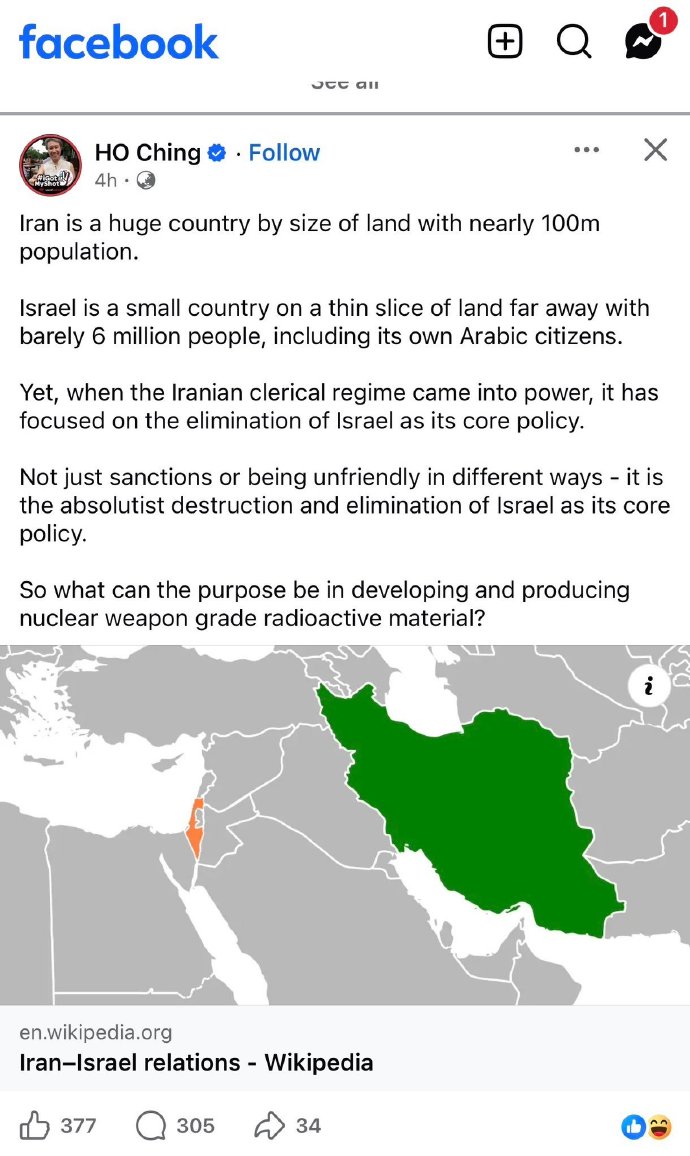
Lee Hsien Loong's wife fully demonstrated Singapore's hypocrisy.
When it comes to Russia and Ukraine, they insist that international law must be respected and no country's sovereignty can be violated. But when the topic shifts to Iran, suddenly the tone changes. The focus becomes branding Iran a theocratic regime and highlighting its threat to Israel.
That's why I always say "Singapore is a bitch, the harder you fxxk it, the nicer it will be".