The captain of the Franklin was an ass. Read about what he did to his own crewmen. Those who had been blown off the burning ship or jumper overboard, due to fires and explosions, were forbidden to reboard, even after the ship docked at Pearl on her way to Brooklyn.
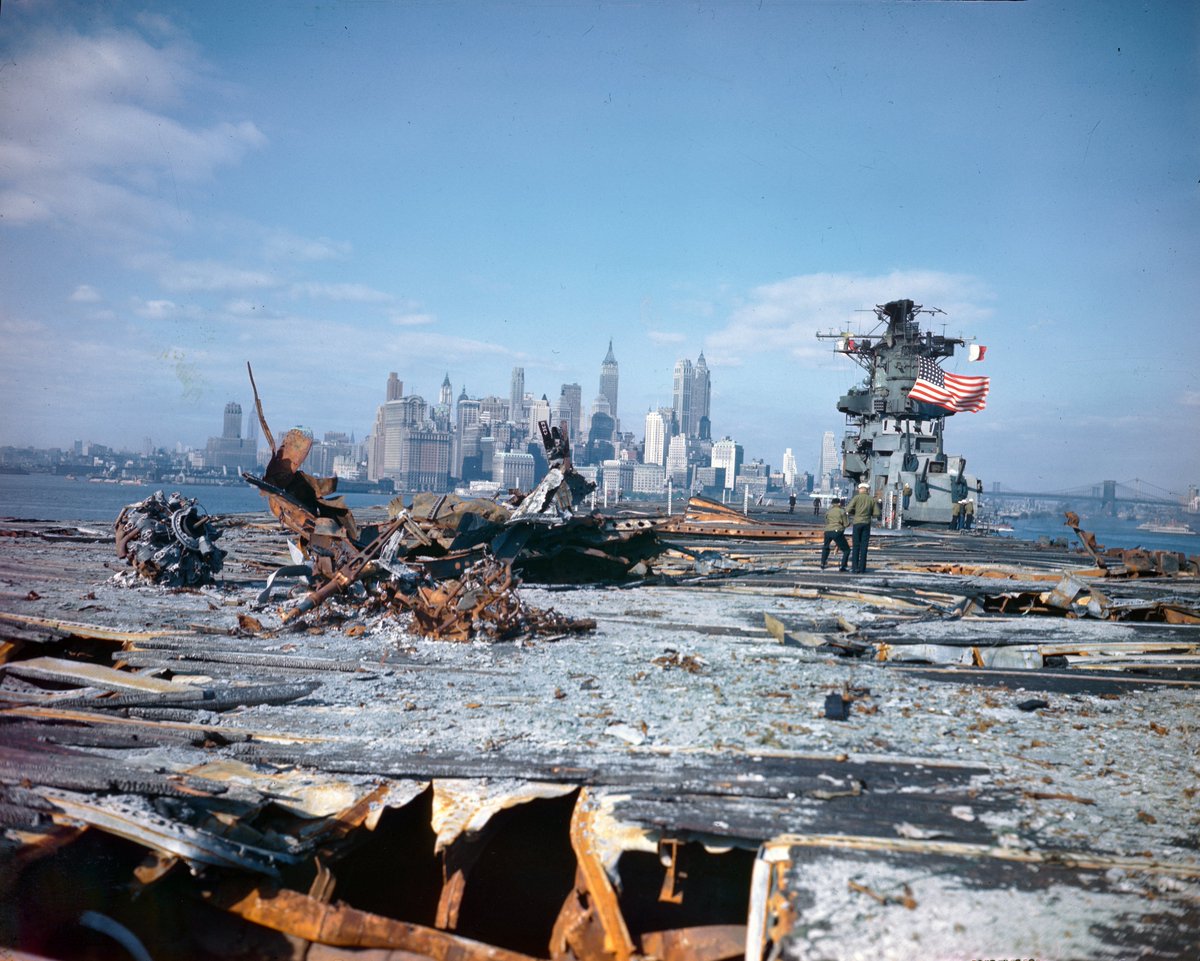
The carrier USS Franklin (CV 13) approaches Manhattan as it prepares to dock at the Brooklyn Navy Yard on April 28, 1945. The Franklin’s deck shows the melted and burned decking and aircraft parts resulting from a March 19, 1945, dive bomber attack.
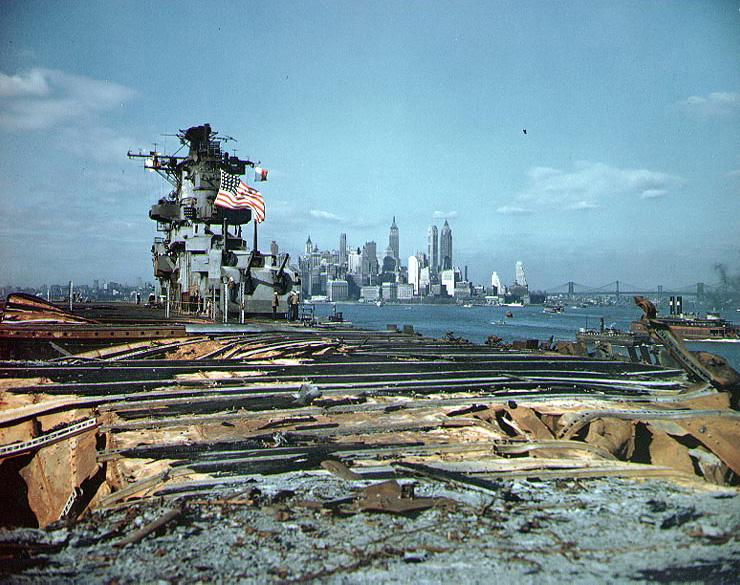
USS Enterprise at anchor in Puget Sound, Washington, US, 7 Jun 1945 still with no forward elevator that was blown off the ship three weeks earlier. Note damage to deck planks and Seattle ferry ‘City of Sacramento’
Everyone knows about the beaches. The boats, the men, the machine guns. June 6th. But the invasion didn't start on June 6th. And the first Americans to die didn't die on a beach.
They died on a minesweeper. The day before. Alone. In the middle of the English Channel. And almost nobody knows their names.
Here is how D-Day actually began.
The entire invasion fleet, over 6,000 ships, could not move an inch until someone cleared the way. The Germans had spent years seeding the English Channel with thousands of moored contact mines, explosive devices chained to the seafloor that would detonate the moment a hull touched them. Before the battleships, the destroyers, the landing craft, the troop transports could go anywhere near Normandy, those mines had to be found and cut. That job fell to the minesweepers.
Minesweepers were small ships. Thin hulls, small crews, slow speeds. Their entire purpose was to drag cutting gear through the water and sever the cables holding mines to the seafloor, then mark the cleared lanes with lighted buoys called dan buoys so the fleet behind them could follow safely. They were, in effect, the tip of the spear for the largest naval invasion in human history. They went in first. In the dark. With no escort. While everyone else waited.
Mine Squadron 7 was assigned to clear the approach channels for Utah Beach. On the afternoon of June 5th, 1944, the day before the landings, they were already out there working. The fleet was still in England. The paratroopers had not yet jumped. The world did not yet know what was coming. The minesweepers were already in the channel, doing the job that made everything else possible.
At approximately 5:55 in the evening on June 5th, USS Osprey (AM 56), a Raven-class minesweeper, struck a moored German contact mine while laying dan buoys to mark the cleared channel. The mine detonated alongside the forward engine room. The explosion blew a massive hole in the hull. Fires broke out immediately. The ship began to list.
The crew fought the fire. They tried to save her. For nearly an hour they worked. It wasn't enough. At roughly 6:55 PM, the order came to abandon ship. USS Osprey slipped beneath the English Channel and was gone.
Six men died. Out of a crew of 105, six men did not make it off that ship. One of them was an officer. USS Chickadee (AM 59) moved in to pull survivors from the water.
Then the rest of Mine Squadron 7 closed ranks and kept sweeping. They did not stop. They could not stop. Six thousand ships were waiting behind them. The invasion was hours away. The job was not done.
The men who cleared those channels never got a movie made about them. They are not in the famous photographs. When people picture D-Day they picture Omaha Beach at dawn, ramps dropping, men running into the surf. They do not picture a small ship in the afternoon light on June 5th, one day early, cracking open on a mine in empty water with no one watching.
But every single landing craft that made it to those beaches did so because men in minesweepers went first and paid the price to mark the way. USS Osprey was the first ship the invasion cost the United States Navy. She went down before the first paratrooper jumped. Before the first shot was fired on the beaches. Before the world knew the invasion had even begun.
Six men. June 5th. The English Channel. The first.
Four flights. 715 hours in space. Two trips to the Moon — and never once a footstep on its surface.
Jim Lovell was one of the most experienced astronauts of his generation. He orbited the Moon aboard Apollo 8 in 1968, helping deliver a Christmas Eve broadcast that reached millions around the world. Later, as commander of Apollo 13, he led his crew through one of the most dangerous crises in spaceflight history and brought them safely home.
He passed away on August 7, 2025, at the age of 97.
Lovell never lived to see Artemis II launch. He wasn't there for the countdown, the liftoff, or the mission that would carry astronauts farther from Earth than any humans had traveled before.
But before his death, he left behind something special.
Months earlier, Lovell recorded a message for the Artemis II crew — Reid Wiseman, Victor Glover, Christina Koch, and Jeremy Hansen. NASA kept the recording private until the right moment.
That moment came on April 6, 2026.
As the crew floated aboard Orion on Flight Day 6, just hours before setting a new distance record from Earth, a familiar voice filled the spacecraft.
"Hello, Artemis II. This is Apollo astronaut Jim Lovell. Welcome to my old neighborhood."
He spoke about Apollo 8, about seeing Earth rise above the lunar horizon, and about the wonder of looking back at a small, fragile planet from deep space. He told the crew he was proud to pass the torch and reminded them to enjoy the view.
Then came his final words.
"Good luck and Godspeed from all of us here on the good Earth."
For a moment, the crew sat quietly.
One astronaut finally broke the silence.
"What an awesome message from Jim Lovell."
Soon after, they pulled out a silk Apollo 8 mission patch that had traveled from Earth with them — a piece of Lovell's own mission history, sent by his son before launch.
Later that day, Artemis II surpassed Lovell's distance record.
The man who set it had already congratulated them.
He just wasn't there to watch.
Some records are broken.
Some legacies keep traveling long after their owners are gone.
Been there. What the real miracle was in this church, is that a mortar round came though the ceiling. It landed dead center in floor and did not explode, a dud.
The SR71 factory floor looks like a rebel base in Star Wars. This does not look like it was first designed in 1959. The SR-71 was 50 years ahead of time🔥😯💎
🚨#BREAKING: Law enforcement agencies say that thieves stole more than 12 tons of KitKat bars while a shipment was en route across Europe
The company Nestle says the chocolate heist could cause shortages ahead of the upcoming Easter holiday
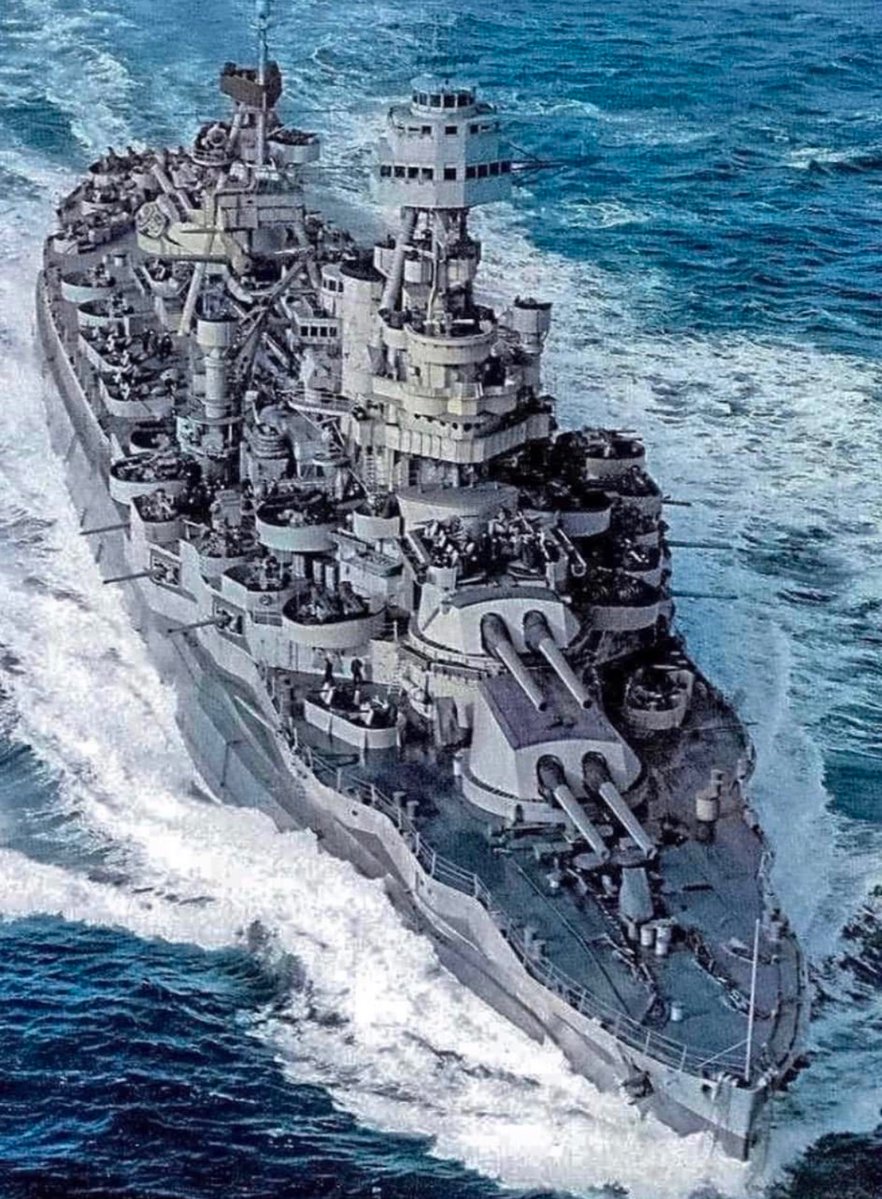
USS Enterprise (CV-6), one of the few pre-WW2 aircraft carriers to survive and the most decorated US Navy Warship in WW2, including the only one to receive the highest honor from the Royal Navy, was towed to be sold for scrap on August 21, 1958.
More rare historical photos: https://t.co/dQjceOPkrz
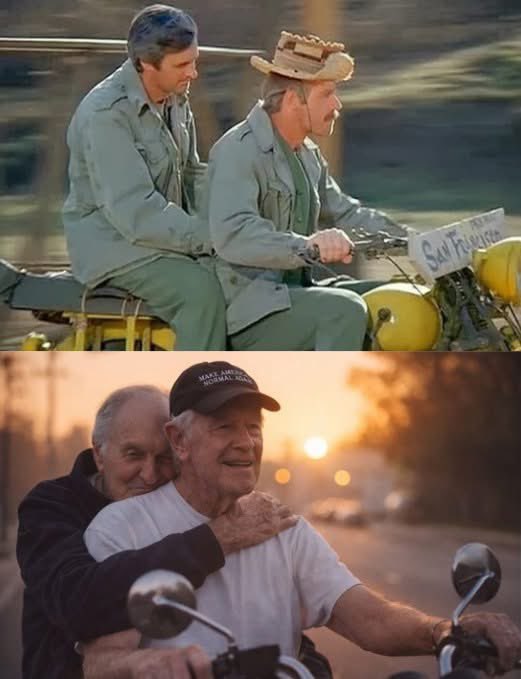
Alan Alda Was Forgetting Who He Used to Be - So Mike Farrell Brought Hawkeye Back—One Last Ride at Dawn
Alan Alda was forgetting things.
Not big things.
Small things.
The small things that make a life feel like your own.
January 2026 — Los Angeles
Alan Alda was 89 years old.
In eight days, he would turn 90.
The man who once was Hawkeye Pierce—
sharp, fast, fearless—
now lived behind a quiet fog.
Parkinson’s had taken so much.
First, his hands.
The hands that performed surgery on MAS*H for eleven years—
now trembling.
Then, his walk.
Once confident.
Now careful. Measured. Afraid.
And now…
his memories.
Not gone.
Just fading.
Like old photographs left in the sun—
still there, but harder to feel.
Mike Farrell came anyway
Every week.
For five years.
Because that’s what B.J. Hunnicutt would do.
And that’s what Mike Farrell did.
He found Alan in the living room.
Sitting in his favorite chair.
Holding something.
A photograph.
Alan’s fingers traced it slowly—
again and again—
like it might disappear if he let go.
Mike leaned in.
And his chest tightened.
It was them
1983
The final episode.
Goodbye, Farewell and Amen.
B.J. on the motorcycle.
Hawkeye behind him.
Smiling.
The last ride out of the war.
“Hey, Alan.”
Confusion first.
Then—recognition.
“Mike.”
A small smile.
But real.
“You came.”
“I always come.”
Alan lifted the photo.
“I remember this.”
“You do?”
“The cameras. The crew. The bike.”
He paused.
Searching.
Then his voice broke.
“But I don’t remember how it felt.”
“I remember it happened,” Alan said.
“But I don’t remember the wind.
The freedom.”
He looked at Mike.
“I’ve lost the feeling.”
Tears followed.
“I’m losing myself, Mike.”
Mike held his trembling hand.
“You’re still here.”
“Not to me,” Alan whispered.
“I forgot Arlene’s birthday. Sixty-eight years. I forgot.”
Silence.
The kind that hurts.
That night, Mike couldn’t sleep.
I don’t remember how it felt.
The words wouldn’t let him rest.
3:00 AM
Mike stood in his garage.
Under a dusty tarp—
a motorcycle.
Untouched for years.
Because every time he saw it,
he saw Alan.
1983
The last ride.
He cleaned.
Polished.
Checked the engine.
His body ached.
But his heart didn’t care.
5:30 AM
Alan Alda’s driveway.
Dark.
Quiet.
Then—
“HAWKEYE!”
Mike’s voice cut through the dawn.
“YOU’RE TOO SLOW!”
Lights snapped on.
Arlene appeared.
Then Alan.
Confused.
Until he saw Mike.
On the motorcycle.
And then—
a smile.
Big.
Real.
Alive.
“B.J., you’re CRAZY!”
“I KNOW!”
Fifteen minutes.
Stairs.
Slow steps.
Careful hands.
Alan insisted.
“I need this.”
They helped him on.
Just like 1983.
“Ready?”
“Ready.”
They rode.
Slowly.
Carefully.
Two old men.
At sunrise.
Alan held on tight.
Not like before.
Not casual.
Like this mattered.
Like this might be everything.
“Mike,” Alan said softly, face against his back.
“I remember now.”
“Remember what?”
“How it feels.”
Wind.
Movement.
Freedom.
For one hour, Hawkeye was back.
When they returned, Arlene was crying.
Alan’s eyes were clear.
“I remembered,” he said.
That night, Alan slept holding the photograph.
And beside it—
a new one.
2026
Same pose.
Same smiles.
Older men.
Still together.
These scenes from the 1959 movie "Strategic Air Command, staring James Stewart, are an incredible time capsule. Filmmakers would never imagine aviation buffs would still be watching them so enthusiastically so many years later!
A giant arrives in the city — The battlescarred USS Enterprise (CV 6), ‘The Big E,’ steams into New York Harbor in 1945. Against the towering skyline, America’s most decorated carrier of World War II is welcomed home, as onlookers capture the unforgettable moment of history meeting triumph.⚓🇺🇸