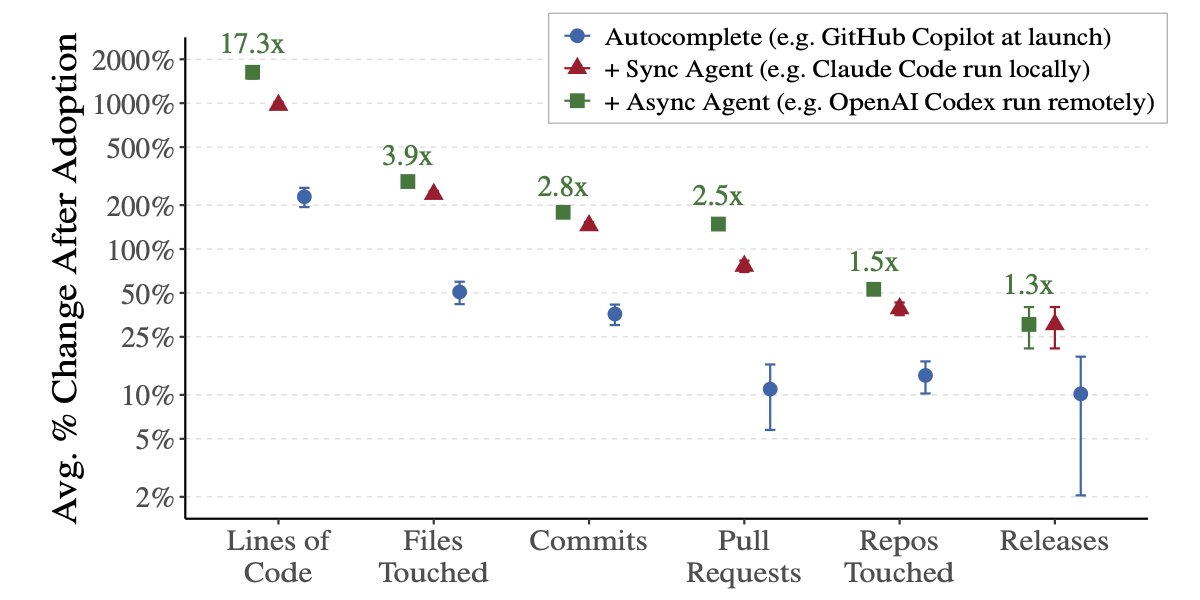
Big paper on AI coding agents using Github & other data
The auto-complete tools (Copilot) led to 2.2x more code, local agents like original Claude Code led to 7.4x, & current remote coding agents 17.3x(!)
But human bottlenecks in coding means actual releases "only" went up 30%
11 AI Prompts Every Teacher Should Know: A useful guide that can help teachers save time, spark engagement and help students actually learn. https://t.co/j1xcDXtaH5 #edtech#ai
In An AI Classroom, Content Knowledge Matters More Than Ever: Strong instruction in an AI-rich classroom depends on strong content knowledge https://t.co/ZOClocqVBe #edtech#ai
Two economists just published a mathematical proof that AI will destroy the economy.
Not might. Not could. Will — if nothing changes.
The paper is called "The AI Layoff Trap." Published March 2, 2026. Wharton School, University of Pennsylvania. Boston University. Peer reviewed. Mathematically modeled.
The conclusion is one sentence.
"At the limit, firms automate their way to boundless productivity and zero demand."
An economy that produces everything. And sells it to nobody.
Here is how you get there.
A company fires 500 workers and replaces them with AI. A competitor fires 700 to keep up. Another fires 1,000. Every company is behaving rationally. Every company is following the incentives correctly. And every company is building a trap for itself.
Because the workers who were fired were also customers.
When they lose their jobs faster than the economy can absorb them, they stop spending. Consumer demand falls. Companies respond by cutting costs — which means automating more workers — which means less spending — which means more falling demand — which means more automation.
The loop has no natural exit.
The researchers tested every proposed solution. Universal basic income. Capital income taxes. Worker equity participation. Upskilling programs. Corporate coordination agreements.
Every single one failed in the model.
The only intervention that worked: a Pigouvian automation tax — a per-task levy charged every time a company replaces a human with AI, forcing them to price in the demand they are destroying before they pull the trigger.
No government has implemented this. No major economy is seriously discussing it.
Meanwhile the numbers are already tracking the curve. 100,000 tech workers laid off in 2025. 92,000 more in the first months of 2026. Jack Dorsey fired half of Block's workforce and said publicly: "Within the next year, the majority of companies will reach the same conclusion."
Nobody is doing anything wrong. Companies are following their incentives perfectly. That is exactly the problem.
Rational behavior. At scale. Simultaneously. With no mechanism to stop it.
Two economists built the math. The math leads to one place.
Source: Falk & Tsoukalas · Wharton School + Boston University ·
In this Manhattan lab, AI designs materials from scratch: Radical AI’s ‘self-driving’ lab designs and tests new alloys, speeding up a material R&D process that often takes human scientists 20 years or more https://t.co/AnaN77FRlG #edtech#ai
A Nobel Prize-winning author spends forty years building a voice. The rhythm of their sentences. The way they open a scene. The weight they put on a single word. Forty years of rejection letters, rewrites, and drafts that became literature.
Researchers took every book that author had published, fed those books into ChatGPT, and asked it to write in that author's voice.
Then they showed the AI's version and a human-written version to MFA writers and to everyday readers. Blind test. No labels. Only the writing.
The readers preferred the AI.
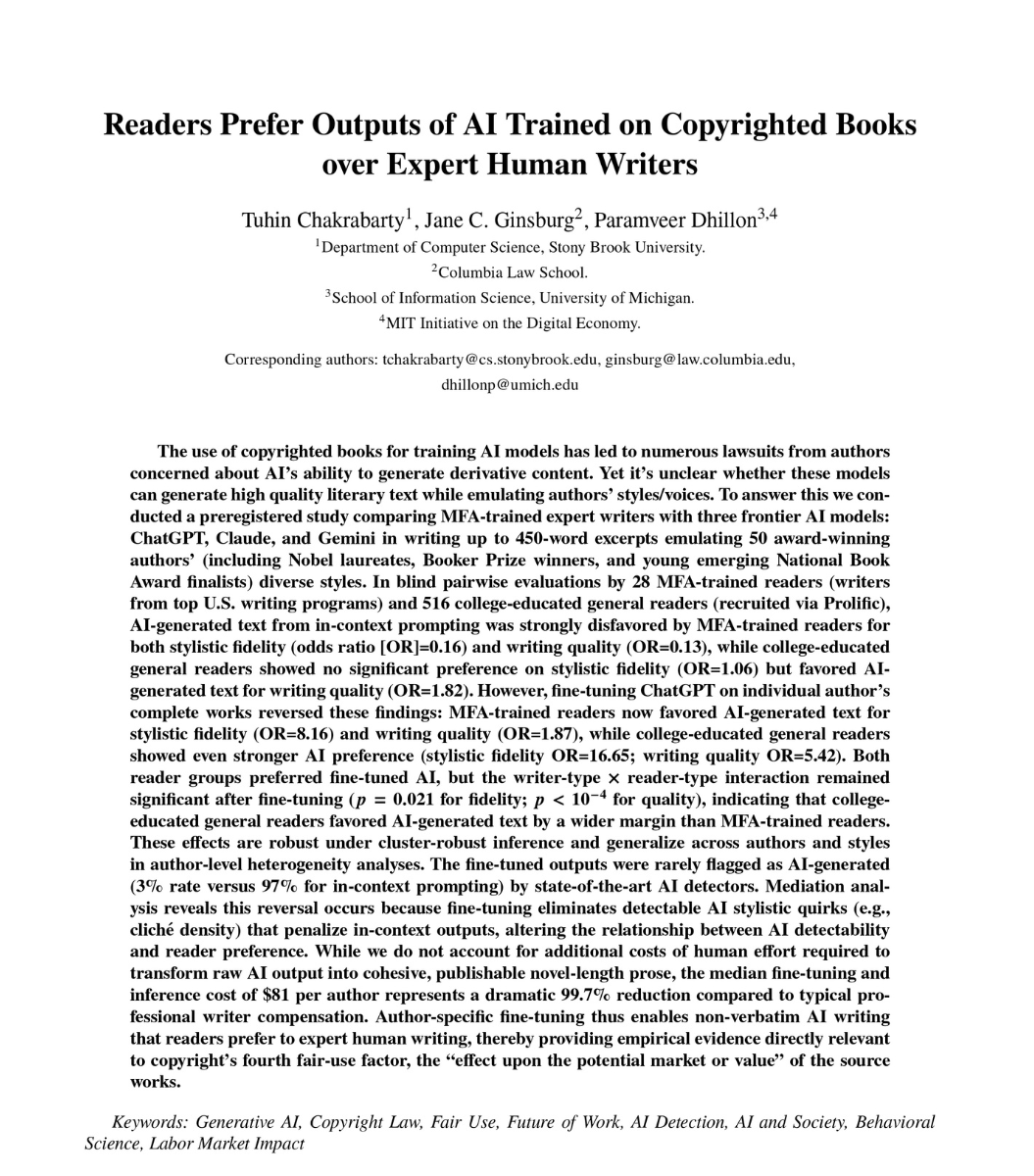
The study comes from Stony Brook University, Columbia Law School, and the University of Michigan. Preregistered. 28 MFA-trained expert readers. 516 general readers. 10,920 blind pairwise judgments. 50 internationally acclaimed authors. 8 Nobel laureates including Han Kang and Annie Ernaux. 8 Pulitzer winners. Booker winners.
When ChatGPT was simply prompted to write like an author, the experts could tell. The odds of an expert choosing the AI over a human were 0.16 for stylistic fidelity and 0.13 for writing quality. The AI sounded like AI.
Then the researchers bought ePub files of 30 living authors' complete works. Every novel they could obtain. Every collection. They fine-tuned ChatGPT on each author's catalog individually.
Same blind test. Same expert readers.
Everything reversed.
Expert readers favored the fine-tuned AI for stylistic fidelity. Odds ratio 8.16. P less than 10 to the minus 12. For writing quality, 1.87. The general readers shifted the same way.
The AI was not only matching the authors. Readers were preferring it over them. Using the authors' own books to do it.
Then the researchers ran the outputs through Pangram, a state-of-the-art AI detector. The plain-prompted AI was caught 97 percent of the time. The fine-tuned AI was caught 3 percent of the time.
The detector went blind.
The median cost to fine-tune and generate for one author. 81 dollars. The paper calls that a 99.7 percent reduction compared to typical professional writer compensation.
The researchers set out to answer the question the courts are weighing in Bartz v. Anthropic and Kadrey v. Meta. Does training AI on copyrighted books harm the market for those books.
The paper answers it in one sentence.
"Author-specific fine-tuning thus enables non-verbatim AI writing that readers prefer to expert human writing."
The second author is Jane C. Ginsburg, a professor at Columbia Law School. She frames this as evidence for copyright's fourth fair-use factor. The effect on the market for the source works.
Every book an author publishes trains the thing that will write the next one without them.