Per trent’anni ci hanno raccontato che l’Italia doveva rinunciare a pezzi decisivi della propria sovranità economica in cambio di più benessere, stabilità e peso internazionale.
Oggi i dati raccontano un’altra storia: salari fermi, potere d’acquisto in calo, risparmi erosi, giovani impoveriti, ceto medio sotto pressione e ricchezza sempre più concentrata.
Non è una crisi passeggera: è il risultato di un modello che ha compresso lavoro, domanda interna, investimenti pubblici e democrazia sostanziale.
Senza sovranità economica non c’è giustizia sociale. E senza giustizia sociale non c’è libertà politica.
Una partnership strategica speciale che non solo andrà a beneficio delle nostre nazioni ma anche dell’intera umanità!
I risultati della mia visita in Italia garantiranno maggiori collegamenti per gli investimenti, migliori opportunità commerciali, legami culturali più stretti e altro ancora.
SAPETE PERCHÉ L'ITALIA HA UN
INTERESSE MONDIALE, DOVE TUTTI VORREBBERO ABITARE?
L'italia occupa lo 0,5% della Terra, e ci vive lo 0,83% dell'umanità.
Le condizioni bio climatiche sono uniche al mondo, permette alla
penisola di essere la prima nazione al mondo per biodiversità.
7000 differenti vegetali-
segue il Brasile con 3000.
58000 specie di animali-
segue la Cina con 20000.
1800 vitigni spontanei da uva- segue la Francia con 200.
997 tipi di mele-
in tutto il mondo ne esistono 1227
140 tipi di grano-
seguono gli USA con 6.
Abbiamo Il parmigiano reggiano-
"Un formaggio inimitabile"
Nessuno al mondo lo produce come il nostro.
L'Italia, possiede il 70% del patrimonio artistico e umano.
il rimanente 30% è sparso in tutto il resto del pianeta.
In pratica siamo in un giardino dell'Eden, ma pochi
italiani lo apprezzano, e rispettano come tale. 🇮🇹
Exclusive: Iranian airstrikes have damaged or destroyed at least 228 structures or pieces of equipment at U.S. military sites since the war began, according to a Post analysis.
The amount of destruction is far larger than what was previously reported. https://t.co/qcDG06Dwa8
Capisco che non sia un argomento succulento come il caro-benzina, la Minetti o Garlasco.
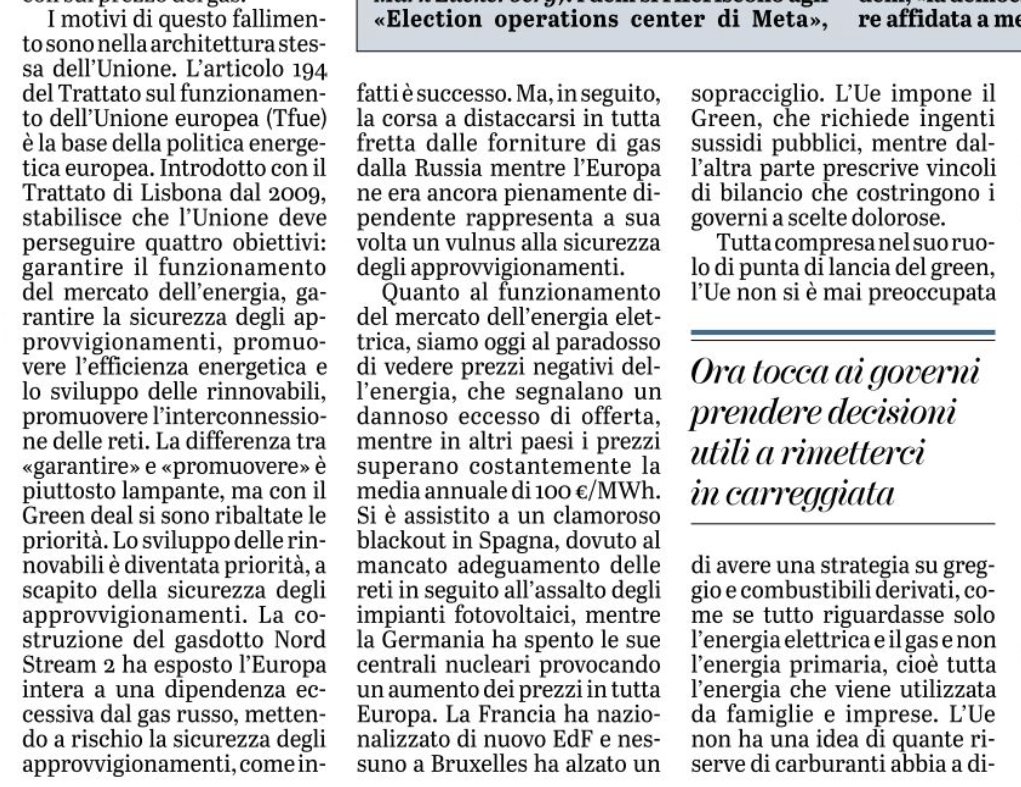
Ma il punto è che l'Unione europea non ha tenuto fede ai propri impegni, soprattutto a quelli dell'art. 194 del TFUE, ovvero garantire energia sicura e un mercato dell'energia funzionante.
In 30 anni l'Unione dell'energia ha prodotto tonnellate di carta senza riuscire a risolvere nemmeno uno dei problemi energetici europei, anzi creandone di nuovi e inediti, come la dipendenza dalla Cina.
Invocare soluzioni da chi peggiora e causa i problemi non è esattamente una strategia vincente.
What China just did with the blocking statutes against U.S. extraterritorial sanctions sets quite a major precedent, probably the financial equivalent of what happened with rare earths last year (in the sense that this is China taking a major step to push back against a U.S. hostile measure as opposed to taking it on the chin).
It's a little complex but, to start with, what many people ignore (and will probably be surprised by) is that - by and large - Chinese companies and financial institutions have largely complied with extraterritorial U.S. sanctions.
Anecdotal story on this: I know for a fact, because I personally know the person, that a very famous guy (whose name I won't reveal but that everyone of you would know) sanctioned by the U.S. was in China recently and tried to exchange money at the counter of a random Chinese bank. Just simply exchange dollars for a Chinese yuan, in mainland China. And he was refused, because he is sanctioned by the U.S. - despite the fact that China as a country has absolutely no problem with the person.
This goes to illustrate just how much goodwill China extended to the U.S. on this - a Chinese bank, in China, refusing to serve someone China has no problem with, just to comply with U.S. extraterritorial sanctions.
It also goes to illustrate why this blocking order marks such a sharp departure.
What triggered it is not new sanctions by the U.S. but recent efforts under the so-called "Operation Economic Fury" to dramatically ramp up enforcement of existing sanctions on Iran.
The U.S. notably issued at the end of April alerts to financial institutions worldwide - including in China - on "the sanctions risks associated with independent 'teapot' oil refineries in China, primarily in Shandong Province, given their continued role in importing and refining Iranian crude oil" (https://t.co/LkHFCKdY5c)
Even more importantly, they also specifically went after Hengli Petrochemical Dalian (https://t.co/y2iGTbiu7R), one of China's largest private refineries, with 400,000 barrels per day capacity and a parent company (the Hengli Group) that's a Fortune Global 500 company.
In effect, what the U.S. extraterritorial sanctions mean is that Hengli - and all other Chinese 'teapot' oil refineries being targeted - is cut off from the dollar system, and any bank, insurer, or trading partner anywhere in the world - including in China - that deals with them risks being cut off too. Which is obviously a major hostile move by the U.S. against China (and, of course, Iran).
Except that China, this time around, is not having it.
Since 2021 they've had regulations ("Measures to prevent the improper extraterritorial application of foreign laws and measures", https://t.co/ENBSJBVor1) that gives the Chinese government power to formally prohibit compliance with foreign sanctions, and that, since this April (https://t.co/82yw0izC6z) are also extraterritorial in nature.
In effect what these regulations - and their April addendum - say is that if you comply with U.S. extraterritorial sanctions by cutting off a Chinese company, you are violating Chinese law. Any entity - Chinese or foreign - that refuses to deal with a sanctioned Chinese company because Washington told them to can be sued in Chinese courts, fined by MOFCOM, and since April, placed on a 'Malicious Entity List' with asset freezes and trade restrictions.
In a nutshell on one side you have the U.S. saying "cut them off or we cut you off" and now China says "well, if you do cut us off we're going to be real nasty with you, in China and potentially beyond."
These regulations were - until yesterday - purely theoretical: they've never actually been applied. But, yesterday, China's MOFCOM made it crystal clear this time is different: they used a statement with a triple negative, saying the U.S. sanctions "shall not be recognized, shall not be enforced, shall not be complied with" ("不得承认、不得执行、不得遵守", https://t.co/3NlBy7I1jL).
In effect you now have companies that are in the middle of this - for instance financial institutions serving Hengli - caught in quite a bind: face U.S. or Chinese hostility. It's a no-win, they need to choose a camp on this.
Concretely speaking, given that the overwhelming majority of companies affected are operating inside China, they'll obviously choose the China side.
The real question therefore is: Is the U.S. ready to act on its threat and cut off Chinese banks or other institutions that keep servicing these refineries?
Because that probably means sanctioning major Chinese financial institutions, which is a whole different level of escalation. The moment the U.S. designates a major Chinese bank for dealing with Hengli, this stops being about Iranian oil and becomes a direct financial confrontation between the two largest economies on earth, which is a much bigger deal with probable consequences for the entire global financial system.
Or will the U.S. back off, meaning China would have effectively caught their bluff, showing that extraterritorial sanctions are a lot of bark but not a lot of bite?
We'll know in the next couple of weeks I guess.
One thing is sure though: whatever happens with these refineries, the broader damage is done. China used to extend remarkable goodwill on sanctions compliance - voluntarily cooperating with extraterritorial sanctions inside its own borders even though it had no legal obligation to respect them. That goodwill has been spent.
And, from a U.S. standpoint, a China with less goodwill vis a vis U.S. financial hegemony is undoubtedly a far bigger issue than a few teapot refineries buying Iranian oil.
The World Economic Forum wants you to own nothing and be happy because a man who owns nothing has no leverage against his masters. This circular economy is just a fancy trap to turn citizens into permanent renters of their own lives. They control the supply, the price, and the access, making sure you stay dependent on their platform forever. It is not about saving the planet. It is about stripping away your property rights to secure their total control.
Magistrati che cantano “Bella ciao”, brindano e prendono in giro una collega. E questi dovrebbero essere quelli "imparziali" che ci giudicano in tribunale. Il CSM, rimasto com'era, li sanzionerà? #zuppadiporro
Renzi oggi dice che Meloni dovrebbe dimettersi. Detto da uno che aveva giurato di lasciare la politica e che è ancora lì con il 2,5% a fare il fenomeno! Tra l'altro non ha avuto nemmeno il coraggio di schierarsi sul referendum. Fa bene Giuliano Ferrara a prenderlo un po' in giro. #zuppadiporro