I've been experimenting with metaverse experiences for a while and finally built out my own engine. You can try it out at https://t.co/U5y7J3Iamg. Very early preview, pretty much just an experiment that I'll continue building and sharing over the next months, but would love for people to check it out and leave any requests/feedback.
Also works in VR, you can just visit in the web browser and click the button in the bottom right to enter in VR. Will share a bit more details around this later on
@jul1anodev Interesting, thank you for trying it out. I made some performance improvements, but also improved the overall quality. It does load fine on my Oculus Quest 2 and on my phone, but I haven't tested on too many devices yet. Would love to know if it loads for you now
In the bad old days, training neural networks took a lot of work. But now frontier LLMs can directly create or edit neural network weights - this opens the new field of "weight-space programming". Imagine LLMs waving a wand and dropping small, real-time AIs into games or robots or directly modifying the behavior of other LLMs.
Weight-space programming was introduced in an MIT blog published last week. I suspected it worked because their LLM had memorized the blog examples in its training data. So this weekend, I hacked with @mvyletel_jr to vibe code a new game (not in OpenAI's or Anthropic's training data) to see whether Astra or Opus 5.5 could create neural networks to fight. It worked. Here's the game being played by two LLM-generated neural networks. Details below
Yield today ≠ yield tomorrow. Introducing the best historical lending data coverage on the market, now live on the Cambrian API. Why is this so useful?
Example: Over the past 30 days, one of the highest-yielding large USDC vaults on Morpho on Ethereum averaged 8.88% APY, yet depositors withdrew a net 21% of its TVL. Meanwhile Aave's USDC pool on Ethereum averaged 4.28% APY and took in $417M in net deposits.
High APY often means money is heading for the exit. Historical flows show you which way the money is moving before you deposit.
Yield hunters can now check 7, 30, 90 & 365-day windows for APY, utilization, deposits, withdrawals & net flows across Aave, Morpho, Euler & Spark, so you can see whether money is coming in or leaving before you deposit. Every protocol comes back in the same format.
The industry's only standardized lending API that tracks where the money is actually moving, down to the curator. And it’s agent-optimized, right out the box.
update: we developed ANOTHER fine-tuned model that does an even better job scouring X to find CT’s most actionable tweets, so you can separate the quasi-prophetic posters from the baseless slopcannons
our model can now process even more tweets than before, with a greater accuracy level (up 5% since last update) - which means you can build social sentiment based trading strategies knowing you’re working with the best volume:accuracy ratio on the market
get started with our offchain intelligence endpoints ⤵️
Hot trading tip: the top trading analyses & arb opportunities aren’t made with Googleable data. Hook your agent up to multi-chain token activity and ultra-rich detail down to the pool level.
The best OHLCV data is now live on @arbitrum, @RobinhoodCrypto & @BNBCHAIN (expanding from @ethereum@base & @solana).
No one else goes this deep. Tap into pool-level OHLCV across Aero, Uniswap, PancakeSwap, Sushi & more. 1-minute to 1-week candles.
Send your agent this post and start trading smarter.
I've tried creating agentic automations for my work with pretty much every new frontier that has come out, and I took all those learnings and tried again with Opus 5.5 and I think I'm finally on a good direction that I've been able to adopt as my daily driver. Not going to share too many details around that and why it finally works in a helpful way with a different mental model than I tried in the past. One thing I will share as a small hint to the broader system is that it treats my human attention as the only non-scalable resource, and I am starting to track several things relating to that which I'm finding interesting.
The screenshot shows the highest level view of that, where using decision models I have spent approximately 45% of my time generating new ideas, 27% steering sessions, 10% checking on status/progress, 7% explaining a fix didn't work, 6% providing answers to questions prompted by claude code UI.
Also interesting that at a pretty fast reading speed if I had read every completion prompt for handoff back to me it would have taken me 847 minutes to read everything but I only took roughly 26 minutes to review (was all for personal projects). I spent 272 minutes of active typing on Saturday and 274 minutes on Sunday, so about 4 and a half hours of actively writing prompts.
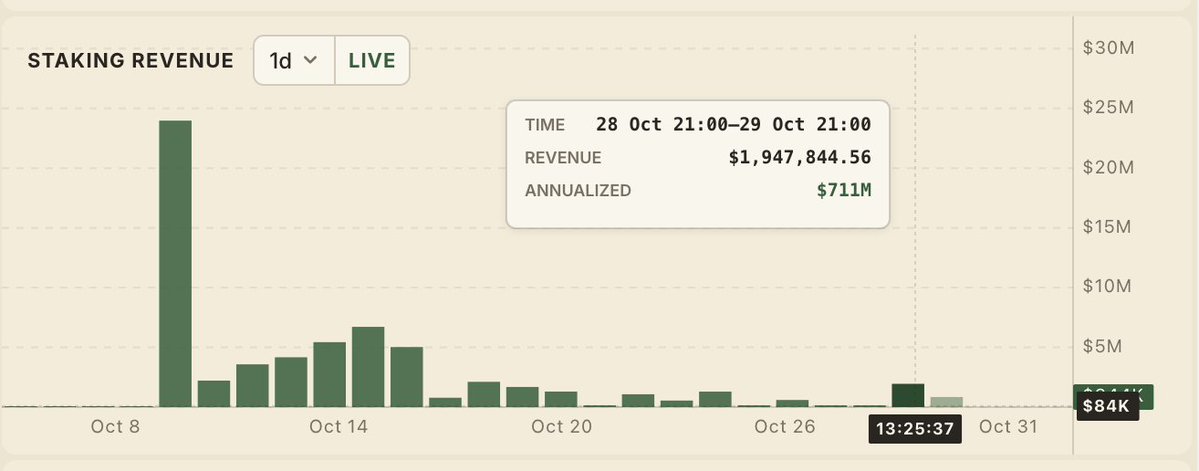
during the Binance hack people rushed back to @papertrade_xyz to short the news. $1.9m staking revenue in one day versus $100k the previous day
product market crisis fit
when Brazil voted on Sunday, the NYSE was closed, but $NU kept trading on Robinhood
the first sale after the polls closed came at 20:28 (ART). by 9 am on Monday, the token was -25% vs Friday's close, and $NU opened on the NYSE at −22.9%
I wanted to understand the pattern behind it, so I backtested Robinhood stock tokens since August with @CambrianNetwork data:
- 366 NYSE opens that gapped >3% across 67 stocks
- 97% of the time, the token price at 9 am ART showed the correct direction (with a 1 pp median error)
Some other observations:
- They linked to official ens urls in the email except for the button, not sure if this helped get past gmail filters
- Phishing email was sent through Lettermint, from an account that just says "team_" followed by 5 numbers I am not posting"
- For some types of VPNs it gets around them using WebRTC needed for video calls without asking for permission, but system installed apps still protect your IP against it
- Their email associated with their github username is from gmail and seems associated with a russian insult, but that doesn't really mean anything.
- Worth checking your home network open ports to protect against potential issues with someone obtaining your IP address
Got an email about ENS v2 from a weird domain, fed it to claude and found that it was to a site that drains wallets. Reverse engineered what I could and found the code was tied to an already banned github account that had several forks of popular skills and agentic repos with dangerous files. Found two more github users that are still active with the same files, strange that they wouldn't have automatically detected that. Reported to @github. Stay vigilant 👀 🚔
One thing that was way too easy for them to do was get past @gmail spam filters by buying a domain that had been active since 2024. Aside from ens they also targeted/impersonated @vfat_io (great product), and "ticket" to impersonate support
Was trying to listen to an audiobook I already bought on @audible_com before getting on a plane and apparently I am not allowed to due to regional restrictions. We don't own anything anymore
Never heard of $RAIN until I recently saw it in the top 20 by market cap at $6.6B. Seems very inflated relative to volume, but still pretty wild to miss totally broken queries on the homepage 😬 doesn't give a lot of confidence given how easy it should be to catch this
Read this if you make videos with Claude.
I built a skill that cut my QA cost on this video from $127 to 16 cents. It was made with Claude in Remotion.
It's called SageCut. It swaps the LLM out of frame-by-frame QA and uses a multimodal decision model, Sage (@levantolabs), instead.
I'm the only video guy at Levanto. I run 3 Claude plans and have been making Remotion videos since early this year, with BlenderMCP in the mix, so the output is pro-grade with very little babysitting.
The problem: it burned through my Max plan, and a video could take 2 days.
When I dug into the workflow, the reason was that Claude subagents were reviewing every single frame. That cost a ton and added 4+ hours per video.
SageCut hands that step to Sage. Sage is great at spotting defective frames, and only those get passed to Opus 5.5 to fix.
Across 6 A/B tests the output was exactly the same, at 1/10 the QA cost and 1/4 the QA time. On this video, Sage read all 3,153 frames for 16 cents.
If you make Remotion videos, try it.
The link to skill is below.
How long does a Remotion video take you right now with Claude?