PLEASE SHARE!
Last Tuesday, we had a lengthy discussion at Council regarding the draft plan for Municipal Development called "The Calgary Plan." We discussed some of the points within the plan in last week's Roundup, and now we are running a survey to ask your thoughts on the draft of The Calgary Plan.
Please be sure to share this with your friends, neighbours, community groups across the city. We'd like to get as much feedback on The Calgary Plan as possible!
Survey Link: https://t.co/04xGf0u4Rn
Additional Resources:
The Calgary Plan current draft: https://t.co/bxul7pI5ZC
June 16th Strategic Meeting of Council Minutes/Agenda: https://t.co/xrWSsjMkoQ
Latest Engagement Report: https://t.co/KZ2CwysBmT
CityNews Report on TCP: https://t.co/4s59lcBY4A
Today the European Parliament voted 418-218 to pass the strictest migration law in EU history.
When the result was announced, MEPs started chanting.
"Send them back."
Inside the parliament chamber. On the floor. In 2026.
Here's what the law actually does:
— Deportation orders now apply across all EU member states. You can't evade removal by crossing a border.
— Detention before deportation extended from 6 months to 30 months. Unlimited for security threats.
— "Return hubs" in third countries. Migrants can be transferred outside the EU while awaiting deportation — including families with children.
— Automatic deportation stays while appeals are pending? Gone. Courts decide case by case.
— Entry bans double from 5 to 10 years. Lifetime bans for security risks.
Currently only about 20% of people ordered deported from the EU actually leave.
For years European leaders told voters that open borders and mass migration were non-negotiable — that wanting enforcement meant you were a fascist.
418 Members of the European Parliament just disagreed.
Trump proved his immigration policies were popular enough to win elections.
After a wave of right-wing electoral gains across the continent, Europe is following in his footsteps.
And the Overton Window is getting kicked off its hinges.
Congratulations @ElonMusk.
Thanks to SpaceX's IPO, he's the first Trillionaire.
He didn't TAKE money from anyone. He CREATED wealth.
He launched satellites that connect even the poorest, most remote parts of the world.
Our world needs more MAKERS like Musk; fewer TAKERS like:
It's the 20th Anniversary of Al Gore's "An Inconvenient Truth."
NONE of his scary predictions have come true.
Mt. Kilimanjaro still has snow and Glacier National Park still has glaciers.
Here's why we are not doomed:
Trump is going to submit 6 months written notice on July 1st to exit the USMCA.
After out of the USMCA, the items listed will no longer be protected from tariffs.
I suspect Trump will crank tariffs to the moon on Canadian goods, pricing Canada completely out the US market, the market Canada depends on to purchase 70-80% of it's exports.
Of course there will be carve outs for items America needs (or wants to purchase at a discount, they really don't NEED anything from Canada), and it won't be much longer after this event that Canada's economy will collapse. At that time I suspect Trump will make some sort of offer of annexation.
Canada's past leaders are to blame for this. Canada is such a resource rich country that sadly has been mismanaged for YEARS and has resulted in heavy dependence on the America market.
It doesn't help that Carney thought it would be a good idea to host Obama and Soros at an event backed by the CCP in Toronto, either.
Hi Corey, one of your constituents here. Would you mind showing me where on your electoral platform your government ran on rupturing ties with Alberta’s largest trading partner, the USA at 88%?
All I can find are clips promising a deal with the US by July 1st—2025 to be sure.
If you also wouldn’t mind showing me where joining the EU was part of the platform? I can’t seem to find any mentions of that anywhere either.
Thanks in advance!
Hunga Tonga is still affecting the atmosphere.
On January 15, 2022, the underwater volcano erupted in the South Pacific. It blasted roughly 160 million metric tons of water vapor into the stratosphere, increasing levels by an unprecedented 10%.
Most major eruptions cool the planet by injecting reflective aerosols. Hunga Tonga erupted underwater and punched seawater high into the atmosphere.
Water vapor is the most dominant greenhouse gas. NASA warned the eruption could have a temporary warming effect. Global temperatures then spiked in 2023 and 2024.
Predictably though, the spike was sold as proof of accelerating CO2-driven warming. Activist-scientists downplayed any influence from the record Hunga Tonga eruption.
But now comes the next test:
The excess water vapor is now declining, slowly, and with it, global temperatures are also falling.
The "accelerating crisis" looks a lot like a temporary atmospheric pulse - now fading on schedule.
Here again, we have a natural driver dominating Earth's climate.
CBC in a rare and unprovoked display of conscience just suplexed Carney and his "Wealth Fund Pitch" into reality!
That's how bad the gaslighting has become... When your allies go:
"𝗖𝗼𝗺𝗺𝗼𝗻 𝗕𝗿𝗼!!!"
It's only been 1 year Carney, Trudeau lied for 10 yrs, keep up!
🤣🤣🤣
Elon Musk avait dit un truc qui m'avait marqué sur l'allocation de ressources. En substance : passé un certain niveau de richesse, l'argent n'est plus de la consommation, c'est de l'allocation de capital.
Cette phrase change tout.
L'économie, dans le fond, c'est juste un problème d'allocation. Tu as des ressources finies et des usages infinis. Qui décide où va quoi ?
Imagine une cour de récré. 100 enfants, des paquets de cartes Pokémon distribués au hasard. Tu laisses faire. Très vite, un ordre émerge. Les bons joueurs accumulent les cartes rares, les collectionneurs trient, les négociateurs trouvent des deals. Personne n'a planifié. Et pourtant chaque carte finit dans les mains de celui qui en tire le plus de valeur. Le système maximise le bonheur total de la cour. C'est ça, la main invisible.
Maintenant fais entrer la maîtresse. Elle trouve ça injuste. Léo a 50 cartes, Tom en a 3. Elle confisque, redistribue, impose l'égalité. Trois effets immédiats. Les bons joueurs arrêtent de jouer, à quoi bon. Les mauvais n'ont plus de raison de progresser, ils auront leur part. Les échanges s'effondrent. La cour est égale, et morte. Elle a maximisé l'égalité, elle a détruit le bonheur.
Le problème de la maîtresse, c'est qu'elle ne peut pas avoir l'information que la cour avait collectivement. C'est le problème du calcul économique de Mises, formulé en 1920. L'URSS a essayé de le résoudre pendant 70 ans avec le Gosplan. Résultat : pénuries, queues, effondrement. Pas parce que les Soviétiques étaient bêtes, parce que le problème est mathématiquement insoluble en mode centralisé.
Quand Musk a 200 milliards, il ne les consomme pas, il les alloue. SpaceX, Starlink, Neuralink, xAI. Chaque dollar est un pari sur le futur. Et lui a un track record. PayPal, Tesla, SpaceX. Il a démontré qu'il sait identifier des problèmes immenses et y allouer des ressources avec un rendement spectaculaire.
L'État aussi a un track record. Hôpitaux qui s'effondrent, éducation qui décline, dette qui explose, services publics qui se dégradent malgré des budgets en hausse constante. Le marché identifie les bons allocateurs, la politique identifie les bons communicants.
Le profit n'est pas une finalité, c'est un signal. Il dit : tu as alloué des ressources rares vers un usage que les gens valorisent suffisamment pour payer. Plus le profit est gros, plus la création de valeur est grande. Quand Starlink est rentable, ça veut dire que des millions de gens dans des zones rurales ont enfin internet. Quand un ministère est en déficit, ça veut dire qu'il consomme plus qu'il ne produit. L'un crée, l'autre détruit, et on appelle ça redistribution.
Dans nos sociétés il y a deux catégories d'acteurs. Les entrepreneurs et les bureaucrates. L'entrepreneur prend un risque personnel pour identifier un problème, mobiliser des ressources, créer une solution. S'il se trompe il perd. S'il a raison, ses clients gagnent, ses employés gagnent, ses fournisseurs gagnent, l'État collecte des impôts. Il est la cellule de base du progrès humain.
Le bureaucrate ne prend aucun risque personnel. Son salaire est garanti. Au mieux il maintient une rente existante. Au pire il la détruit par excès de réglementation, mauvaise allocation forcée, incitations perverses qui découragent ceux qui produisent. Mais dans aucun cas il ne crée.
Regarde les 50 dernières années. iPhone, internet civil, SpaceX, Tesla, Google, Amazon, Stripe, mRNA, ChatGPT. Toutes des inventions privées, portées par des entrepreneurs, financées par du capital risque. Pas un seul ministère n'a inventé quoi que ce soit qui ait changé ta vie au quotidien.
La France est devenue le laboratoire mondial de la dérive bureaucratique. 57% du PIB en dépenses publiques, record absolu. Une administration tentaculaire, une fiscalité qui pénalise la création de richesse. Résultat : décrochage face aux États-Unis, à l'Allemagne, à la Suisse. Fuite des cerveaux. Désindustrialisation. Dette qui explose.
Et le pire c'est que la mauvaise allocation s'auto-renforce. Plus l'État prélève, moins les entrepreneurs créent. Moins ils créent, moins il y a de base fiscale. Plus l'État s'endette et taxe. Boucle de rétroaction négative parfaite. La maîtresse pense qu'elle aide, et chaque année la cour produit moins.
Dans nos sociétés, ce sont les entrepreneurs, toujours, qui font avancer la civilisation. Les bureaucrates au mieux maintiennent une rente, au pire la détruisent. Aucune société n'a jamais progressé en taxant ses créateurs pour subventionner ses gestionnaires.
La question n'est jamais qui a combien. C'est qui alloue le mieux la prochaine unité de ressource pour maximiser le futur de l'humanité. La réponse depuis 200 ans n'a jamais changé. Ce ne sont pas les fonctionnaires.
@stephen_taylor@cnm5000 Well done. What An amazing resource to produce so quickly. I just did a tldr of a sector I was interested
In and it was super helpful
To my X followers,
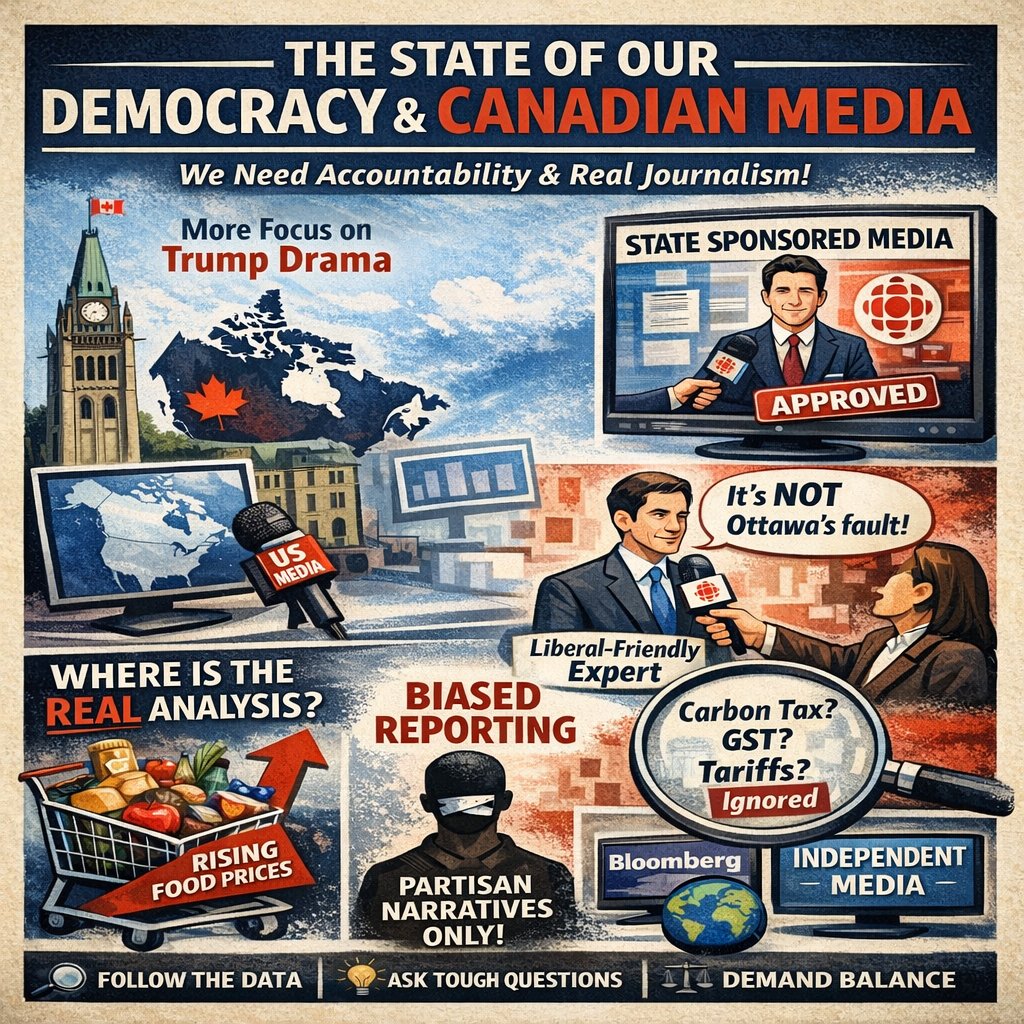
I’ve worked with the media for nearly 25 years. For most of that time, the relationship was professional and balanced. But in recent years, something has shifted.
I am increasingly concerned about the state of our democracy — particularly how media, in general, are informing Canadians about food policy, food inflation, and economic policy.
I now find myself learning more about Canada’s economy and policy changes from American outlets than from Canadian ones. Much of our national coverage feels reactive, shallow, or overly fixated on partisan narratives rather than substantive policy analysis.
What troubles me most is the lack of scrutiny applied evenly across governments and institutions.
For example, when the Bank of Canada suggested that Ottawa’s counter-tariffs contributed to food inflation, only one major outlet — Bloomberg — gave it meaningful coverage. The grocery benefit program received very little examination regarding how it would be financed. It took days before anyone pressed for clarity.
During the latest spike in food inflation, several outlets turned to the same small circle of commentators who dismissed any potential role of federal policy — carbon pricing, GST holidays, counter-tariffs — despite mounting evidence that policy decisions can and do affect food prices.
Instead of investigating structural drivers of inflation, much of the coverage focuses on fact-checking opposition rhetoric, even though the opposition has not governed since 2015. Scrutiny should be applied equally — not selectively.
Quebec media, while imperfect, appear to have maintained a broader range of debate. In much of the rest of Canada, I see increasing concentration of voices — often from the same region, Ontario, often reflecting similar policy perspectives — and less diversity of thought grounded in empirical research.
This isn’t about partisan politics. It’s about accountability, transparency, and healthy democratic discourse.
Media are under financial pressure — that’s real. But public trust depends on independence and depth. Subsidy structures, incentives, and newsroom economics all matter.
Canada deserves stronger policy journalism — especially on food affordability, supply chains, and economic resilience.
We need more data-driven analysis, more intellectual diversity, and more courage to ask uncomfortable questions — regardless of which party is in power.
Until that happens, Canadians would be wise to diversify their news sources and think critically about what they’re being told — and what they’re not.
For years several Ontario & BC community colleges ran a massive scam to monetize student visas.
In broad daylight.
The federal government did its part by giving full time work permits (!) even to foreign “students” enrolled at dodgy diploma mills.
Some provinces allowed publicly funded community colleges to contract out programs, and therefore foreign students, to the same private diploma mills.
The consequence: hundreds of thousands of families overseas mortgaged farms, houses and business to pay the recruitment agencies to get their kids a “ticket to Canada” through this scam.
They were assured by the recruiters and overseas immigration consultants that the study / work permit combo would guarantee them permanent residency, and with it the ability to sponsor their families.
And if that didn’t work out? Don’t worry, just make an asylum claim, and Canada will never get around to removing you. In the meantime, you’ll qualify for welfare, basic and supplementary health insurance, publicly subsided housing, open work permits, etc.
But for many of these young people, their Canadian dream looked more like a nightmare: jammed into insanely expensive apartments and houses, sleeping in shifts, working bottom end delivery jobs, enrolled in fake or third rate programs.
And we all know the broader social consequences this has had: from housing affordability, to declining per capita GDP, to the upheaval in our immigration system.
So how is it possible that there have been no consequences, professional, legal, or political, for those responsible?
Where did the money go?
What bonuses were paid to the presidents of Conestoga College, and others amongst the worst offenders?
Are we all supposed to pretend that this didn’t happen?
There is no shortage of blame to go around. But the college presidents who betrayed the mission of their institutions, and the public trust, should be the first held to account.
I have a lot of respect for Professor Skuterud and his incisive take on the huge damage done to Canada's human capital model of economic immigration, and how to repair it.
But IMO @PierrePoilievre is absolutely right here.
People who are *illegally* in Canada, who have exploited our generosity by making false asylum claims should not receive government benefits of any kind, let alone supplementary benefits that Canadians don't get.
They should follow our fair laws and leave. If they refuse to do so, they should be removed. They should not receive benefits that constitute an incentive to continue over staying, and undermining the integrity of our immigration laws.
That's why, as Immigration Minsiter, I removed Interim Federal Health coverage from bogus asylum claimants.
This kind of laxity is one of the reasons why our once high functioning asylum system has cratered, with over 300,000 people in the queue, and the IRB rubber stamping tens of thousands of applications.
The case for consistency in sentencing foreign nationals convicted of criminal offences is even stronger. It is outrageous that courts are now openly issuing reduced sentences for foreign nationals who have committed serious crimes, in order to save them from deportation.
The intent of Parliament in the Immigration and Refugee Protection Act (IRPA) is both clear and reasonable: if a foreign national (i.e. a non citizen of Canada) is convicted of serious crime, defined by a penal sentence of six months or longer, they are inadmissible to Canada and subject to deportation.
I should know, as I proposed the Faster Removal of Foreign Criminals Act in 2013, which amended IRPA to lower the threshold for criminality from sentences of two years to six months, and truncated appeals and delays impeding the removal of convicted foreign criminals.
Yet courts are now regularly imposing sentences below that threshold, explicitly to shield foreign criminals from inadmissibility under IRPA, and therefore removal. In doing so, they have created an indefensible two tier standard of justice: higher sentences for Canadians than for foreigners who violated our laws and victimized Canadians.
When elites get radically out of touch with the moral intuition of the general public on such issues, they create fertile conditions for actual xenophobes, and undermine public support for properly managed legal immigration.
The political, judicial, and opinion elites in many of our peer democracies made this mistake. The consequence? Reform leading in the UK; the RN in France; the AfD in Germany; and One Nation almost leading in Australia.
That's not what I want for Canada. Nor do I want a country that is regarded as a soft target for criminals and others who abuse our generosity and our laws.