Stop saying "Just following up" in your career emails. You are signaling desperation. You are handing them the leverage.
Here are 22 professional alternatives you can steal:
Your body replaces 98% of its atoms every year. Within five years, every single one is swapped out. The you from 2021 is physically gone. Not "mostly gone." Gone. The atoms that used to be your face are now part of the air, the ocean, somebody else's lunch.
Oak Ridge National Laboratory proved this in 1953. Your skin right now is about a month old. Your liver, six weeks. Your stomach lining regrows every five days. Your skeleton is completely different from ten years ago. A few atoms do stick around for life, buried in some brain cells, in parts of your heart, and in your tooth enamel. Scientists at the Karolinska Institute in Sweden tracked them using leftover radiation from 1950s nuclear bomb tests. The oldest surviving piece of "you" lives in your brain, your heart, and your teeth.
Your brain is also erasing you. On purpose. A neuroscientist named Ron Davis at Scripps Research found that the brain has cells that release dopamine, the same chemical you feel after a good meal or a win, and use it to dissolve memories. When his team shut these cells off in test animals, they remembered twice as much. The chemical behind your best feelings is the same one shredding your past, and it never stops running.
Ebbinghaus proved this back in 1885. You lose about half of everything you learn within one hour. A 2020 study from Baycrest's Rotman Research Institute had people live through a real experience and then checked how much they kept. At best, about a quarter. 75% of the details of your own life are being actively wiped by the organ that is supposed to be keeping track of it all.
The universe is 13.8 billion years old. Squeeze all of it into one calendar year, with the Big Bang on January 1st, and humans show up at 11:52 PM on New Year's Eve. Your whole life, every birthday and breakup and boring Tuesday, lasts 0.17 seconds on that calendar. Not even long enough to blink.
Stars will keep burning for about a hundred trillion more years, then the fuel runs out and the lights go off everywhere. The last things left will be black holes, places where gravity is so strong not even light can escape. Even those slowly leak away over a number of years so large you would need a hundred zeros to write it. After the last one is gone, nothing is left. No light, no warmth, nothing bumping into anything else, ever again. The universe reaches total stillness and stays there. Forever.
Brian Cox once described the window where life can even exist as one-thousandth of a billion billion billionth, billion billion billionth, billion billion billionth of a percent of the universe's total run time. You are in that window right now. Built from borrowed atoms, running on a brain shredding its own records, here for a fifth of a second on a cosmic calendar that ends in permanent silence. Anyway, hope your Tuesday is going alright.
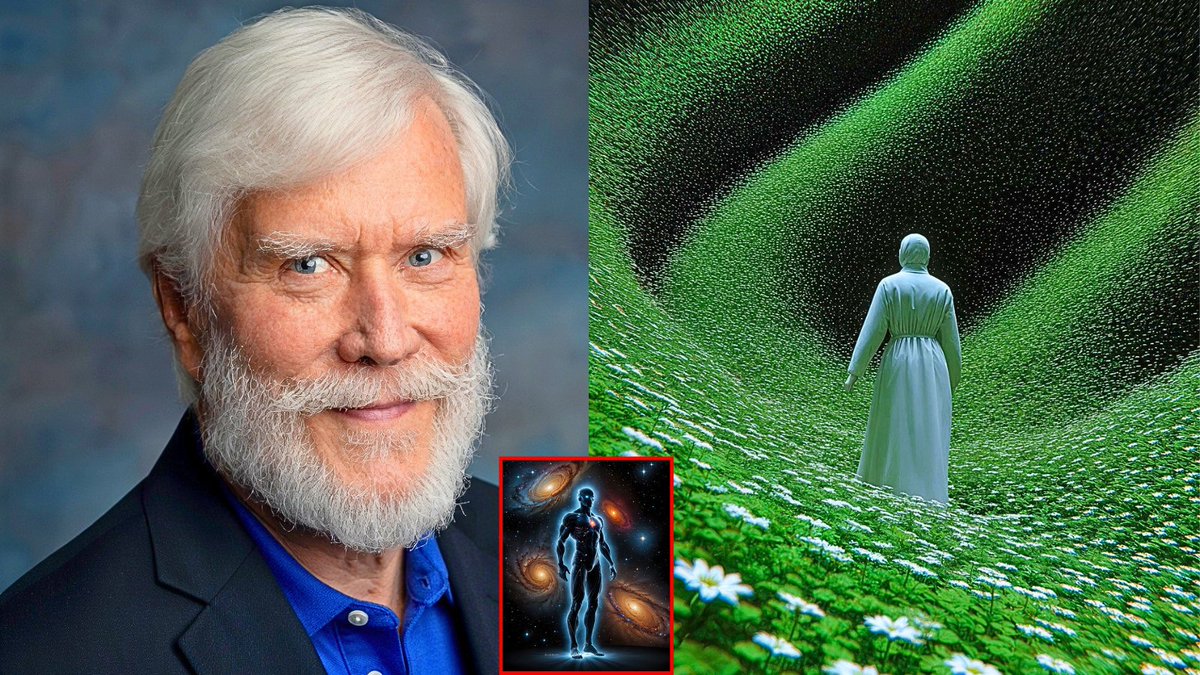
Thomas Campbell, a physicist and former NASA contractor, says consciousness is the true foundation of reality, not physical matter: "Our Reality Is a Simulation.”
He compares the universe to a very advanced virtual reality or video game that began with a “digital Big Bang,” arguing that we are consciousness using human bodies as avatars inside a rule-based simulation built for learning and growth.
He says we are “individuated units of consciousness” receiving data streams that create our experience, so the physical world only exists as rendered information when it is observed, similar to game graphics that load only when a player looks at them.
In his view, the larger consciousness system is like an intelligent information system that runs the simulation efficiently and consistently so it can function as a kind of school where consciousness evolves by making choices.
🔥🚨DEVELOPING: Filmographer Richard Sidey captured chilling footage of a killer whale breaching ice in Antarctica as it looks at the camera with eyes that used to drive sailors mad in the 19th century.