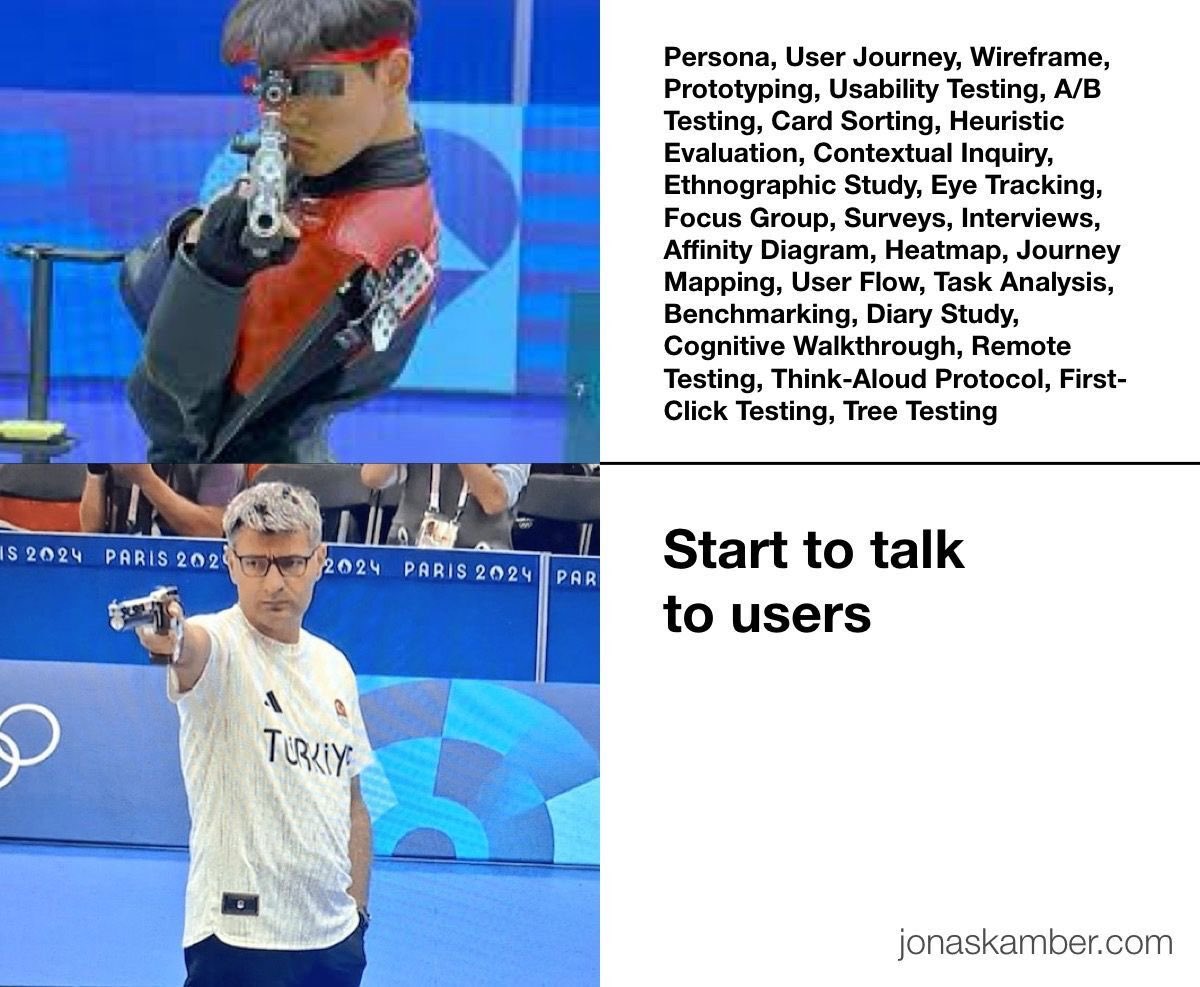
Next time you’re thinking about trying something new and don’t feel super confident, remember this quote.
“You miss 100% of the shots you never take”.
Give it a go. Sure, you’ll probably miss. But you you never know, you might score. And those who shoot more, score more. 🏀
“Great product teams expect 70% of ideas on their roadmap to fail” 💡
If you apply this mindset, you’ll approach these ideas very differently. Optimising for a rapid test and learn approach to validate concepts with users quickly vs developing a fully featured, scalable MMP.
💡 Did you know that humans are inherently motivated?
So the job of a leader should be to minimise the number of demotivators impacting your team. ✋
And what’s the number 1 demotivator? Not having autonomy.
Empower your team to go smash it… knowing you’ve got their back 💥
Adding some new content to our Product Design Playbook today ✨
Starting with a very high level overview of the role of UX, helping explain the value we bring to the business, aimed at those less familiar with UX and how we build digital experiences for our customers.
Is it just me who finds this UI incredibly overcomplicated and difficult to use? Layers on top of layers. Multiple interaction methods. 🤯
Is it me, or are the affordances just not clear enough???
I used to shy away from this, expecting a good idea to speak for itself. Don’t assume that will happen. Share ideas, your vision, get people on board, get them excited about the future and the impact your idea could have.
That’s how great ideas turn into great products. 🙌
I wish I knew this when I started my career…
That being a great communicator and storyteller would help me ‘sell’ my ideas and designs within a business, and to spend time getting comfortable sharing my ideas with others.
10 Principles of Good Design ~ Dieter Rams
1. Good design is honest.
2. Good design is aesthetic.
3. Good design is innovative.
4. Good design is unobtrusive.
5. Good design is long-lasting.
6. Good design makes a product useful.
7. Good design is environmentally friendly.
8. Good design makes a product understandable.
9. Good design is thorough down to the last details.
10. Good design involves as little design as possible.
Nice to get a bit of focus time this morning to work on our Product Design playbook in @figma 👌
I’m building a one-stop-shop for everything product design, from our design team goals, values, and ways of working, to our design toolkit and our design process itself. 👀
Demystifying the ‘product design process’
There is no such thing as a ‘design process’. Instead, there are just a variety of tools that you should learn, suited to solving different problems at different times. Learn as many as you can (and maintain a curious mindset to learn new approaches in the future) and you’ll become a product design maestro in no time.
Brief overview
What is a design process anyway?
1. The Double diamond (Design Council)
2. Continuous discovery (Teresa Torres)
3. Triple diamond
4. Build Measure Learn
Just to name a few! Each have their own merits, and offer a similar but different take on product design, but fundamentally they help achieve the same end goal.
A useful way to think about the idea of a design process is to see it as a way of helping you do 2 things:
1. Determine a solution to the problem as quickly as possible (focus on speed)
2. Ensure you’re solving the right problem in the first place (focus on risk)
How a design process helps and hinders
A solid design process has its place in anyone’s toolkit or business process, and can often act as a very useful tool to align thinking across multiple teams or divisions in your organisation.
Think about the design process as a way of moving from problem to solution as quickly and effectively as possible:
- How long do you spend on each stage?
- How much effort do you invest?
- Who else do you involve?
- How much research is enough?
- What’s the best way of testing your idea?
- How do you learn as quickly as possible? How do you prioritise learning, i.e. via MVPs, user testing, forming great hypotheses, desirability testing.
What will actually help you figure out the most important thing allowing you to move on to the next step, rather than blindly following each step of your process just because it’s your process:
- Are stakeholder interviews relevant for this project?
- Do you really need to conduct primary research if this is already a well understood problem space?
- Do you need to work up detailed wireframes if we could test something with users in the same timeframe by pairing with an engineer?
- Could we run desirability testing using marketing channels/social channels to gauge customer appetite before we conduct lengthy research cycles or commit to code?
Thinking differently about the process of design
In essence, what we’re really talking about here is ‘design thinking’ rather than design process. While ‘design process’ may outline WHAT you’ll do, ‘design thinking’ focuses on WHY you’re doing it.
- What is the outcome from this stage of my process?
- What do I need to learn in order to move to the next step?
- How can I get to a conclusion as quickly as possible?
- What do I need to learn to de-risk this project or idea?
- How will this tool/framework/workshop/research help me determine the right solution?
Maintain a curious mindset
1. Try to understand a variety of tools from problem discovery, to prioritisation, ideation and validation. Only through understanding the pros and cons to each tool (the first part of Shuhari) will you begin to master them. Keep track of the tools you’ve learnt, log them somewhere helpful for future reference, even create your own toolkit for the future.
2. Understand what you don’t know. Even if you haven’t had a chance to use the tool itself, simply being aware of it is the first stage of learning!
3. Test out new tools. See your next design challenge as an opportunity to validate these new tools you’ve discovered and see if they help you get from A to B more efficiently, with a better outcome, than other tools you’ve used before.
Read the full post:
https://t.co/LL3JX4ohZv
Great work @riggydigs
#ux #ui #uxdesign #uidesign #userexperience #prototype #productdesign #designprocess #problemsolving #designthinking #designresearch #uxstrategy #uxresearch #usertesting #usabilitytesting #research #design #agile #mvp #business