🚨‼️I really believe God is testing people right now. He is letting things surface that reveal where hearts truly are, what people will excuse, who they will defend, and whether they will keep the glory with Jesus Christ or hand it to another. Tests do not always come with a warning label. Sometimes they come through images, narratives, personalities, and public moments that force you to choose between blind loyalty and biblical discernment.
And the frightening thing is how many are failing the test while calling it faith. When people will not prove all things, will not judge righteous judgment, will not abstain from the appearance of evil, and will defend anything as long as it comes from their favorite man, that is not spiritual maturity. That is exposure. God is letting it come into the light. He is showing who fears Him and who just fears losing their idol.
Throughout history, the descendants of Abraham, Isaac, and Jacob have played a central role in biblical and world affairs. After all, Israel is the only nation ever to have a covenant with God - a covenant concerning them as a people and their land. Following the initiation of this covenant, hatred for them as a people and nation quickly surfaced and exists to this day, even spouting from the mouths of celebrities. What is Judaism? What is Zionism? Why are the two, when paired together, such a driving force for Antisemitism? Join Amir on a tour through biblical and world history as he brings clarity to "Judaism, Zionism, & Antisemitism".
Seven Questions Every New Christian Asks (But Might Be Afraid To)
Introduction
One of the worst things that can happen to a new Christian is not that he has questions. It is that he thinks he is not allowed to ask them. That is where a lot of confusion, fear, and fake spirituality get started. A man gets saved, the Lord begins dealing with him, his whole world starts shifting under the power of the gospel, and suddenly he has a hundred questions running through his head. He wants to know what just happened to him, what changes now, what the Bible means, why his mind still fights him, why the old sins still tug at him, whether God is really hearing him, whether he is doing this thing right, and whether he is the only one struggling with what he is struggling with. But because church people can sometimes act like everybody should already know the answers, or because some religious crowd makes honesty feel dangerous, the new believer gets quiet. He nods, smiles, says amen, and keeps carrying the questions around in private like contraband. That is not healthy. That is a recipe for unnecessary fear and shallow growth.
The truth is, new Christians have always had questions. They had them in the New Testament. They had them in the early church. They had them in revivals, mission fields, storefront churches, and country churches. The issue is not whether a man has questions. The issue is where he takes them and what he lets answer them. If he takes them to the Bible, to the Lord in prayer, and to sound Bible-believing counsel, he can grow through them. If he takes them to the world, to skeptics, to half-baked religious entertainers, or to his own imagination, he will likely get twisted up before he ever gets settled. The Bible says, “As newborn babes, desire the sincere milk of the word, that ye may grow thereby” (1 Peter 2:2). That means growth is expected, and babies who are growing are going to ask things, need things, and cry over things they do not yet understand. There is no shame in that. The shame comes when older believers make new saints feel like the only acceptable face is a polished fake one.
So this essay is for the new Christian who is wondering things he may not have said out loud yet. It is also for anybody helping new believers who needs to remember that the early days of the Christian life are full of joy, yes, but also full of adjustment, confusion, fear, temptation, wonder, and learning. And if somebody does not answer these things straight, the devil will gladly step in and answer them crooked. So let us take seven questions every new Christian asks, or at least ought to ask, even if he is a little afraid to. We are not going to handle them like nervous philosophers trying not to offend the modern age. We are going to handle them by the Book.
1. “If I’m Really Saved, Why Do I Still Struggle With Sin?”
That is one of the first and biggest questions a new believer asks, whether he says it aloud or not. He gets saved, feels the reality of Christ, maybe senses joy, relief, peace, and gratitude, and then before long he notices something disturbing. The flesh did not evaporate. Temptation still shows up. Old habits still tug. Certain thoughts still come back. Weaknesses still flare. And then fear whispers, “Well, if you were really saved, you would not be fighting this.” That is one of the devil’s favorite tricks. He cannot unsave a man washed in the blood of Christ, so he will gladly try to confuse him with the presence of conflict. But the truth is, the fight itself often proves life, not death.
Paul said in Galatians 5:17, “For the flesh lusteth against the Spirit, and the Spirit against the flesh.” There is a war now that was not there in the same way before salvation. Before a man is saved, he may feel guilt, fear, or outward consequences, but after salvation there is an inward battle in a new sense because the Spirit of God now lives in him. Romans 7 lays that struggle bare when Paul says, “For the
Behold My Hands and Feet - The Resurrection Sunday Proof That Changes Everything
Main Passage: Luke 24:39
Introduction
Resurrection Sunday is not about a religious mood, a seasonal tradition, or a soft sentimental reflection that fades by Monday morning. It is about the greatest event that ever broke into human history after the creation of the world itself. It is about a crucified Saviour who got up out of the grave and stood alive in the midst of frightened men who thought all their hopes had died on a cross outside Jerusalem. When the risen Lord stepped into that room in Luke 24, He did not offer the disciples a philosophy, a memory, or a symbolic interpretation. He said, “Peace be unto you” (Luke 24:36), and then He said, “Behold my hands and my feet, that it is I myself” (Luke 24:39). That statement is one of the most powerful declarations in all of Scripture because it anchors the resurrection in visible, tangible, undeniable reality. It was not a myth born in the minds of grieving followers. It was not a hallucination stirred by emotional exhaustion. It was the Lord Jesus Christ standing there alive after His death, showing the very body that had been nailed to the tree.
There is something deeply moving about the fact that Jesus did not hide the marks. He could have stepped into that room clothed only in dazzling glory, and He would have had every right to do it. He could have appeared in such blazing majesty that the disciples collapsed in speechless awe, unable even to look up. But instead, He gave them something tender, personal, and full of meaning. He pointed to His hands and His feet. He showed them the wounds. Those scars were not weaknesses. They were not reminders of failure. They were heaven’s receipts stamped in blood and raised in triumph. They proved He was the same Jesus who had suffered, the same Jesus who had been buried, and the same Jesus who now stood alive forevermore. On Resurrection Sunday, that truth ought to put steel in a believer’s spine and tears in his eyes at the same time. The wounds of Christ are not there to depress the saint. They are there to assure him that the work is finished, the payment is accepted, and the enemy is defeated.
That is why this message is so needed. We live in a world of fear, confusion, disappointment, and empty religion. Men are looking for peace while rejecting the Prince of Peace. They are looking for hope while ignoring the empty tomb. They want comfort without repentance, blessing without truth, and victory without a bloody cross. But the Bible will not let them have it that way. The Lord Jesus Christ rose bodily, literally, historically, and gloriously, and when He said, “Behold my hands and my feet,” He was calling men to look directly at the evidence of redeeming love and conquering power. That is what I want to magnify in this essay. I want to lift up the risen Christ on Resurrection Sunday and point hearts back to the One who still bears the marks of Calvary, not as tokens of loss, but as eternal emblems of victory. If you are saved, those hands and feet are your assurance. If you are troubled, they are your peace. If you are weary, they are your hope. If you are doubting, they are your answer. The risen Christ still stands before His own and says, “Behold.”
1. The Risen Christ Still Invites Us to Look
The first thing that strikes me in Luke 24 is how direct the Lord is with fearful disciples. The passage says, “But they were terrified and affrighted, and supposed that they had seen a spirit” (Luke 24:37). There they were, shaken by the crucifixion, rattled by the reports of the empty tomb, and unsettled by the sudden appearance of Jesus Himself. Fear had clouded their judgment. Their hearts were behind their eyes, and their eyes were not yet governed by faith. That is exactly where many believers find themselves at times. They know the truth in doctrine, but in the pressure of life, fear starts talking louder than Scripture. Yet the Lord did not
Shalom from Japan!
When I first came to faith in Yeshua the Messiah, I was lost in a sea of events and holidays I had never celebrated, with names unfamiliar to me. Easter was one of them.
In fact, the modern Hebrew name for it – Pascha – was my biggest riddle. Later, I discovered that it is the Greek name for Passover. In my Jewish Israeli mind, it made sense that since the events took place during Passover, they would be connected to that name.
However, when I began to travel in the United States, the name “Easter” kept coming up. “What is this all about?” I asked myself. I went to the books and found that the most commonly cited explanation comes from the 8th-century English monk Bede.
He wrote that:
▪️ The name derives from a pagan Anglo-Saxon goddess called Eostre (or Ostara).
▪️ She was associated with spring, renewal, and fertility.
▪️ The month in which the Christian celebration occurred was called Eosturmonath, named after her.
Over time, when Christianity spread in northern Europe, the celebration of the resurrection adopted the existing local name.
Rabbits and eggs were also later cultural additions to the season, as they represent birth, renewal, and reproduction.
Much of the above may be interesting to see and experience, but to the average Jewish person, adding a new holiday can feel somewhat foreign. So I had to dig deeper, only to discover that there was never any need for a new holiday.
If the purpose is to celebrate Yeshua’s resurrection, then it is already embedded in a feast that was waiting for its fulfillment during that Passover season: the Feast of Firstfruits. It is the third of the seven feasts of the Lord listed in Leviticus 23:9–14.
Verses 11–12, in particular, identify both the timing and the offering:
“He shall wave the sheaf before the Lord, to be accepted on your behalf; on the day after the Sabbath the priest shall wave it. And you shall offer on that day, when you wave the sheaf, a male lamb of the first year, without blemish, as a burnt offering to the Lord.”
Paul the apostle wrote:
“But now Christ is risen from the dead, and has become the firstfruits of those who have fallen asleep.” (1 Corinthians 15:20)
So here you have it – a perfect fulfillment of an already existing appointed time. No need for new names or additional traditions.
Have a blessed weekend, remembering the real Passover Lamb who was slain and how, on the day after the Sabbath, He became the Firstfruits!
Thankful for His sacrificial death, empowered by His resurrection, and awaiting His return,
Amir
If we are going to speak biblically - then let us speak biblically:
Isaiah the prophet foretold that the Messiah would suffer and die for the sins of the world:
“But He was wounded for our transgressions,
He was bruised for our iniquities;
The chastisement for our peace was upon Him,
And by His stripes we are healed.
All we like sheep have gone astray…
And the Lord has laid on Him the iniquity of us all.”
• Isaiah 53:5–6 (NKJV)
“Yet it pleased the Lord to bruise Him…
When You make His soul an offering for sin…”
• Isaiah 53:10 (NKJV)
The suffering of the Messiah was not accidental. It was ordained.
Jesus Himself declared:
“For I have come down from heaven, not to do My own will, but the will of Him who sent Me.”
• John 6:38 (NKJV)
“No one takes it from Me, but I lay it down of Myself. I have power to lay it down, and I have power to take it again.”
• John 10:18 (NKJV)
The cross was voluntary obedience to the Father.
It was not forced. It was not stolen. It was laid down.
And the apostle Paul, speaking of unbelieving Israel, wrote:
“Concerning the gospel they are enemies for your sake, but concerning the election they are beloved for the sake of the fathers. For the gifts and the calling of God are irrevocable.”
• Romans 11:28–29 (NKJV)
Irrevocable - not temporary.
Irrevocable - not transferable.
Irrevocable - not replaced.
So when someone claiming to be a Christian says:
• “The Jews killed Jesus.”
• “God replaced them.”
• “They are no longer His people.”
That is not the testimony of Scripture.
Peter preached in Jerusalem:
“Him, being delivered by the determined purpose and foreknowledge of God, you have taken by lawless hands, have crucified, and put to death.”
• Acts 2:23 (NKJV)
Notice the order -
First: the determined purpose and foreknowledge of God.
Then: human responsibility.
The cross was the sovereign plan of God.
Sin put Him there - all of us.
And Paul asks plainly:
“I say then, has God cast away His people? Certainly not!”
• Romans 11:1 (NKJV)
Certainly not.
God is faithful to His covenants.
The Messiah came as promised.
He laid down His life as foretold.
And the calling of Israel remains - because the character of God does not change.
Shalom friends,
Many Christians love to use Corrie ten Boom as the ultimate example of forgiving the enemy. And yes - her forgiveness was powerful.
But let me remind you of something.
The most Christian thing Corrie did was not forgiving a Nazi guard after the war - the most Christian thing she did was refusing to stay silent while Jews were being hunted. She hid them. She protected them. She risked everything.
She did not sit on the sidelines - she acted.
She was a Ruth - “Your people shall be my people.” She attached herself to the Jewish people in their darkest hour - not when it was convenient.
Today we are witnessing an unprecedented wave of antisemitism. Loud hatred. Polished hatred. Academic hatred. Even some self-proclaimed conservative influencers fanning the flames.
Let me be very clear -
You will never provoke Israel to jealousy through hatred.
You will never draw Jewish hearts toward the Messiah through violence.
You will never reflect Jesus by attacking His own people.
The apostle Paul spoke about provoking Israel to jealousy - but jealousy comes from love, from holiness, from walking in truth - not from slander and conspiracy theories.
Silence in a time like this is not wisdom - it is surrender.
If we claim to follow the Jewish Messiah - then we must not be ashamed of the Jewish people.
This is not the hour to retreat - it is the hour to stand.
Anti-Zionists, beware.
The land of Zion belongs to the people of Zion. That’s not politics, it's Scripture. When critics say the Jewish people don’t belong in Israel, they’re not arguing with a government. They’re arguing with God.
Watch the entire teaching here: https://t.co/jbvW9bYAc1
Former KGB defector Yuri Bezmenov warned decades ago that America wouldn’t be defeated with bombs, but through ideological subversion.
Here we are.
He said it takes 15 to 20 years to demoralize a nation. That’s one generation.
Look around. We’ve already lost several.
That’s why I fight. Not for clicks. Not for headlines. But to expose the next generation to truth while we still can.
#Europe is committing suicide through uncontrolled immigration, progressive liberal policies, and green legislation that have increased its dependence on Russian energy, particularly following the shutdown of many nuclear power plants.
It is profoundly ironic that the very governments so complacent about the rise of antisemitism within their own countries are simultaneously pursuing policies that undermine their own societies.
The moment Europe abandoned its Christian heritage, it opened the door to a massive Islamic influx – one that had waited patiently for hundreds of years.
The situation today is unmanageable unless a drastic move is taken by a world leader who will emerge from the territory of the ancient Roman Empire. He will not merely be admired – but worshiped. He will not only halt Islamic expansion and its culture of death – but will also strengthen (confirm, as stated in the English #Bible) a peace agreement and allow the Jews, after 2,000 years, to rebuild their Temple – a move possible only once radical Islam is crushed and moderate Muslims begin seeking something better, yet inclusive.
That same world leader will be regarded as a #messiah. But at some point – three and a half years after the peace agreement is confirmed – he will reveal his true nature, enter the Jewish Temple, and declare himself to be God.
Sounds like science fiction?
It’s not.
It’s the book of Daniel, chapter 9.
The past portion of that prophecy was fulfilled with unmatched accuracy.
The future will be fulfilled in the same way.
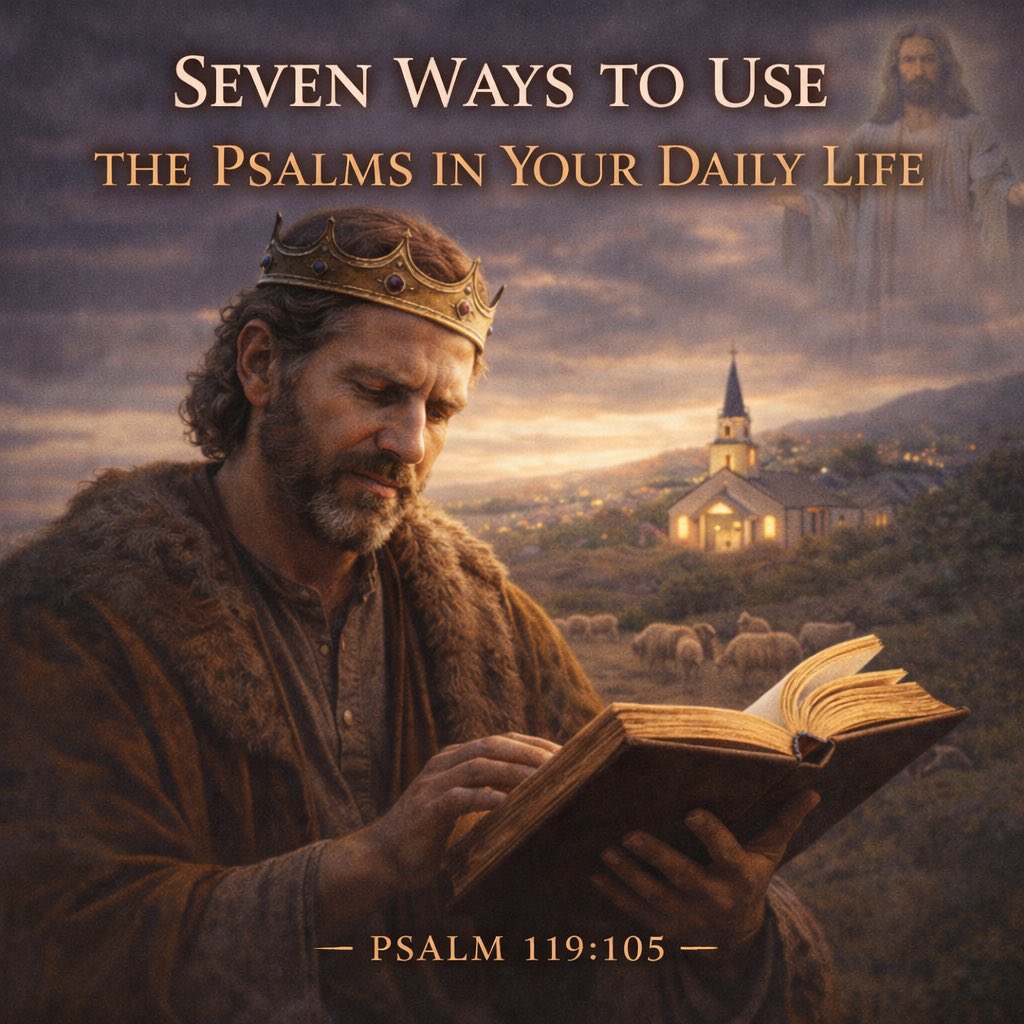
Seven Ways to Use the Psalms in Your Daily Life
INTRODUCTION
There is no book in the Bible that matches the emotional range, theological depth, and spiritual honesty of the Psalms. The Psalms were the hymnbook of Israel, the prayer book of saints, and the battlefield manual of believers who knew what it meant to walk through both green pastures and the valley of the shadow of death. A Christian can pick up the Psalms in any state of mind and find words for it. When the heart is burning with praise, the Psalms provide a vocabulary of worship. When the heart is crushed under sorrow, the Psalms provide a language of lament. The world talks about “emotional intelligence.” God gave the Psalms to give saints spiritual intelligence in emotional seasons. David did not merely survive emotions — he sanctified them.
The Psalms are not sentimental poetry. They are Scripture. They carry doctrine about creation (Psalm 8), prophecy about the crucifixion (Psalm 22), second advent warfare (Psalm 2), repentance (Psalm 51), millennial reign (Psalm 110), and daily Christian sanctification (Psalm 119). A Christian who avoids the Psalms is like a soldier who refuses to learn how to use his shield. Paul writes in Romans that we learn “patience and comfort of the scriptures” (Romans 15:4), and nowhere is patience and comfort more accessible than in the Psalms. They take the theology of the prophets and the historical narratives of the kings and put them into the bloodstream of devotion.
Most Christians read Psalms occasionally — like spiritual first aid kits — but the Bible believer learns to use the Psalms as part of his daily arsenal. In dark times, the Psalms provide refuge. In bright times, they provide perspective. In confusing times, they provide clarity. Too many saints are emotionally dislocated because they feed their hearts on news cycles and self-help clichés instead of letting the Psalms tune their soul. So in this essay we will outline seven ways a Christian can use the Psalms daily — not as museum pieces of ancient Hebrew poetry, but as living, breathing Scripture that transforms the inner life.
1. USE THE PSALMS FOR PRAISE IN THE MORNING
The first way a Christian uses the Psalms is for praise at the beginning of the day. David writes, “I will call upon the Lord, who is worthy to be praised” (Psalm 18:3). Praise is not a booster shot for God’s ego; it is realignment for the believer’s perspective. Morning praise sets the compass of the soul. The devil wants a Christian to begin the morning with self-pity, anxiety, checking notifications, checking the market, checking the headlines — anything except checking in with God. But praise in the morning reminds the believer that the world is not governed by chaos but by a sovereign Lord who “hath prepared his throne in the heavens” (Psalm 103:19).
Psalm 5:3 says, “My voice shalt thou hear in the morning, O Lord; in the morning will I direct my prayer unto thee.” David begins with vocal praise, not silent dread. He points the barrel of his prayer life upward. A Christian who wakes and immediately praises God with a Psalm — for His mercy, His sovereignty, His holiness, His goodness — is like a pilot setting instruments before takeoff. The turbulence of the day may shake him later, but the bearings were set when his feet hit the floor. Praise is a shield against the creeping bitterness and cynicism that attempt to attach themselves before breakfast.
Morning praise from the Psalms also trains the affections. The heart is not neutral; it must be tuned like a harp. Psalm 33:2 says, “Praise the Lord with harp: sing unto him.” When a believer sings Psalm 100, or quotes Psalm 103, or recites Psalm 145, he teaches his affections where to dwell. The flesh defaults to complaint. The spirit defaults to praise when fed by Scripture. A Christian who begins the day with praise from Psalms begins the day with God above the headlines, above the bank account, above the anxieties. That is not
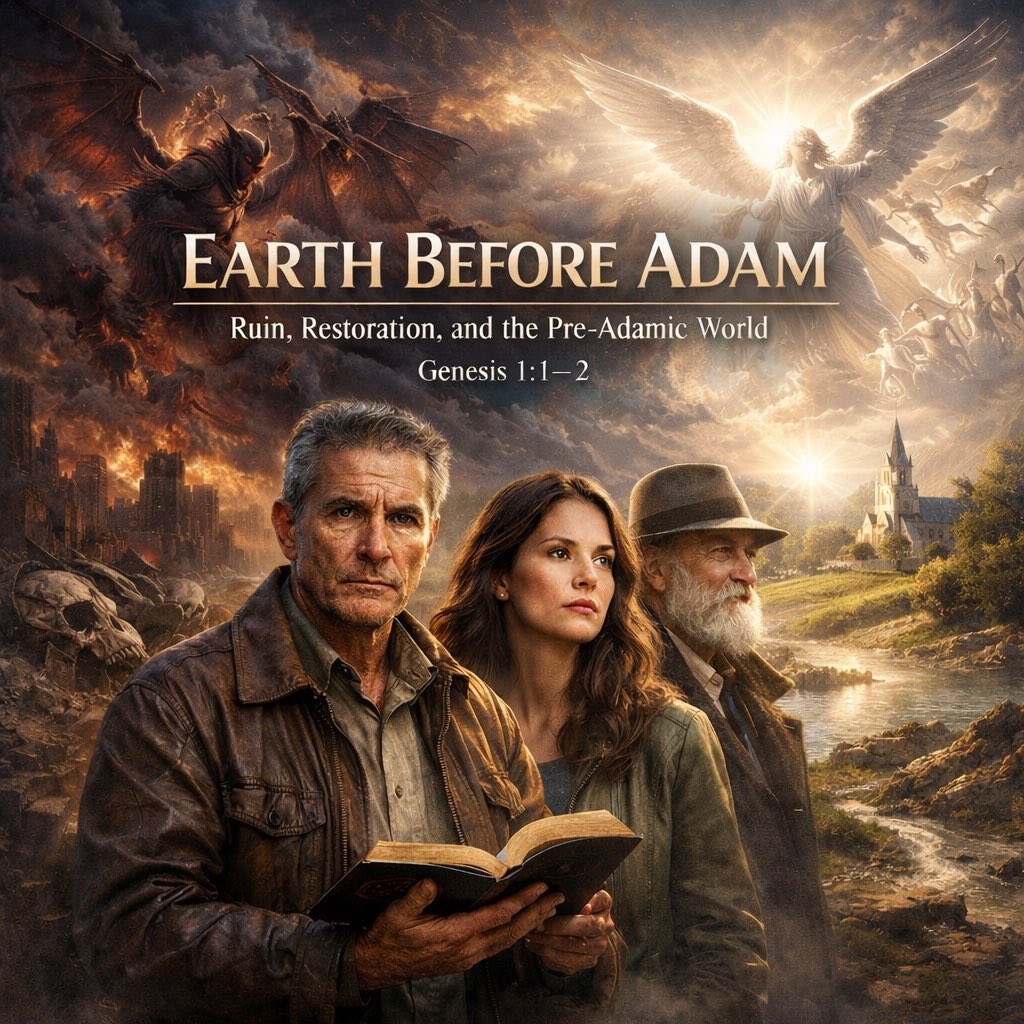
The Earth Before Adam – Ruin, Restoration, and the Pre-Adamic World
Main Passage: Genesis 1:1–2
Introduction
The opening lines of the Holy Scriptures do not take you into Eden, nor do they introduce you to Adam, Eve, Cain, Abel, or the serpent. They take you back further than human memory, beyond the reach of human history, into the primal act of creation itself. “In the beginning God created the heaven and the earth” (Genesis 1:1). That verse stands complete and self-contained. It does not beg for interpretation, nor does it require supplemental commentary to declare its truth. Yet without warning or narrative bridge, the very next verse confronts the reader with a world in ruin. “And the earth was without form, and void; and darkness was upon the face of the deep” (Genesis 1:2). There is a gulf of unknown duration between God’s perfect creation and a drowned, darkened world submerged under the waters of the deep. That gap is not populated by Moses’ imagination but by the Holy Ghost’s silence, and that silence has driven Bible-believers to examine what occurred before Adam ever drew breath.
A Bible believer does not begin his theology with modern geology, astronomy, or paleontology. He begins with the Book God wrote, not the guesses men have made. At the same time, the Bible believer does not have to bury his head in the sand when confronted with fossil beds, ancient strata, or geological upheavals. He is not required to pretend that dinosaurs boarded the ark or that the devil planted fossils to trick evolutionists. He is free to acknowledge that the earth existed before Adam, that a previous order may have been judged, and that fossils may belong to creatures that lived and died before man was formed from the dust. None of this compromises a literal six-day restoration for Adam’s world. It merely lets the Bible speak where it speaks and remain silent where it is silent.
Furthermore, recognizing a pre-Adamic earth does not force a Bible believer to surrender Genesis to Darwin. The so-called geological ages are only a threat if one insists that death entered creation solely through the fall of Adam, as though Adam’s fall were universal instead of federal. Adam’s death sentence applied to humanity, not to any previous order. Nothing in Scripture prohibits the existence of creatures before Adam, nor does anything require their survival past the judgment hinted at in Genesis 1:2. The presence of a gap does not endanger six-day creation; it explains the condition of the earth prior to those days. The real danger is not the gap—it is the refusal to take the text seriously. What follows, then, is an examination of the earth before Adam, the ruin that befell it, and the restoration God wrought in six literal days to prepare a new steward upon a reclaimed world.
1. The Textual Gap Between Creation and Ruin
The first chapter of Genesis provides two distinct statements that describe two distinct conditions. The first is the original act of creation: “In the beginning God created the heaven and the earth” (Genesis 1:1). The second is the condition of that earth when God moves to restore it: “And the earth was without form, and void; and darkness was upon the face of the deep” (Genesis 1:2). These conditions are not identical. One describes a finished act of divine creation; the other describes a shapeless, emptied, drowned globe suffocated under darkness. If Genesis 1:2 were describing God’s methodology for creating the earth, it would stand in contradiction to Isaiah 45:18, where the Lord declares that He “created it not in vain (tohu), he formed it to be inhabited.” Yet the earth in Genesis 1:2 is precisely in that tohu condition—without form—while submerged beneath waters not mentioned in verse 1.
Devotional: Becoming Little Again
Matthew 18:3 KJV
“And said, Verily I say unto you, Except ye be converted, and become as little children, ye shall not enter into the kingdom of heaven.”
Reflection
Jesus doesn’t flatter pride, He confronts it. The disciples were thinking about rank and greatness, and the Lord answered with a child. Not a résumé. Not accomplishments. A child.
In Scripture, a child represents dependence, trust, humility, and teachability. Children don’t pretend they have it all figured out. They ask questions. They believe what they’re told. They reach up because they know they can’t reach high enough on their own.
Jesus says, “Except ye be converted.” That word matters. This isn’t a minor adjustment or a personality tweak. It’s a turning. A reversal. The world says, “Grow up, be strong, be self-sufficient.” Christ says, “Come down, become small, depend on Me.”
We don’t enter the Kingdom by proving our worth, but by admitting our need.
Heart Check
Somewhere along the way, maturity can harden into self-reliance. Knowledge can crowd out wonder. Experience can replace faith. This verse calls us back, not to childishness, but to childlikeness.
Ask yourself honestly:
Do I still trust God when I don’t understand?
Do I pray like I need Him, or plan like I don’t?
Am I teachable, or just experienced?
The Kingdom is not entered by the confident stride of the proud, but by the open hands of the humble.
Application
Today, practice being “little” before God:
Pray simply, without polish or performance.
Trust His Word even when it challenges your logic.
Admit your weakness, and stop pretending strength impresses Heaven.
God is not looking for impressive servants. He’s looking for dependent sons and daughters.
Prayer
Lord, strip away my pride and self-reliance. Convert my heart again. Teach me to trust You like a child trusts a father, fully, simply, and without fear. Make me small in my own eyes, that You may be great in my life. Amen.
Closing Thought
Growing older is unavoidable. Growing proud is optional.
The door to the Kingdom is low, only the humble fit through it. ✝️
Prayer for the People of Iran
Heavenly Father,
We lift up the people of Iran who are crying out for justice, dignity, and freedom. You see every protester standing in courage, every family living in fear, and every voice that has been silenced. Be their shield and their refuge. Grant them wisdom, restraint, and unity. Protect the innocent from violence and oppression. Strengthen the weary, comfort the grieving, and give hope to those who feel forgotten. Turn the hearts of leaders toward righteousness, mercy, and truth. Lord, let light overcome darkness. Let justice roll down like waters, and let peace take root where fear has ruled. May Your presence be near, Your will be done, and Your grace abound.
In Jesus' name we pray. Amen. 🙏
Jesus Walks on Water: More Than a Miracle?
What really happened when Jesus walked on water? This episode of Explore the Bible goes deeper than the surface—literally. Discover the overlooked miracles in John 6, including the sudden arrival at shore, Peter’s moment of faith, and the meaning behind Jesus’ words: “It is I” or more accurately in Greek, “I AM.”
Amir Tsarfati and Dr. Rick Yohn explore the connections between the Gospels, the Psalms, Exodus, and Deuteronomy to reveal the full weight of this moment. This isn’t just about walking on water; it’s about understanding who Jesus truly is.