Two identical $15 million music catalogues, same songs, same AI squeeze. By 2030 they're $3.2 million apart, and most of the gap is the valuation multiple, not new AI income. Where the money moves, and what to fix first: https://t.co/1R0Qobg8Zp
A producer credit isn't a master deal.
Early Yellow is credited as producer on Travis Scott's 'What To Do?'. He's now suing, claiming the track was built on his recording and he's had no master royalties in nearly seven years. He wants half the master. Those are his claims; nothing's been decided.
A credit on Spotify shows you were there. It doesn't say what you own. Only a signed agreement does.
This is the thin end of the wedge - our insitutional infra (judicial etc etc) and businesses are increasingly unable to handle the rate of change - massive codebases need updating, algo's changed... an avalanche is coming that is only going to get bigger. It might be a one off with Suno, but I suspect its not.
AI & Creativity... good point. We have yet to explore the total surface of all possible music genres, but this is thin gruel to Artists - AI gen music is going to eat an ever greater % of listener time.
The problem is that by the time all this is done SOTA models will have subsumed everything anyway. There will be little to no room - there will be some utility, but the same problem arises, utilitarian models will also be far more advanced by the time its done. The space is moving too quickly for a newcomer to do anything useful unless its off the back of the existing models.
‼️ The EU's open AI model, EUROPA, is being tested at nearly 1 trillion parameters, more than twice the size the EU asked for.
Domyn, the Milan company the European Commission picked in June to build it, ran the trials on Germany's JUPITER, Europe's first exascale supercomputer.
The test model has 951.9B parameters against a 400B minimum. It splits the work across 384 expert networks, so only about 32.8B run for each token.
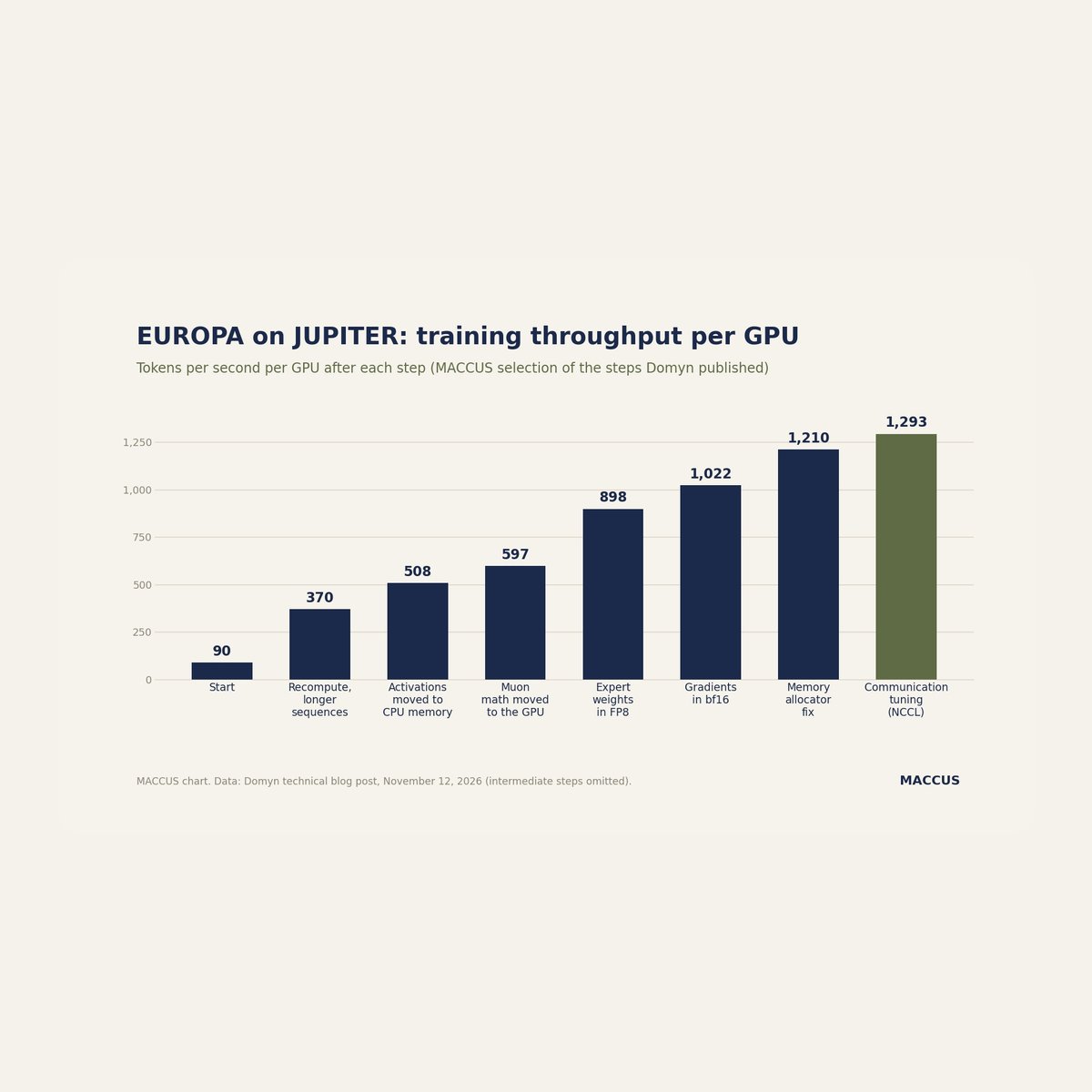
Training got about 14 times faster, from 90 to 1,293 tokens per second per GPU.
There are no weights yet. The licence, training data and release date are unknown.
@AI_Lender in fact, i am going to look into this. We literally value music catalogs and give bond like ratings - we have AI engineering backgrounds and the venn diagram might be closer then first glance. 🤔
Good comparison. Catalogue buyers don't just price the income history. They check each song's registrations, etc because income you can't prove you own isn't worth much. Data will need the same: who collected it, under what licence. Does it behave like a bond? (Beatles, Stones Metal etc) or like Pop? (Katie Perry) these are valued differently in catalog valuations
@monsieurbulb@rowlsmanthorpe Agreed - but its the signalling thats important. businesses will follow. Somewhere in here is an emergent parallel system...
Reading and writing was exclusive to the priesthood. The Gutenburg bible enabled reading and writing to the masses who went on to create science and modernity. This is the same. We shouldn't focus on sovereign ways of writing, the value is in accessibility to intelligence by the masses: we win with superior plumbing of data sources.