Matchday 1 penalty to Portugal
Matchday 2 penalty to Portugal
Matchday 3 penalty to Portugal
Ro of 32 penalty to Portugal
Ro of 16 penalty to Portugal, Spain elimination
Quarterfinals penalty to Portugal, Argentina elimination
Semi final 3 penalties to Ronaldo
Final 1 tap in,1 red card to opponent and 2 penalties to Ronaldo
MORGAN STANLEY TO ALLOW HOUSE PETS TO BUY SPACE X IPO SAYS OPEN ACCOUNT IN PETS NAME FUND ACCOUNT AND BUY SHARES 50 DOLLAR MINIMUM EXCEPT FOR RETRIEVERS RETRIEVERS MUST HAVE MINIMUM 1K DOLLARS
Hilarious move from Perez.
Riquelme went on the show 'El Hormiguero', where he promissed to sign Haaland.
So Florentino Perez bought the advertisement slot right after the show ended, to officially announce Mourinho.
And Mourinho just says: 'Si.' 😂
Today a crazy quantum story just got wilder.
On March 31, the Google Quantum AI team published a landmark result on Shor's algorithm for elliptic curve cryptography. Technically, the paper was a bombshell: a dramatic 10x improvement over the state-of-the-art. As a stunt and wakeup call to the blockchain space, those optimisations were illustrated on secp256k1, the elliptic curve underlying Bitcoin and Ethereum signatures.
But perhaps the most striking part of the paper was sociological, not technical. Instead of following standard academic process, the optimisations were kept secret, hidden behind a zero-knowledge (ZK) proof. Google's accompanying blog post mentions they "engaged with the U.S. government". The ZK proof demonstrates the existence of algorithmic improvements without leaking details. Academic censorship with ZK, a historic first!
As a co-author of the Google paper I witnessed some of the context surrounding this censorship. To be honest, multiple aspects of that context don't sit well with me. As much as I believe the general public ought to know more, I am limited in my ability to whistleblow. Though let me be clear about one thing: the Google team's professionalism has been absolutely exemplary, and they deserve nothing but praise.
Censorship has a way of backfiring. The Streisand effect, where an attempt to bury something only draws more attention to it, is exactly what's unfolding today. First, Google's key optimisation has been rediscovered by the French. And in a thrilling turn of events, a collaborative Shor-at-home challenge just launched. The initiative, available at ecdsa[.]fail, breached a new Shor world record in a matter of hours.
Let's start with the rediscovery. Just two months after Google's paper, French quantum expert André Schrottenloher cracks the main secret optimisation. His paper, titled "Optimized Point Addition Circuits for Elliptic Curve Discrete Logarithms", landed on the arXiv today. Big congrats to André, who beat several other nerdsnipped experts to it. In a blog post also published today, Craig Gidney, the world expert on Shor optimisations, revealed that he'd been sitting on this very optimisation for a whole year under censorship pressure.
Interestingly, André missed a handful of minor optimisations, both from Google's original publication and from improvements found since. It's plausible there's still plenty of juice left to squeeze out of Shor, and this is exactly what the ecdsa[.]fail challenge is about. The verifier program developed for the ZK proof does double duty, automatically filtering for valid submissions. Dozens of compounding small and micro improvements are rolling in. As of the time of writing there's an 8.4% improvement to Google's circuit, as measured by the product of logical qubit count and Toffoli gate count. Nice!
The nerdsnipping ran deeper than anyone expected. Over the last few weeks it became clear it extended well beyond André and other quantum experts. Behind the scenes, a small army of amateurs quietly got to work. Inspired by Karpathy-style autoresearch, they turned AI on Shor. Ironically, the verifier program for the ZK proof makes an ideal reward function for AIs. The barrier to entry for this modern style of research is refreshingly low, with several non-experts, even a teenager, finding nice optimisations. Get in touch if you'd like to join a Telegram group with fellow autoresearchers :)
Part 2: neutral atoms and qday
The story doesn't end with Google. On the same day Google went public, a stealthy startup called Oratomic published its own Shor paper in a coordinated release. It made a splash, ultimately becoming the most upvoted paper on scirate[.]com, a website ranking arXiv papers.
Oratomic's claim was wild. By building on Google's logical optimisations and applying custom physical optimisations for neutral atoms, they claimed just 10K physical qubits were sufficient to run Shor's algorithm on secp256k1. That number is mind-bogglingly low.
Knowing essentially nothing about neutral atoms when Oratomic's paper landed, I was intrigued and decided to learn more about the tech. I fell straight down the rabbit hole and spent a couple hundred hours on the topic. I got a little obsessed and watched every YouTube video I could find and spoke to a bunch of experts.
My conclusion? The tech is real, very real. Even Google recently decided to start a neutral atom lab, a notable pivot from their sole focus on superconducting qubits. If you care about qday, i.e. the day a quantum computer will break the first piece of cryptography in production, neutral atoms demand your attention. I shared some of my learnings on Shor and neutral atoms in a 30min talk at the ZKProof cryptography conference. You can find it on YouTube by searching "zkproof neutral atom".
Here's an interesting observation about this duo of breakthrough papers: neither Google nor Oratomic say a word about what their results mean for qday. No timelines. Zero. Nada. That is especially baffling given that the whole point of whitehat quantum cryptanalysis is to inform qday estimations and help the general public make good decisions.
So let me attempt to partially fill the silence, similarly to what Scott Aaronson did in his April 29 post. Given everything I know, including scary non-public information, I now put the odds of qday by 2032 at 50%. 10% by 2030.
Anecdotally, the US government has its own date: 2035. Originating at the NSA and later adopted by NIST, it's when branches of the US government will be disallowed from using quantum-vulnerable cryptography. In plain language: with hindsight, that date is a joke and should be discounted entirely. I don't see how NIST avoids being forced to pull it forward by years.
Part 3: post-quantum cryptography
There are good reasons to sound the alarm today, but please do not panic. Rushing carelessly towards immature post-quantum cryptography is a recipe for disaster. IMO a good target date for migration is 2029, roughly 3.5 years out. 2029 happens to be the date selected by Google, Cloudflare, and the Ethereum Foundation.
These days most of my time goes to safely migrating Ethereum towards post-quantum cryptography as part of the broader lean Ethereum effort. There's a lot to do. We need to rip out and replace BLS signatures at the consensus layer, KZG commitments at the data layer, and ECDSA signatures at the execution layer.
The plan to get there is compelling, and is based on hash-based cryptography. Within the Ethereum Foundation we've developed a Swiss army knife called leanVM (github[.]com/leanEthereum/leanVM) powered by the magic of hash-based SNARKs. Thanks to truly exceptional work by Emile, Thomas, and others, its performance is derisked. Regarding security, leanVM is a jewel, a minimal zkVM crafted for end-to-end formal verification and maximum security.
Want to help? There are two $1M initiatives. First, the Proximity Prize (proximityprize[.]org). Solve a long-standing mathematical conjecture in coding theory, improve hash-based SNARKs, and go home a millionaire. Second, the Poseidon Initiative (poseidon-initiative[.]info), offers $1M for breaking Poseidon, the SNARK-friendly hash function.
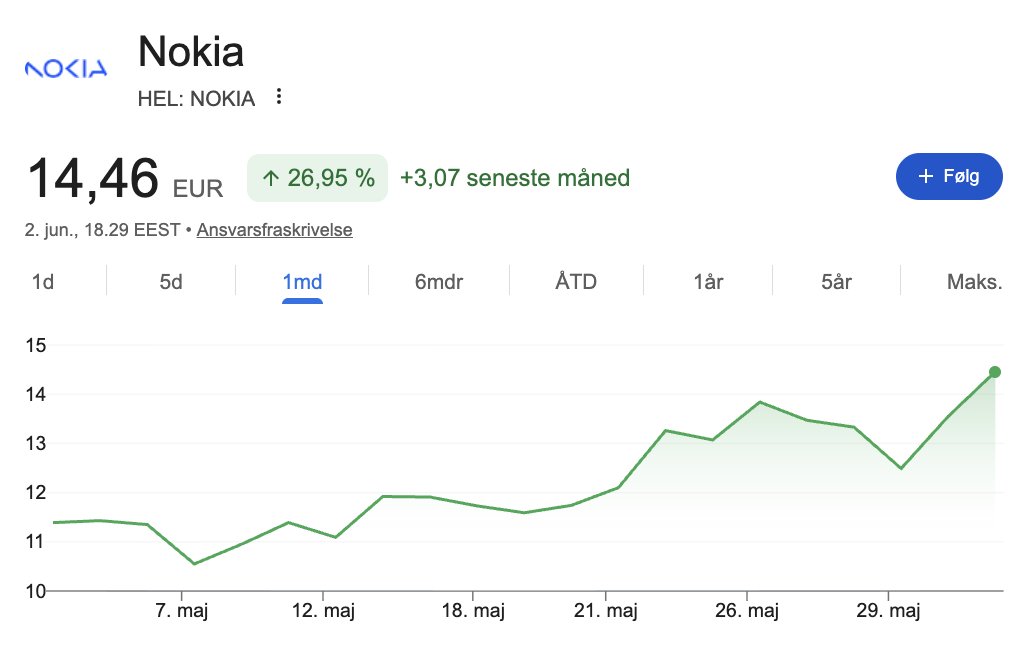
I believe $NOK is one the most overlooked setups right now, which is why I recently took a position in them.
To me, it has a simular setup as $OUST.
You remember $NOK as the company that made the phone everyone had, then lost it all, then spent a decade stumbling through acquisitions and identity crises while the world moved on without it.
That version is over NOW.
What's happening with Nokia right now is one of the most misunderstood setups I've seen in a long time and I hold it.
Here's the full thesis:
When people hear Nokia, they still think of the brick phone, 3310 or the game snake. Maybe they think of the Ericsson comparison. Maybe they think "slow European telecom equipment vendor."
None of that is the trade.
The trade is this: Nokia is quietly becoming the infrastructure layer for the AI-native wireless era and the market hasn't fully priced it yet.
The unlock happened in October 2025. Jensen Huang flew to Washington D.C. and, at NVIDIA's GTC event, announced a $1 billion equity investment in Nokia, at $6.01 per share, giving NVIDIA a 2.9% stake in the company. The announcement caused Nokia shares to surge 15-25% in a single session. It was Nokia's largest single-day gain in over a decade.
What many missed was NVIDIA's strategically allocate capital and putting a billion dollars behind their conviction that Nokia owns a critical piece of the AI infrastructure stack.
When Jensen bets a billion, I listen.
Let me explain the technology plainly, because this is where most investors glaze over and miss the opportunity.
The RAN — Radio Access Network — is the part of a wireless network that connects your phone, your car, your robot, your drone, to the broader internet. It's the "last mile" of connectivity.
For decades, RAN was hardware-defined: dumb antennas, proprietary chips, fixed performance. You got what you built. That was fine when the network just needed to move voice calls and streaming video.
AI breaks that model completely.
When AI-driven applications start running in the physical world; autonomous vehicles, robotic systems, edge inference, real-time sensing, the network demands become fundamentally different.
Latency isn't just important, it's deterministic. Jitter can't exist. The network has to be adaptive in real time, not just provisioned and left running.
Nokia launched its AI-RAN initiative in October 2025, demonstrated it with T-Mobile, and is now moving into commercial trials in 2026, targeting commercial release in 2027.
The core idea is transforming the RAN from a fixed hardware layer into a software-driven platform, one that uses AI to optimize itself continuously, responds to traffic patterns in real time, and can monetize spare GPU compute by offering AI inference capacity to external customers.
Read that last part again.
The base station becomes a revenue-generating AI compute node. Nokia's demonstrations at MWC26 in Barcelona showed exactly this: spare GPU capacity in the distributed AI-RAN network being offered to external customers as compute. The radio tower becomes a distributed edge data center.
This is the architectural shift. This is why NVIDIA cares.
Let me be precise about what the NVIDIA relationship means structurally.
NVIDIA introduced the Aerial RAN Computer Pro (ARC-Pro) a 6G-ready accelerated computing platform that combines connectivity, computing, and sensing in a single device.
Nokia is building its next-generation AI-RAN product line on top of this platform.
Dell Technologies is providing the PowerEdge servers.
The software stack runs on Red Hat OpenShift.
The ecosystem now includes Quanta and SuperMicro as hardware partners. BT, Elisa, NTT DOCOMO, Vodafone Group, and T-Mobile are all working with Nokia and NVIDIA on AI-RAN integration.
As of Q1 2026, Nokia has 10 publicly committed customers for its AI-RAN platform, including T-Mobile, Deutsche Telekom, Vodafone, SoftBank, and NTT Docomo.
Nokia's CEO Justin Hotard, who came in from Intel's data center division, put it plainly at MWC26:
"AI-RAN transforms RAN into a software-driven platform optimized for AI, and with NVIDIA and a growing ecosystem of partners we are progressing from validation to commercial deployment. This is a foundational step toward AI-native networks and 6G."
Jensen Huang said it even more plainly:
"AI is redefining computing and driving the largest infrastructure buildout in human history and telecommunications is next."
This is the AI infrastructure playbook being applied to the last uncaptured domain: the wireless edge.
Nokia delivered a strong Q1 2026. The company raised its full-year growth expectations for its Network Infrastructure business and reported a €1 billion order intake for the quarter. Net cash on the balance sheet stands at €3.8 billion, up from €3.4 billion at end of Q4 2025.
Remember what I said; simular to the $OUST setup, great cash balance.
For the full year, Nokia is targeting comparable operating profit of €2 to €2.5 billion in 2026, with a longer-term target of €2.7 to €3.2 billion by 2028. That's a meaningful step-up trajectory as AI-RAN revenues begin to compound.
The AI-RAN market itself, according to analyst estimates, is projected to exceed a cumulative $200 billion by 2030.
6G infrastructure spending is expected to reach $30 billion annually by 2033, growing at a 63.5% CAGR.
Nokia, as the lead equipment vendor in an NVIDIA-backed AI-native architecture, is positioned to capture a disproportionate share of that buildout.
The restructuring matters too. Nokia reorganized into two operating segments effective January 2026; Network Infrastructure and Mobile Infrastructure, simplifying the model and sharpening capital allocation.
This is not a company still searching for an identity. The pivot is complete.
The final brick in the puzzle is the detail that made me take a second look before I entered the position, and it matters more than most people give it credit for.
The insider buying at Nokia has been consistent and significant. Multiple Article 19 EU MAR disclosures have been filed; senior managers buying shares on the open market at RECENTLY highs and prices.
This is required public disclosure in the EU, which means we're seeing it unfiltered. When insiders file mandatory transaction disclosures showing open-market purchases at market prices, that's unambiguous directional signal from the people who know the most about where this company is going.
Outsiders react to headlines. Insiders act on conviction. To me, the disclosures are speaking.
It will take time to play out, but I believe Wall Street is about to slowly catch up. Morgan Stanley raised its price target from €11 to €14 in May 2026 and maintained a Buy rating.
SEB Equities upgraded from Hold to Buy.
73% of covering analysts are currently at Buy or equivalent.
The analyst community tends to be lagging indicators.
The entry zone has been constructive. The stock is now in the mid-teens. I'm watching the commercial trial results in 2026 and the 2027 commercial launch cadence closely. That's when this goes from a NVIDIA-backed thesis to a revenue story.
Here's what I want you to sit with.
Every AI infrastructure buildout conversation eventually hits a ceiling: where does the intelligence meet the physical world? Data centers get you to the edge of the cloud. Fiber gets you to the building. 5G gets you to the street. AI-RAN gets you to the device, the robot, the vehicle in real time, adaptively, without latency, at scale.
Nokia is building the bridge between the cloud and physical AI. That's not a niche play. That's infrastructure for the next twenty years of computing.
The Robotic AI Radio isn't a product name. It's a description of what every base station eventually becomes.
Nokia was dismissed for a decade because people couldn't see past what it used to be. That's exactly the kind of mispricing where the best returns live.
I hold it. I'm watching it closely. And I think the rest of the market is just starting to understand what NVIDIA understood in October.
Please note: As always this is not financial advice. This reflects my personal analysis and position as part of my portfolio. Do your own research. Know your risk.
—BP