Meet Rill 🦦 The secure-by-default embedded wallet infrastructure that keeps money flowing.
We help apps give users wallets that move money in and out, safely, at any scale.
A Webot Group company. More soon.
Breakpoint London starts Sunday.
We'll be there talking with teams that want to embed wallets in their apps, including the ones where an agent will need to spend on a user's behalf.
Come say hi, and tell us the hardest wallet problem you've run into. 🦦
#Breakpoint2026
Tenon’s checklist asks who approved the spend.
For a wallet, the question is whether the agent’s key can move more than the user approved. Rill uses delegated signing, spend limits and allowlists, so the limit is set at the key.
What would you let an agent spend without asking?
ChatGPT Wallet launched today, and the interesting part is the payment stack under the shopping. For an agent to pay safely, three layers have to exist. Here’s the model, and where it stops fitting apps beyond cards 🧵
@CNN Outages like this are a good prompt for a dependency audit: what’s in your critical path, what happens to users when it’s down, and can you tell them what broke?
@Cointelegraph Volume ≠ revenue.
Gemini Q3 (QoQ): spot +18% to $4.5B, retail -14% to $600M. Institutions were ~87% of volume, but retail drove ~3/4 of exchange revenue.
Rough math: retail pays ~1.7% on notional vs under 10 bps for institutions. The part that shrinks is the part that pays.
Social login should be the front door, not the vault key.
We’re building Rill with that principle in mind. Follow along for more wallet security breakdowns.
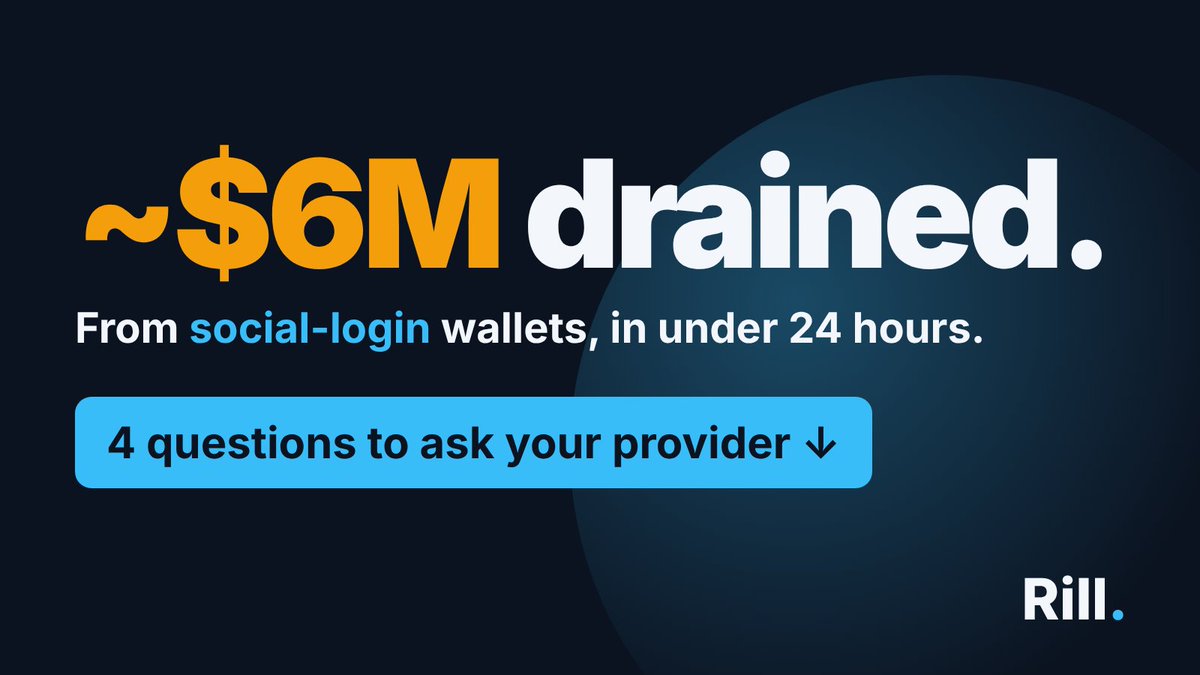
~$6M drained from social-login wallets in under 24 hours.
If your app lets users “sign in with Google”, here are 4 questions to ask your wallet provider. 🧵
Q4: Can users get out, and how does the provider handle incidents?
Can users export keys without your app in the middle? Is there a public post-mortem history? How a team handles a bad day tells you a lot.