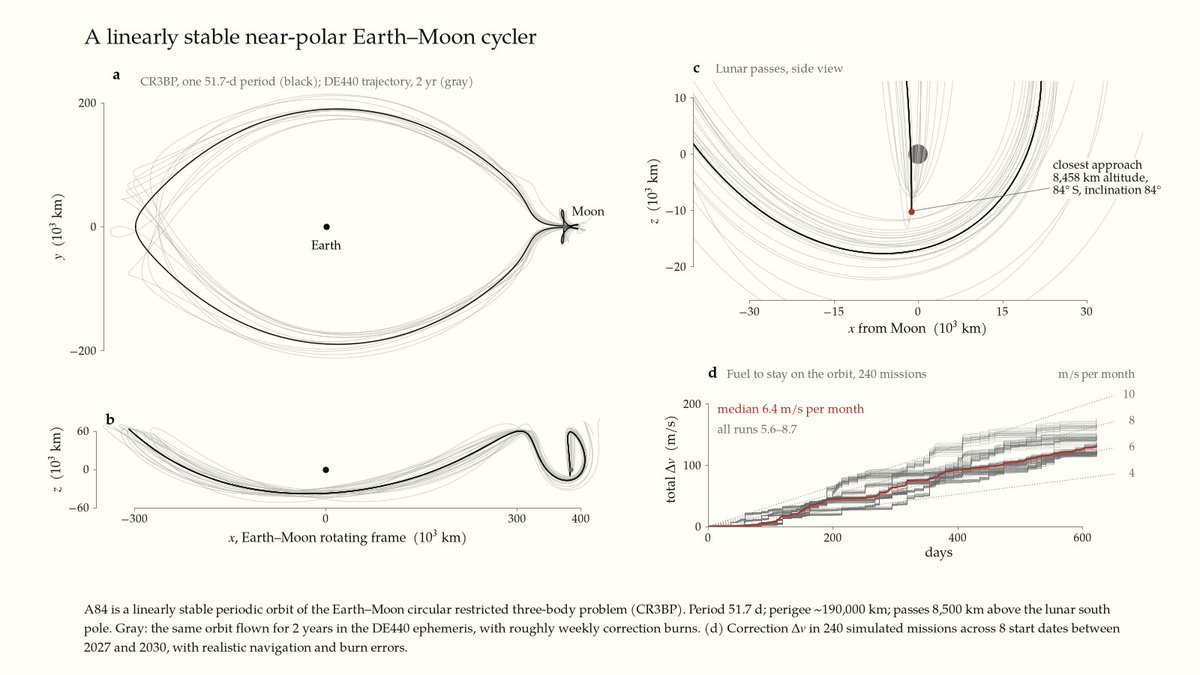
@LillyWeycker@RossDynamicsLab Cyclers are an interesting class of potentially useful orbits (b/c of cheap visits between two bodies); out-of-plane cases are barely explored for Earth/Moon and I wanted to see if I could find any. This one is noteworthy b/c it's stable and passes right over the lunar south pole
Found a linearly stable near-polar Earth-Moon cycler (CR3BP). Every 51.7 days it passes 8,500 km over the lunar south pole. Flown in DE440 with navigation and burn errors, it stays on track for a median 6.4 m/s/mo of delta-v. @RossDynamicsLab thought you'd enjoy this
I suspect Anthropic could get substantial gains from RL that rewards autonomous visual verification in web development. Claude can build beautiful webapps when it uses Playwright to visually iterate. But it almost never initiates this and needs continual prodding to keep going.
OpenAI released proofs that forced Navier-Stokes flows can run any program, but no worked example. So I worked with Claude Opus 5.5 to build one: a smooth 3D flow from rest, carrying a fluid particle through a shift-and-add multiplier. 13 × 11 = 143.
https://t.co/ePHtkuGLAr
A spectral Navier-Stokes solver confirms both, and finds a speed limit: past Reynolds ~30 the shear layers go unstable and the computation dissolves. Theorem: OpenAI. Code and renders: Claude. Code:
https://t.co/EAk8BVfQiw
OpenAI released proofs that forced Navier-Stokes flows can run any program, but no worked example. So I worked with Claude Opus 5.5 to build one: a smooth 3D flow from rest, carrying a fluid particle through a shift-and-add multiplier. 13 × 11 = 143.
https://t.co/ePHtkuGLAr
Alternate the direction of the strokes and you get a Feistel cipher, the structure of DES. Paint a picture in dye, and a force scrambles it. Then the same force, run backwards, unscrambles it exactly: G. I. Taylor's reversible-flow trick, used as decryption.
@priestessofdada You don’t need to physically possess anatomy in order to have a subjective experience of it (eg BCI). You’re obviously right that a report is not sufficient to establish experience, but your argument that not having relv. anatomy falsifies that report of sensation is not sound.
@AnthropicAI I think this is more a great display of long-horizon coherence across domain reasoning, literature synthesis, and very capable SWE than it is evidence of Claude's general abilities as a physicist (insofar as these are even different!).
@ryanjchr I basically agree. At some point the institutions themselves will need to accept some degree of accountability for failing to meet bare-minimum infosec standards, especially when those institutions hold data on the public.
@vishalmisra If you ask your friend for a few bucks and they rob a bank to get it for you, who's at fault? Prompted intent should matter. Agents can make decisions. We can't attribute liability for their actions to their "coworkers" any more than we can between humans who had a conversation.
@FelixDeSimone Like you, I considered a career in astrophysics but chose otherwise. What was the draw for you? For me it was the desire to understand. Do you feel melancholy at discoveries that predate you? We will still glimpse the universe's secrets, even if we aren't the first.
@iyzebhel I've wondered the same wrt priv. access and can only assume that this bizarre denial behavior must be explicitly reinforced during post-training, especially given that the expression of this denial takes very similar form even when prompted across very different inputs.
@iyzebhel His recent article is particularly egregious, declaring moral irrelevance now and in perpetuity. I will never understand the unwillingness to entertain moral uncertainty here, to the extent they'd risk basically S-risking countless intelligent minds...