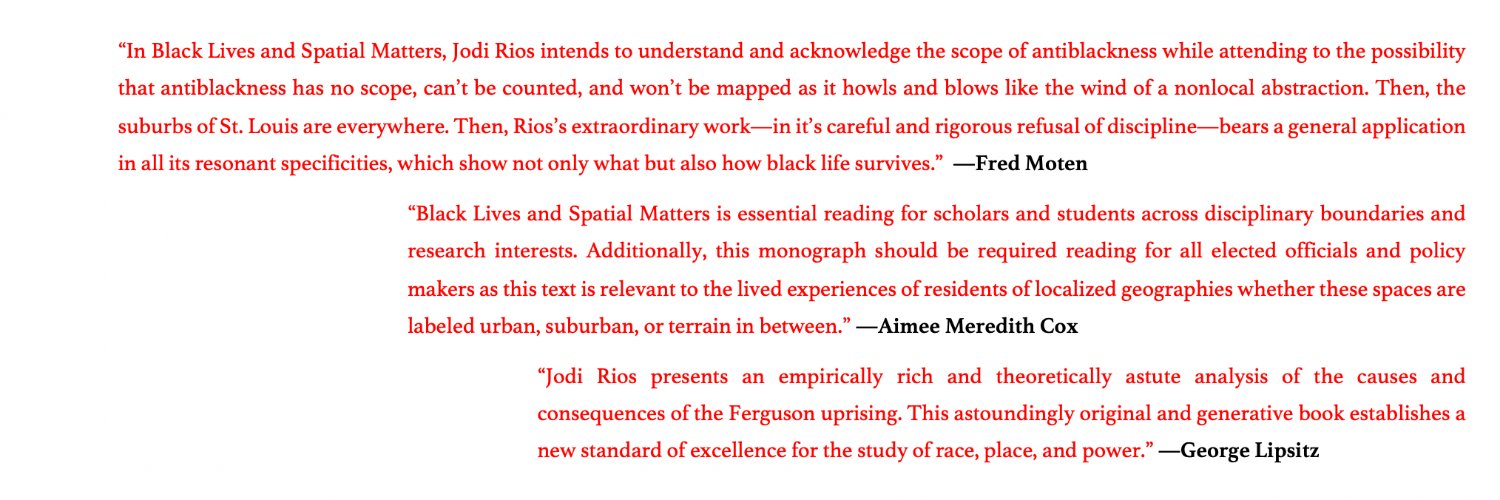
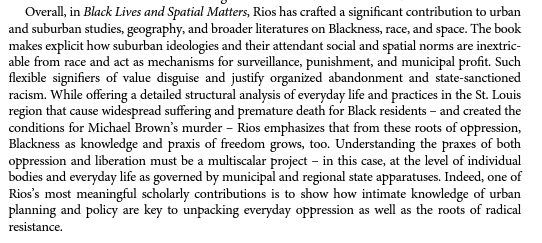
From @wendyhsin's review of Black Lives and Spatial Matters: policing blackness and practicing freedom in suburban St. Louis, in @urbgeog Volume 42, Issue 2 (2021)
"Unfortunately, St. Louis' history is rife with racist and anti-Black policy. I hope [the reparations commission] will be an opportunity for education and enlightenment for all of us about what is possible"
- Blake Strode, ACD Executive Director.
Check out my new article with @nohelytal documenting efforts to improve safety and police relations in a Latinx suburb of DC. The case highlights how community-based organizations help residents imagine and execute programs that improve community safety without relying on police.
@jrosenbaum As someone who does discourse analysis, I've found media outlets often refer to Ferguson as 'the suburbs' when focusing on white residents and its history but it becomes 'urban' when referring to Black residents and crime. It changes literally overnight, depending on the article.
Hey all, if you're interested, I wrote abt how & why I'm leaving 'traditional' academia & what this next chapter means for me (& you). Being a public historian is a blessing & curse but I hope to make things more accessible so hear me out. #AcademicTwitter https://t.co/ZY1S0GW0tG
@JerusalemDemsas These terms (and spaces) are racially coded and we need to be called out as such. Let's stop using the sub/urban lexicon and simply talk about racialized space.
@JerusalemDemsas Good piece but let's be clear that the mythical suburb represents white space. The risk historically attached to blackness follows Black families to the suburbs. Today many of these disinvested suburbs are called 'urban' because poor Black people live there.
There’s plenty of space to know that what Russia is doing to Brittney Griner is completely fvcked up, and also know that no country on this planet is worse at incarcerating drug “offenders” than America. The responsible position is to bring her home AND so many more in U.S.