193.30% 𝐈𝐧 𝐉𝐮𝐬𝐭 𝟑 𝐌𝐨𝐧𝐭𝐡𝐬. 📈
I started this year with a high-six-figure trading account, and my portfolio is up 𝟏𝟗𝟑.𝟑𝟎% over the last 3 months alone.
And the interesting part? This happened during some of the toughest market conditions for swing traders.
No magic indicators. No secret strategy. No gambling on earnings or 0DTE options.
Just 𝐩𝐫𝐢𝐜𝐞 𝐚𝐜𝐭𝐢𝐨𝐧, 𝐭𝐫𝐞𝐧𝐝 𝐟𝐨𝐥𝐥𝐨𝐰𝐢𝐧𝐠, 𝐫𝐢𝐬𝐤 𝐦𝐚𝐧𝐚𝐠𝐞𝐦𝐞𝐧𝐭, and knowing when to trade and when to sit out.
After 6+ years of trading, here's how I approach the market and what has worked for me.
𝐍𝐨. 𝟏 — 𝐌𝐲 𝐓𝐫𝐚𝐝𝐢𝐧𝐠 𝐒𝐭𝐫𝐚𝐭𝐞𝐠𝐲 — 𝐊𝐞𝐞𝐩 𝐈𝐭 𝐒𝐈𝐌𝐏𝐋𝐄
I'm primarily a swing trader and a trend follower.
My core tools are:
• 𝟗 & 𝟐𝟏 𝐄𝐌𝐀: The foundation of my strategy. I follow price action and trade in the direction of the trend.
• 𝐕𝐨𝐥𝐮𝐦𝐞 𝐏𝐫𝐨𝐟𝐢𝐥𝐞: Helps me identify important levels, support, resistance, and areas of interest.
• 𝐀𝐧𝐜𝐡𝐨𝐫𝐞𝐝 𝐕𝐖𝐀𝐏: I use it occasionally, mostly for larger timeframes.
That's pretty much it.
I don't need 20 indicators or complicated systems. I want clean price action, a clear trend, and a good entry.
𝐍𝐨. 𝟐 — 𝐀+ 𝐒𝐞𝐭𝐮𝐩𝐬 𝐨𝐫 𝐍𝐎 𝐓𝐑𝐀𝐃𝐄
This is probably the most important rule in my trading.
• I only trade A+ setups, whether the opportunity is to the upside or downside.
• If I don't see my setup, I simply don't trade.
• I can sit out for a day, a week, a month, or even a year if necessary.
• I don't feel the need to participate in every market move.
𝐍𝐨 𝐬𝐞𝐭𝐮𝐩 = 𝐍𝐨 𝐭𝐫𝐚𝐝𝐞. 𝐈𝐭'𝐬 𝐭𝐡𝐚𝐭 𝐬𝐢𝐦𝐩𝐥𝐞.
𝐍𝐨. 𝟑 — 𝐀𝐝𝐚𝐩𝐭 𝐭𝐨 𝐭𝐡𝐞 𝐌𝐚𝐫𝐤𝐞𝐭, 𝐃𝐨𝐧'𝐭 𝐅𝐢𝐠𝐡𝐭 𝐈𝐭
This is something that has helped me tremendously, especially over the last few months.
• When the market is trending, I focus on swing trading and riding the trend.
• When the market becomes choppy and directionless, I avoid swing trades and mostly look for intraday opportunities.
• And when nothing looks attractive? I sit in cash.
I don't force my strategy on the market.
𝐊𝐧𝐨𝐰𝐢𝐧𝐠 𝐰𝐡𝐞𝐧 𝐍𝐎𝐓 𝐭𝐨 𝐭𝐫𝐚𝐝𝐞 𝐢𝐬 𝐣𝐮𝐬𝐭 𝐚𝐬 𝐢𝐦𝐩𝐨𝐫𝐭𝐚𝐧𝐭 𝐚𝐬 𝐤𝐧𝐨𝐰𝐢𝐧𝐠 𝐰𝐡𝐞𝐧 𝐭𝐨 𝐛𝐮𝐲.
𝐍𝐨. 𝟒 — 𝐑𝐢𝐬𝐤 𝐌𝐚𝐧𝐚𝐠𝐞𝐦𝐞𝐧𝐭 — 𝐂𝐮𝐭 𝐋𝐨𝐬𝐞𝐫𝐬, 𝐑𝐢𝐝𝐞 𝐖𝐢𝐧𝐧𝐞𝐫𝐬
My approach is simple.
• I generally cut my losses around 𝟏𝟓–𝟐𝟎% on options positions.
• But when I'm right, I try to hold my full position for as long as the trend remains intact.
• I do take very light trims along the way, but I don't aggressively sell just because a position is up 30%, 50%, or even 100%.
• If the trend is still there, I want to stay in the trade.
Of course, not every trade works, and sometimes losses can exceed the planned stop.
𝐂𝐮𝐭 𝐲𝐨𝐮𝐫 𝐥𝐨𝐬𝐞𝐫𝐬 𝐞𝐚𝐫𝐥𝐲. 𝐆𝐢𝐯𝐞 𝐲𝐨𝐮𝐫 𝐰𝐢𝐧𝐧𝐞𝐫𝐬 𝐫𝐨𝐨𝐦 𝐭𝐨 𝐠𝐫𝐨𝐰.
𝐍𝐨. 𝟓 — 𝐏𝐨𝐬𝐢𝐭𝐢𝐨𝐧 𝐒𝐢𝐳𝐢𝐧𝐠 — 𝐆𝐫𝐨𝐰 𝐒𝐥𝐨𝐰𝐥𝐲, 𝐍𝐨𝐭 𝐄𝐦𝐨𝐭𝐢𝐨𝐧𝐚𝐥𝐥𝐲
I started this year with a high-six-figure account.
• As my account grows, I gradually increase my position sizes every few months.
• But here's the important part — I only increase my size when I believe I can comfortably handle the potential losses.
• Just because my account grows doesn't mean I should immediately double my position sizes.
• I need to be mentally comfortable with the risk.
𝐈𝐟 𝐲𝐨𝐮 𝐜𝐚𝐧'𝐭 𝐡𝐚𝐧𝐝𝐥𝐞 𝐭𝐡𝐞 𝐥𝐨𝐬𝐬, 𝐲𝐨𝐮 𝐬𝐡𝐨𝐮𝐥𝐝𝐧'𝐭 𝐛𝐞 𝐭𝐚𝐤𝐢𝐧𝐠 𝐭𝐡𝐚𝐭 𝐬𝐢𝐳𝐞.
𝐍𝐨. 𝟔 — 𝐌𝐲 𝐓𝐫𝐚𝐝𝐢𝐧𝐠 𝐀𝐜𝐜𝐨𝐮𝐧𝐭 — 𝐏𝐫𝐢𝐦𝐚𝐫𝐢𝐥𝐲 𝐎𝐏𝐓𝐈𝐎𝐍𝐒
This account is almost entirely options trading.
I primarily trade:
• Options
• Selling puts
• A very small allocation to leveraged shares
Interestingly, I started my trading journey with options, not stocks.
My stocks are mostly part of my long-term investment portfolio, which I barely even look at.
Many people think options trading is extremely difficult.
I believe options become much more manageable once you understand the instrument, develop a strategy, and learn proper risk management.
That doesn't make options easy or eliminate their risks.
𝐌𝐚𝐬𝐭𝐞𝐫 𝐨𝐧𝐞 𝐬𝐭𝐫𝐚𝐭𝐞𝐠𝐲 𝐢𝐧𝐬𝐭𝐞𝐚𝐝 𝐨𝐟 𝐜𝐡𝐚𝐬𝐢𝐧𝐠 𝐭𝐞𝐧 𝐝𝐢𝐟𝐟𝐞𝐫𝐞𝐧𝐭 𝐬𝐭𝐫𝐚𝐭𝐞𝐠𝐢𝐞𝐬.
𝐍𝐨. 𝟕 — 𝐍𝐨 𝟎𝐃𝐓𝐄 𝐆𝐚𝐦𝐛𝐥𝐢𝐧𝐠. 𝐍𝐨 𝐄𝐚𝐫𝐧𝐢𝐧𝐠𝐬 𝐋𝐨𝐭𝐭𝐞𝐫𝐲.
This is another rule that has helped me stay disciplined over the years.
• I don't gamble on 0DTE options, earnings announcements, or random speculative plays hoping for overnight jackpots.
• I prefer trading stocks that are already trending, with clear price action and defined risk.
Sure, someone might make 500% or 1,000% overnight on an earnings gamble.
Good for them. But that's not my game.
Avoiding these trades has helped me stay away from bad habits, overtrading, FOMO, and the temptation to make quick money.
𝐈'𝐦 𝐡𝐞𝐫𝐞 𝐭𝐨 𝐭𝐫𝐚𝐝𝐞 𝐚 𝐬𝐭𝐫𝐚𝐭𝐞𝐠𝐲, 𝐧𝐨𝐭 𝐛𝐮𝐲 𝐥𝐨𝐭𝐭𝐞𝐫𝐲 𝐭𝐢𝐜𝐤𝐞𝐭𝐬.
𝐍𝐨. 𝟖 — 𝐌𝐲 𝐁𝐢𝐠𝐠𝐞𝐬𝐭 𝐀𝐜𝐡𝐢𝐞𝐯𝐞𝐦𝐞𝐧𝐭 𝐈𝐬𝐧'𝐭 𝐭𝐡𝐞 𝟏𝟗𝟑% — 𝐈𝐭'𝐬 𝐌𝐲 𝐄𝐌𝐎𝐓𝐈𝐎𝐍𝐒
This is something I'm genuinely proud of.
After 6+ years of trading, I've reached a stage where I barely feel any emotion whether a trade is up 100% or going against me.
• 𝐍𝐨 𝐣𝐮𝐦𝐩𝐢𝐧𝐠 𝐚𝐫𝐨𝐮𝐧𝐝 𝐰𝐡𝐞𝐧 𝐈 𝐦𝐚𝐤𝐞 𝐦𝐨𝐧𝐞𝐲.
• 𝐍𝐨 𝐩𝐚𝐧𝐢𝐜 𝐰𝐡𝐞𝐧 𝐈 𝐥𝐨𝐬𝐞.
• 𝐍𝐨 𝐫𝐞𝐯𝐞𝐧𝐠𝐞 𝐭𝐫𝐚𝐝𝐢𝐧𝐠.
• 𝐉𝐮𝐬𝐭 𝐟𝐨𝐥𝐥𝐨𝐰𝐢𝐧𝐠 𝐦𝐲 𝐩𝐥𝐚𝐧.
It took years of mistakes, losses, learning, and experience to get here.
I wasn't always like this.
But over time, I've learned to detach myself from the outcome of individual trades.
𝐈'𝐯𝐞 𝐛𝐞𝐜𝐨𝐦𝐞 𝐦𝐨𝐫𝐞 𝐨𝐟 𝐚 𝐘𝐎𝐆𝐈 𝐢𝐧 𝐭𝐫𝐚𝐝𝐢𝐧𝐠. 🧘♂️
Win or lose, my emotions remain the same.
And for someone trading options with meaningful position sizes, I consider that a bigger achievement than any percentage return.
𝐅𝐢𝐧𝐚𝐥 𝐓𝐡𝐨𝐮𝐠𝐡𝐭𝐬
𝟏𝟗𝟑.𝟑𝟎% 𝐢𝐧 𝟑 𝐦𝐨𝐧𝐭𝐡𝐬 𝐢𝐬 𝐠𝐫𝐞𝐚𝐭, 𝐛𝐮𝐭 𝐭𝐡𝐞 𝐫𝐞𝐚𝐥 𝐬𝐭𝐨𝐫𝐲 𝐢𝐬𝐧'𝐭 𝐭𝐡𝐞 𝐫𝐞𝐭𝐮𝐫𝐧. 𝐈𝐭'𝐬 𝐭𝐡𝐞 𝐩𝐫𝐨𝐜𝐞𝐬𝐬 𝐛𝐞𝐡𝐢𝐧𝐝 𝐢𝐭.
• I don't try to predict every market move.
• I don't chase every breakout.
• I don't buy every dip.
• I don't gamble on earnings.
• And I certainly don't need to trade every day.
• I know when to buy.
• I know when to sell.
• I know when to increase my size.
• And most importantly, 𝐈 𝐤𝐧𝐨𝐰 𝐰𝐡𝐞𝐧 𝐭𝐨 𝐒𝐈𝐓 𝐎𝐔𝐓.
Some traders think making money means constantly being in a trade.
I believe the opposite.
𝐓𝐡𝐞 𝐦𝐚𝐫𝐤𝐞𝐭 𝐫𝐞𝐰𝐚𝐫𝐝𝐬 𝐩𝐚𝐭𝐢𝐞𝐧𝐜𝐞 𝐣𝐮𝐬𝐭 𝐚𝐬 𝐦𝐮𝐜𝐡 𝐚𝐬 𝐞𝐱𝐞𝐜𝐮𝐭𝐢𝐨𝐧.
After 6+ years, one thing is clear to me:
𝐓𝐫𝐚𝐝𝐢𝐧𝐠 𝐢𝐬𝐧'𝐭 𝐚𝐛𝐨𝐮𝐭 𝐜𝐚𝐭𝐜𝐡𝐢𝐧𝐠 𝐞𝐯𝐞𝐫𝐲 𝐨𝐩𝐩𝐨𝐫𝐭𝐮𝐧𝐢𝐭𝐲. 𝐈𝐭'𝐬 𝐚𝐛𝐨𝐮𝐭 𝐰𝐚𝐢𝐭𝐢𝐧𝐠 𝐟𝐨𝐫 𝐘𝐎𝐔𝐑 𝐨𝐩𝐩𝐨𝐫𝐭𝐮𝐧𝐢𝐭𝐲 𝐚𝐧𝐝 𝐦𝐚𝐤𝐢𝐧𝐠 𝐢𝐭 𝐜𝐨𝐮𝐧𝐭.
That's the RIP way. 🎯
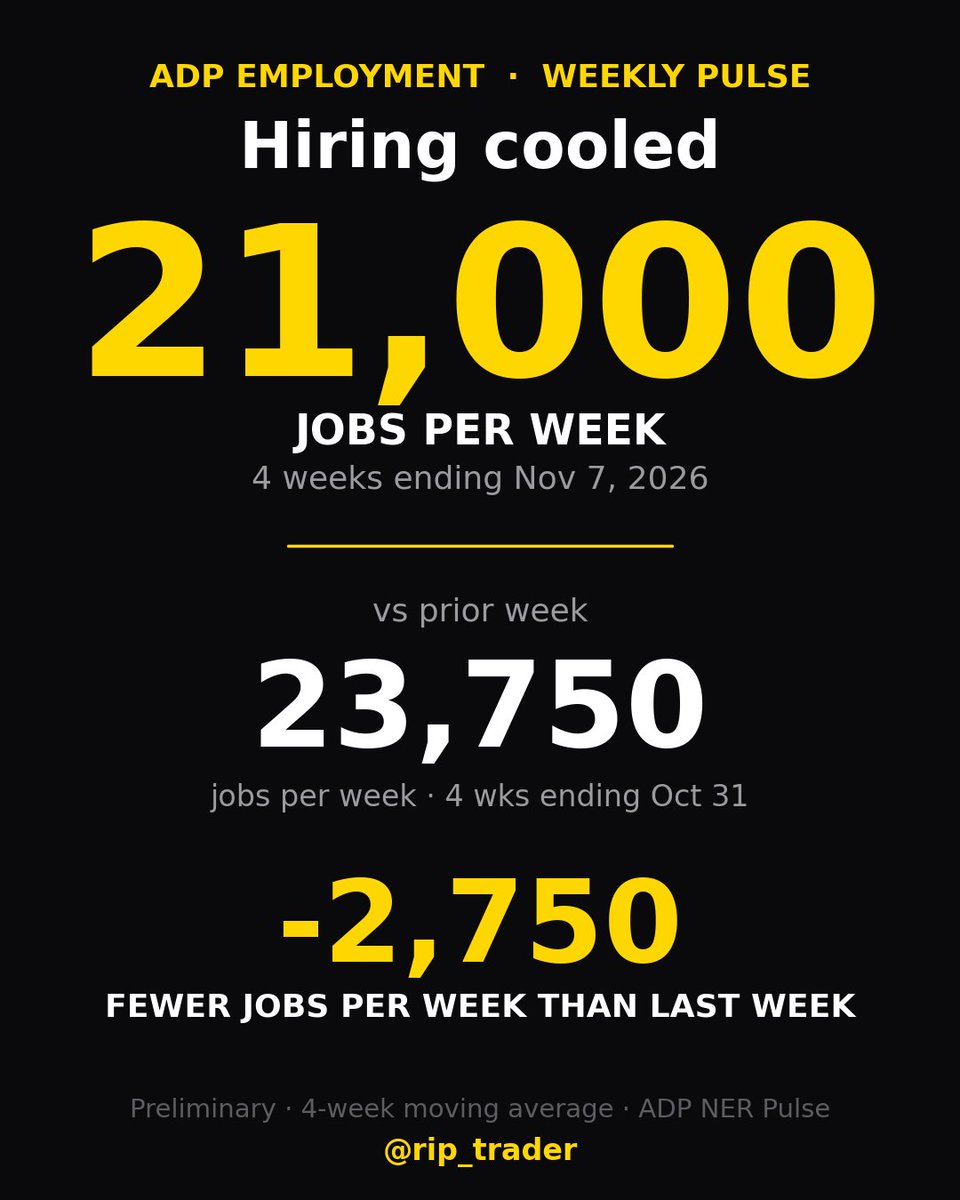
ADP's weekly jobs pulse just landed — and hiring cooled a touch.
• Actual: 21,000 jobs a week on average (4 weeks ending Nov 7)
• Prior: 23,750 a week (4 weeks ending Oct 31)
• That's 2,750 fewer jobs a week — about 12% slower than last week's read
• No consensus forecast on this weekly series, so the honest read is vs last week, not vs Wall Street
• Context: hiring had strengthened to 23,750 last week from 19,250 the week before — this gives some of that back
• The full monthly ADP report lands Dec 2, and the BLS jobs report is delayed to Dec 16
Market reaction:
• S&P futures -0.3%, Nasdaq futures -0.9%, Dow flat — mostly profit-taking after Monday's huge rally, not an ADP move
• 10-year yield ~4.91%, 2-year ~4.67%
• Dollar easing off a 20-month high, DXY ~104.25
My take: I read this as a gentle cool-down, not a crack — still adding jobs, just slower. With Wednesday's PCE and jobless claims ahead, that's the data I'll be watching. What's your call — is hiring cooling for real, or just noise?
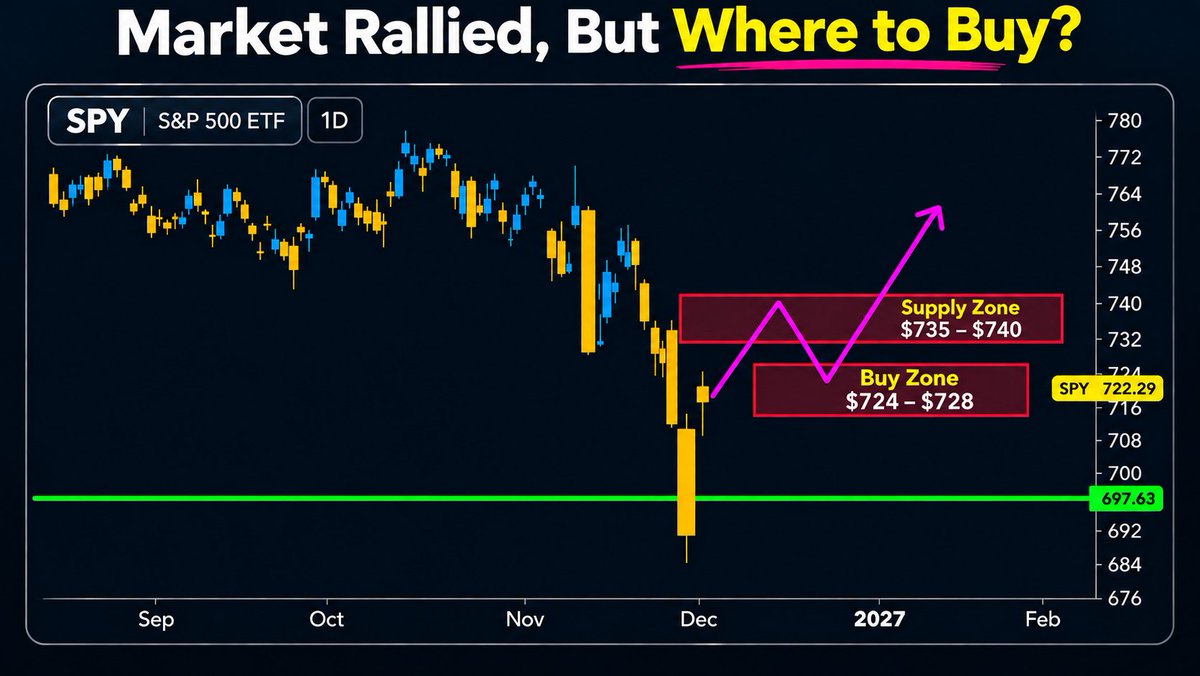
$SPY – The market rallied, but where exactly should you buy?
That's probably the biggest question on everyone's mind right now.
I'm seeing plenty of posts telling people to buy the dip, but very few explain WHERE to buy, WHEN to buy, and WHAT confirmation to look for.
That's exactly what I'm trying to show with this chart.
Here's my game plan:
1. Supply Zone: $735–$740
I expect SPY could face rejection around this zone. That's perfectly normal after a strong rally.
2. Wait for a Higher Low
If the market genuinely wants to move higher, I'd like to see a pullback followed by a higher low. I don't want to chase the rally.
3. My Buy Zone: Around $724–$728
If SPY pulls back into this area, holds support, and confirms a higher low, that's where I'll look to deploy more cash.
4. What if the setup fails?
Simple. I'll stay on the sidelines or look for potential short setups. There's no reason to force a trade.
My Current Positioning:
I'm still roughly 18–20% invested, more than 10% deployed today. That means I'm holding significant cash and have plenty of room to add if the market confirms strength.
The pink path on my chart illustrates what I'd ideally like to see. It's a scenario, not a prediction.
Remember: A strong rally doesn't automatically mean it's time to go all in.
I want confirmation, a clear entry, and a defined risk before putting more money to work.
@ohiain For most of FinTwit, you’re a loser if you didn’t trade or make money today. But when the right time comes, we’ll be the first ones to hit the gas pedal full throttle. Until then, patience is key.
How Do You Know When the Market Has Bottomed?
One of the biggest mistakes traders make is assuming that a single indicator can identify a market bottom.
Some look for capitulation. Others rely on follow-through days (FTDs), RSI, oversold conditions, or a VIX spike.
But no single indicator can consistently predict the exact bottom.
Here's what I look for before considering a dip worth buying:
Capitulation: Sharp selling, unusually high volume, long lower wicks, and extreme fear. This could signal selling exhaustion, but it doesn't guarantee a bottom.
Rally Attempt: The market stops making lower lows, starts recovering, and potentially forms a higher low. Selling volume begins to decline.
Follow-Through & Market Breadth: A strong rally on increased volume is encouraging, but are more stocks participating? Or is the entire market being carried by a few mega-cap names?
Trend Confirmation: $SPY and $QQQ reclaim important moving averages, hold support during pullbacks, and begin forming higher highs and higher lows.
Economic & Market Conditions: Are inflation expectations improving? Is the Fed becoming less restrictive? Are bond yields, $VIX, and credit spreads stabilizing? Is the original reason for the sell-off starting to improve?
Remember, even follow-through days can fail. We saw multiple FTDs during the 2022 bear market before the actual October bottom.
You don't need to catch the exact bottom to make money.
The goal isn't to predict the bottom. It's to identify when the probability of a sustainable recovery is improving.
Before calling every sell-off a buying opportunity, make sure the market is actually giving you reasons to buy.
There is NO perfect strategy in trading.
Some traders make money using RSI.
Some use MACD.
Some rely on VWAP, Volume Profile, EMAs, or trendlines.
Others simply buy the dip, DCA, or follow price action.
And guess what? All of them can work.
The real question isn't which strategy is the best.
It's whether that strategy works for YOU.
Your mindset, patience, risk tolerance, and discipline matter more than the indicators on your chart.
Here's where most traders go wrong:
They try one strategy for a week, lose a few trades, and immediately jump to another.
Next week, another strategy.
Next month, another indicator.
And the cycle never ends.
You can't expect consistency when you're constantly changing your approach.
Find what works for you. Test it. Refine it. Master it.
A simple strategy executed with discipline can outperform a complicated strategy executed without conviction.
Stop chasing the perfect strategy. Start becoming a better trader.
𝐒𝐂𝐎𝐑𝐄𝐁𝐎𝐀𝐑𝐃: 𝐓𝐨𝐦 𝐋𝐞𝐞 𝐯𝐬 𝐓𝐡𝐞 𝐌𝐚𝐫𝐤𝐞𝐭
Nov 9 — Tom Lee: "we bottomed" | $QQQ fell
Nov 10 — Tom Lee: "we bottomed" | $QQQ fell
Nov 11 — Tom Lee: "we bottomed" | $QQQ fell
Nov 12 — Tom Lee: "we bottomed" | $QQQ fell
Nov 13 — Tom Lee: "we bottomed" | $QQQ fell
Nov 14 — Tom Lee: "we bottomed" | $QQQ fell
𝐅𝐢𝐧𝐚𝐥 𝐬𝐜𝐨𝐫𝐞: 𝐌𝐚𝐫𝐤𝐞𝐭 𝟔, 𝐓𝐨𝐦 𝐋𝐞𝐞 𝟎
• $QQQ Nov 9: $679.35
• $QQQ Nov 20: $608.45
• Since the call: -10.44%
He's not calling bottoms anymore. He's calling the market's bluff — and losing every time. 😭
𝐖𝐡𝐚𝐭 𝐈'𝐦 𝐰𝐚𝐭𝐜𝐡𝐢𝐧𝐠 𝐧𝐞𝐱𝐭: Monday. If he says it a 7th time, I'm not even checking the chart. I'm just buying puts.
@Mr_Derivatives Wow, this definitely wasn’t on my 2026 bingo card! 😂 I’ve been a huge fan of yours, quietly following from my burner account. Really appreciate everything you do for the FinTwit community. Keep up the amazing work! 🙌
@NickSchmidt Maybe you should just trade for them, make the profits, and hand over the gains to them too, I guess and still they complain for not making enough 😂
@ProblemSniper Prathi okkariki oka roju vasthundi… Aa roju vachesariki manam siddhanga undali. Lekapothe, prathi roju laage aa roju kuda mana kalla mundhe jaaripothundi.
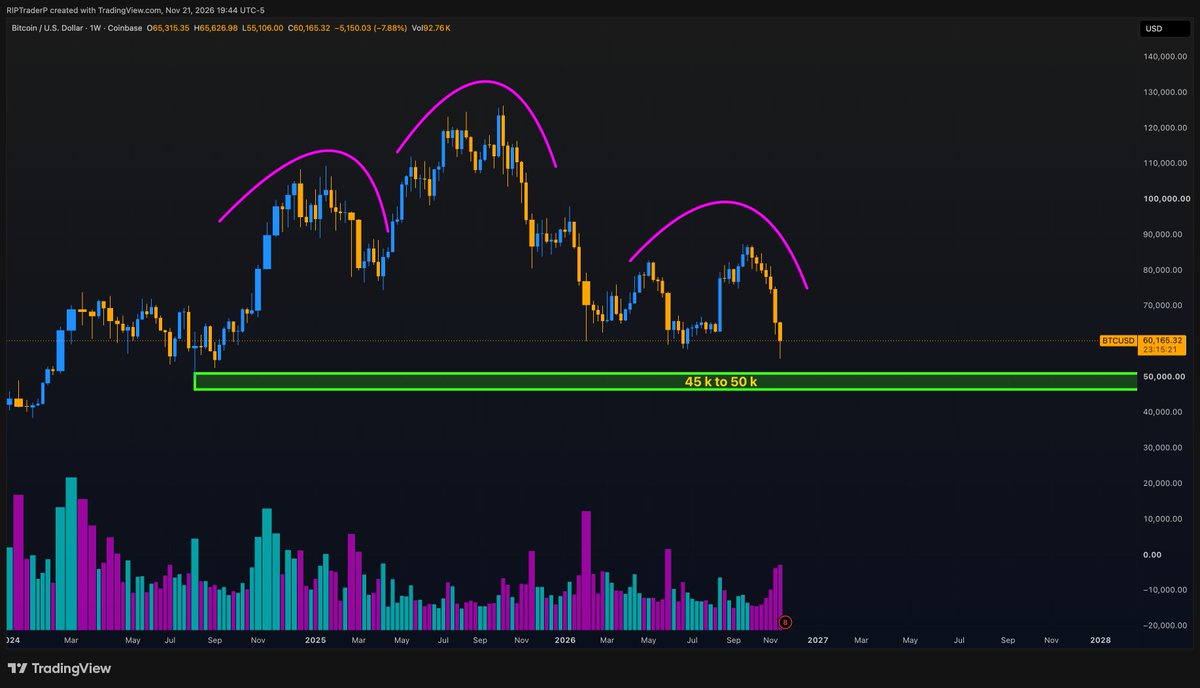
bitcoin:native – I believe Bitcoin could head toward the $45K–$50K zone sooner than many expect.
This isn't just about technical weakness. Several factors could drive further downside:
• Deleveraging: Overleveraged positions getting liquidated, triggering more selling.
• Liquidity tightening: Less capital flowing into speculative assets.
• Risk-off sentiment: Investors moving away from high-risk assets amid broader market uncertainty.
• Institutional selling: Potential ETF outflows and reduced institutional demand adding selling pressure.
I expect more deleveraging events going forward. Every bounce doesn't necessarily mean the bottom is in.
Don't confuse a relief rally with a trend reversal.
Elon Musk just highlighted one of the biggest risks facing the AI industry.
Here's a simple way to understand what he's saying.
Imagine opening a lemonade shop. 🍋
Hundreds of customers are waiting outside.
You spend almost all your money buying machines, lemons and building the shop.
But there's a problem.
• The shop isn't ready.
• There's no electricity.
• The machines aren't working.
• Expenses keep piling up.
• Revenue is ZERO.
You have the customers. You have the demand. But you're running out of money before you can even open the shop.
Now imagine this happening across the AI industry, with hundreds of billions of dollars at stake.
That's what Elon is warning about.
He's not questioning AI demand. He's questioning how companies will fund this massive infrastructure buildout if revenue is delayed.
AI can be the future, and AI companies can still face a cash crisis. Both can be true.
The biggest question isn't whether people want AI.
It's whether companies have enough money to meet that demand.
Getting this amount of compute turned on, cooled and working reliably is incredibly hard.
The cash shortage is also going to be nuts next year. Even cumulative industry delays of a few months between paying for compute and getting it reliable enough to generate revenue will mean hundreds of billions of incremental dollars just for working capital. Where will that come from?
One thing I noticed during the recent sell-off in $SPY and $QQQ is that some of the Mag 7 stocks haven't fully reflected the broader market's selling pressure.
After Friday's price action, several of these names are looking increasingly vulnerable. If the market leaders start breaking their key support levels, things could get ugly for the broader indices.
Here are the key levels I'm watching:
• $GOOGL : Needs to hold $250-253. Losing this zone could open the door to $200-206.
• solana:Aw5SxKyYhXFdZj2BHCqs11UaV5ohwpFQjauB9jFhpump : Hanging by a thread. If the current trendline breaks decisively, $334-337 is the next support. Below that, we could see $310-312.
• $MSFT : Needs to defend $475. A breakdown could send it toward $400-420.
• $Meta: Already looking extremely weak. If $550 breaks, I wouldn't be surprised to see $500-510.
• $Tesla: Another major name looking vulnerable in this market.
I'm not saying all these downside targets will be hit. These are potential scenarios if key support levels fail.
The market has already corrected significantly, but if the leaders start breaking down together, we could see another major leg lower in $SPY and $QQQ.
Stay open-minded, respect the price action, and don't rush to buy every dip.
🎄 Holiday Stock Shopping List 2026 -- Thanksgiving → Black Friday → Cyber Monday → Christmas Deals!
Many stocks from last year's holiday shopping list turned into multibaggers.
I'm planning to put together another list this year with my preferred buying levels. Let me know if there are any specific stocks you'd like me to look into and include on the list.
If there's enough interest, I'll share it here. Let me know which stocks you're looking to grab at a discount!
One thing I noticed during the recent sell-off in $SPY and $QQQ is that some of the Mag 7 stocks haven't fully reflected the broader market's selling pressure.
After Friday's price action, several of these names are looking increasingly vulnerable. If the market leaders start breaking their key support levels, things could get ugly for the broader indices.
Here are the key levels I'm watching:
• $GOOGL : Needs to hold $250-253. Losing this zone could open the door to $200-206.
• solana:Aw5SxKyYhXFdZj2BHCqs11UaV5ohwpFQjauB9jFhpump : Hanging by a thread. If the current trendline breaks decisively, $334-337 is the next support. Below that, we could see $310-312.
• $MSFT : Needs to defend $475. A breakdown could send it toward $400-420.
• $Meta: Already looking extremely weak. If $550 breaks, I wouldn't be surprised to see $500-510.
• $Tesla: Another major name looking vulnerable in this market.
I'm not saying all these downside targets will be hit. These are potential scenarios if key support levels fail.
The market has already corrected significantly, but if the leaders start breaking down together, we could see another major leg lower in $SPY and $QQQ.
Stay open-minded, respect the price action, and don't rush to buy every dip.