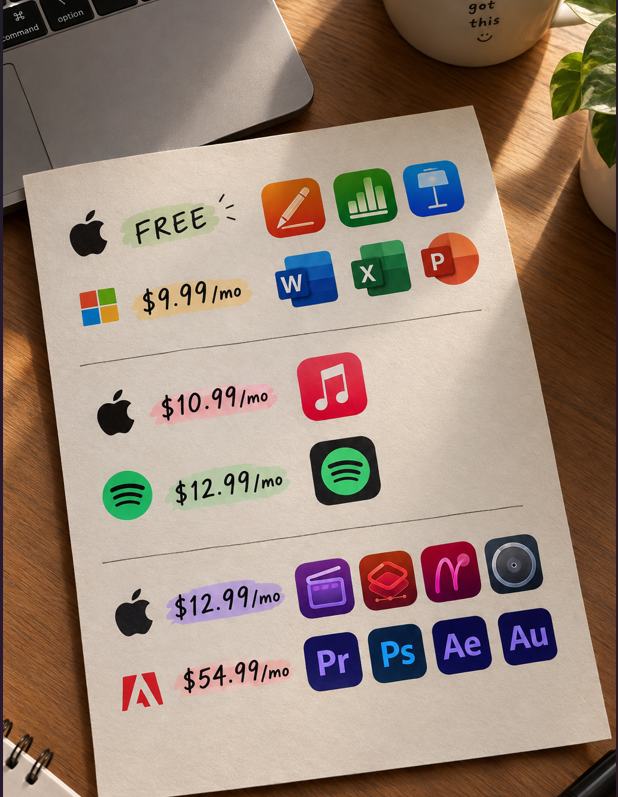
The MacBook lineups are the only ones where a price increase makes sense, because the quality and performance justify the higher cost. In fact, the Mac M5 feel cheaper when it launched.
Now the price creates a steep entry barrier for college students who want a MacBook. Previously, people bought a Mac for everyday use, but today, if you need serious productivity, a MacBook is the only sensible choice; otherwise, it isn’t worth it.
@mayuri_3015 I think it isn’t a single AI tool; it’s a mix of several. Some tools excel at specific tasks, so relying on just one is tough.
For me, the tools I use are:
- Codex
- Replit
- Antigravity
- Claude Code
@solopribuilds Developers should learn design because AI can quickly build whatever you tell it to, but it often produces poor UX or UI. With a basic design language, you can guide the result toward quality, that’s the most important skill to learn.
It depends on the output you expect. If the AI returns the result in a single response, debugging, or even writing code, doesn’t make sense. Both approaches become relevant when you need an output and the AI fails to provide it after many iterations; at that point, writing code is reasonable. The issue isn’t debugging, but our limited ability to make the AI understand what we want.
A large user base can be leveraged even without a subscription. With a sizable audience, you can monetize their data by selling products, services, or algorithms on other platforms, or by providing the data to third‑party companies.
In today’s world, data is the most valuable asset. It can train AI models and power algorithms. Nothing is truly free; if you aren’t paying for a service, your data and information are covering the cost.
The biggest mistake I see in AI products:
taking a normal SaaS product + adding a chat box
= "AI-native"
AI-native UX should rethink the workflow itself.
Not just the input field.
Vibe coding changed something interesting.
Building became dramatically cheaper.
Which means the bottleneck is slowly moving from:
"Can we build this?"
to
"Should we build this?"
That's a product problem, not an engineering problem.
Most startup landing pages don't have a design problem.
They have a clarity problem.
I should know within 5 seconds:
What is this?
Who is it for?
Why should I care?
What should I do next?
Beautiful ambiguity is still ambiguity.
Hot take:🔥
AI won't make product designers irrelevant.
It will make designers who only know how to produce screens irrelevant.
Taste.
Product judgment.
Understanding users.
Knowing what NOT to build.
Those become more valuable when screens become cheap.