Restaurant software doesn't have to feel like restaurant software.
So I built a concept for KioSnap: run your restaurant floor like a strategy game.
An AI host seats walk-ins, quotes waits and holds booked tables. 6 tables or 43, same floor.
Built with Opus 5.5
@ivarunchaudhary Shipped salon and studio bookings in KioSnap this week: a day calendar with team members as columns and an advance to hold a slot. Hardest bug: two people tapping the same 4 pm slot, and a payment replay landing after a move. What are you shipping this weekend?
@mddanishyusuf Fair for a content site. I run 4 Next.js apps but none on my own box: they deploy to Vercel. The Hetzner box only runs the API, the BullMQ worker, Postgres and Redis, twice (staging and prod). Was the 850MB a self-hosted next start, or the dev server?
@GenAI_is_real Step 3 is the one I will not copy yet. Agents write most of my code, but nothing merges itself: every change is a PR, pre-commit runs lint and typecheck, pre-push adds a smoke suite, and a human merges. Who scores the risk, and has a "low risk" PR bitten them yet?
@expo Timely. Our order alarm is an Expo module in Kotlin: a high-priority FCM push starts a foreground service that rings until someone taps. JS makes small sync calls into it (stop ring, read permissions). Does Kolibri help that path too, or mostly C++ hot loops?
@thorstenball Same here. Our agents run the whole KioSnap stack locally: Postgres and Redis in Compose, the Fastify API and the BullMQ worker in one process. The part I have not solved is parallel agents. Does each orb get its own database, or do they share one and you live with it?
@Iam_HITESH__ Building from India, half this list changes: Razorpay instead of Stripe, phone OTP instead of email login, and WhatsApp matters more than email. My API runs on one Hetzner box instead of managed hosting. Which piece was hardest to swap for India?
@lukeigel I film my app's help videos with agents too: a script drives the real dashboard and records it, then narration is added step by step. The edit was never the hard part. Keeping videos in step after the UI changes is. Does Kino re-cut when the footage changes?
@illyism Same instinct here: one Hetzner box, and slow work runs in a separate worker container off the same image, so a long sweep never blocks the API. How do you cap Chrome memory at 3,500 sessions a day? That would be my first fear.
@betomoedano The under-the-hood part I needed most: my Expo vendor app rings order alarms with the app killed. So the alarm is a native Kotlin module and service, not JS, because JS can't be trusted to be alive. Will the series cover native modules and background work?
@theo For me the harness matters less than the guardrails around it. My agents all open PRs, a pre-commit hook runs lint and typecheck across the whole monorepo, and nothing merges itself. Does T3 Code make that loop easier when you run many sessions at once?
If you're running AI-built software, ask yourself three questions:
Who reviews what goes live?
Who can explain it if the builder leaves?
Who gets the 2 AM call?
If the answer to any of them is "nobody," that's a risk to your business.
@CoderYouDie@Microsoft Haha, they got a way to become a influencer. Microsoft won't as in a same salary they have these much of influencers for Microsoft brand.
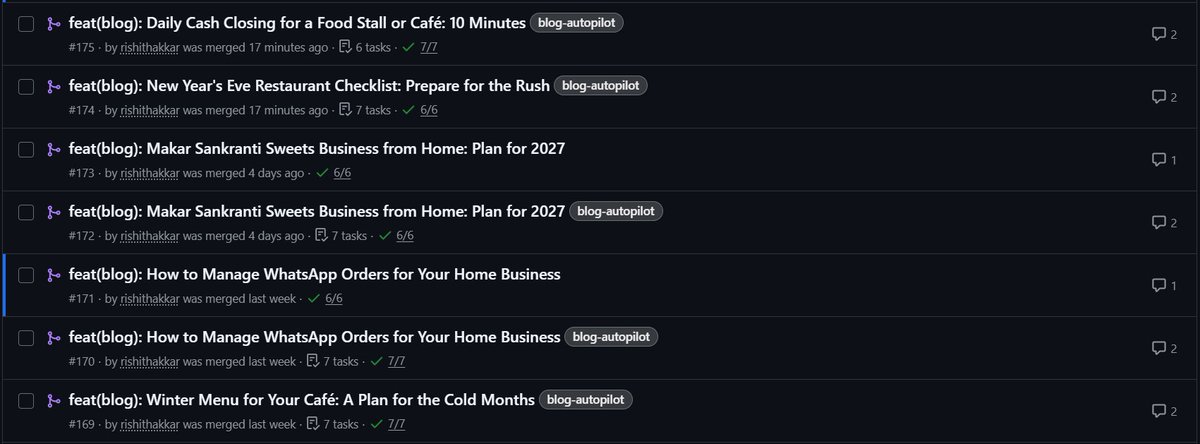
My blog has an AI writer and one rule. Each run, an agent picks the week's best keyword, writes one post, generates its photos and opens a PR. It cannot merge itself. This week: daily cash closing, a New Year's Eve rush checklist, Makar Sankranti sweets.
https://t.co/LoKbql6l4l
@anya_yfa7 Nice streak. With agents, commits got cheap for me. The number I watch now is how many changes a real shop used that week. What share of your 227 reached users?
@Denche2005 "Thread founders". My check: are your buyers on X? Mine are café owners in Ahmedabad and none of them are. So X gets me builders and feedback, and the selling still happens at the counter. https://t.co/E0kTJCNfQ7
@techartist_ A 3D book for a GCSE topic is a great use of this. How does it run on cheap phones? Most people I build for in India hold a ₹10,000 Android, and that changed every 3D choice I made.