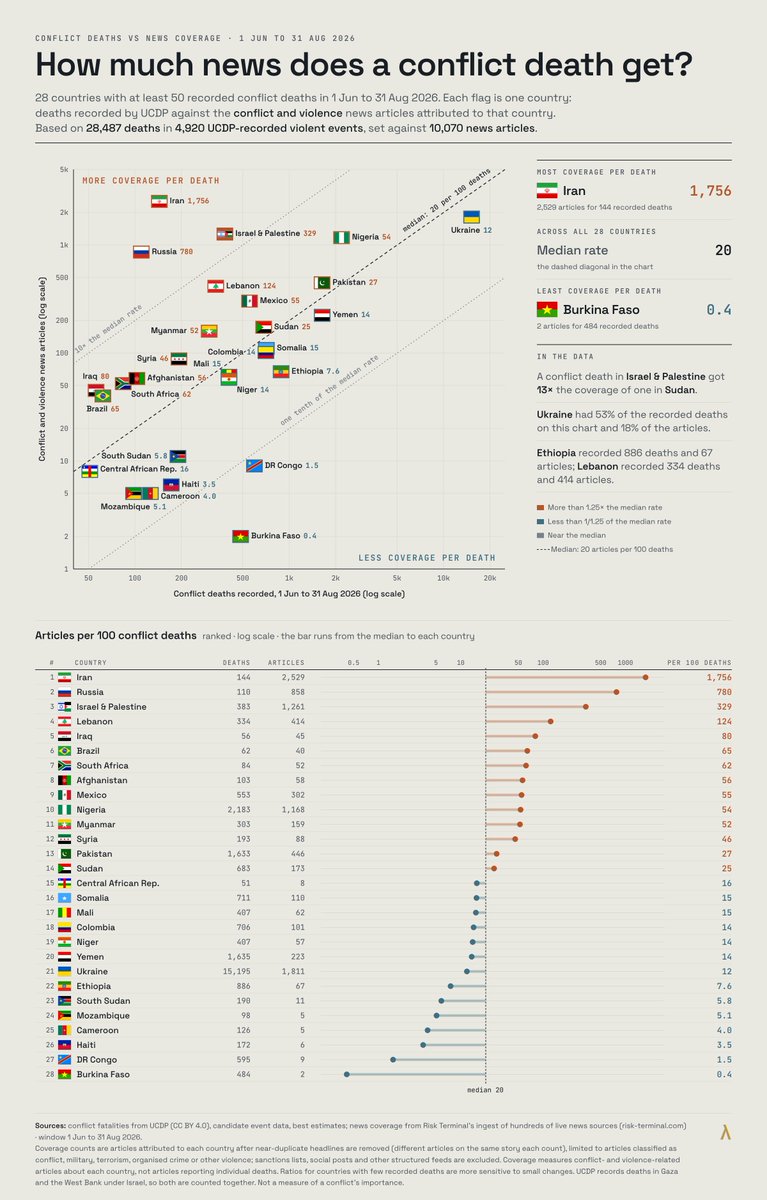
I wanted to see how unevenly different conflicts show up in the news relative to the number of people killed.
This compares UCDP-recorded conflict deaths from 1 June to 31 August 2026 with 10,070 conflict- and violence-related news articles collected by Risk Terminal across 28 countries.
The median was about 20 articles per 100 recorded deaths, but the variation is huge. For example, a recorded conflict death in Israel & Palestine received about 13× as much news coverage as one in Sudan during this period.
A couple of caveats:
The news count includes conflict- and violence-related articles about each country, not only articles specifically reporting deaths.
Countries with relatively few recorded deaths can have more volatile ratios.
This is not a measure of which conflicts are more important, just a look at how attention is distributed.
Deaths: UCDP
News data: Risk Terminal, with near-duplicate headlines removed.
Would be interested in what other variables people think explain the differences, beyond raw casualty levels.
Full dislaimer: https://t.co/fYgDtzlFA2 is my app, (fully free, not a paid for service), just wanted to share the kinda data we gather!
BREAKING: It’s been revealed NVIDIA's $12,930,300,000.00 acquisition of Hugging Face contains an easter egg.
The first 6 numbers of the acquisition price represent the decimal conversion of Unicode character U+1F917.
The 🤗 emoji.
This is the seventh round of these talks since March, when Hezbollah's rocket fire into Israel — backing Iran — dragged Lebanon into the war. The June framework has Hezbollah disarming, Israel withdrawing from the south, and the Lebanese army moving in first through small test "pilot zones." Hezbollah's Naim Qassem called the whole process shameful the day before this round even started. Seven rounds in, is Beirut actually in a position to deliver disarmament, or just to keep showing up to Rome?
It's worth separating the two minerals here. Germanium isn't really the gap; Teck's Trail smelter in BC is already North America's largest producer and the only current supplier of germanium dioxide to the US, and Canada just funded doubling that capacity.
Scandium is the real unknown. There's no serious non-China producer at scale, and Elk Creek, the one Western project trying to change that, doesn't produce until 2029.
@FT the original 10% was section 122, which legally dies after 150 days. all they did was file a forced-labour case against 60 countries that reimpose the same tariff under section 301, which doesn't expire. The tariff was never leaving. this is just its new paperwork.
@BRICSinfo funny timing. trump says he'll make iran pay for ship damage with iran's own money, iran says the aggression just raised the price of his deal. two guys both insisting the other one is the desperate one
That "iranian money the US controls" is the ~$24b that was set to go back to iran under the ceasefire framework. Spending the peace-deal escrow is the clearest sign there's no peace deal left to protect it for. and you don't pre-fund damage you aren't expecting. the white house just told you more and more tankers in the strait are going to get hit, without saying it.
nearly a straight party-line vote. collins (r) crossed to back the check, fetterman (d) crossed to kill it, they cancelled out. the two republicans with the most consistent war-powers record, paul and murkowski, just weren't there for it and nobody's said why. and it wouldn't have mattered: run the math with them voting yes and it's 49-49, still short. this isn't a near miss. a check on this war doesn't have 50 votes. 47 is the ceiling
@elioth4u This is really cool!
I also built a tool that tracks global affairs, and assigns a risk score to each country. The world's in quite a messy spot!
One second Washington is stating that Tehran is refusing to negotiate, and the other they're refusing to meet. On the flip side, Khamenei refuses to respect pen to paper, or discuss terms that last at all. With Yemen coming into the mix, these will be some dangerous waters for the world.
@WSJ The key word here is 'believe's'
The United States has been roped into wars before on false or unconfirmed intelligence, it remains of paramount importance that they act on verified intel, otherwise the escalation ladder has no final rung.
@AJENews The longer this war continues, the further strained the US becomes on their support systems in Taiwan and Ukraine, and the more it strains the global oil supply. How much longer will this sustain?
@AJENews The US can block as many vessels as they'd like, the question is how long they can maintain the blockade without drawing in immense international criticism. The stress on oil is only up from here.
The Gulf has survived, and I never argued that the Gulf states would fall; you made an assumption.
I posed a question: how long will the Gulf states remain in a bloc with the USA, if its protection is insufficient?
I am also not inflating US centrality; whether you consider it true or not, the fact remains that the US, for the time being, remains a regional hegemon in the Gulf, and has significant influence over geopolitical developments and trade.
The 1945 alliance I was referring to was the USS Quincy Agreement, where the 'oil for security' framework was formalised.
Happy to discuss further, but I'd argue our time would be better spent debating things we argue, not assumptions we take from them.
I’m talking about modern geopolitics, not ancient geography. And if we're talking geography, the lines have only existed since about 1922, when the British drew the lines that literally made Kuwait.
The current US-Gulf security umbrella and the petrodollar were literally established in 1945; if that modern security apparatus fails, the economic bloc shifts. It appears you missed the actual argument; why deflect, it doesn't hurt to read what I said.